

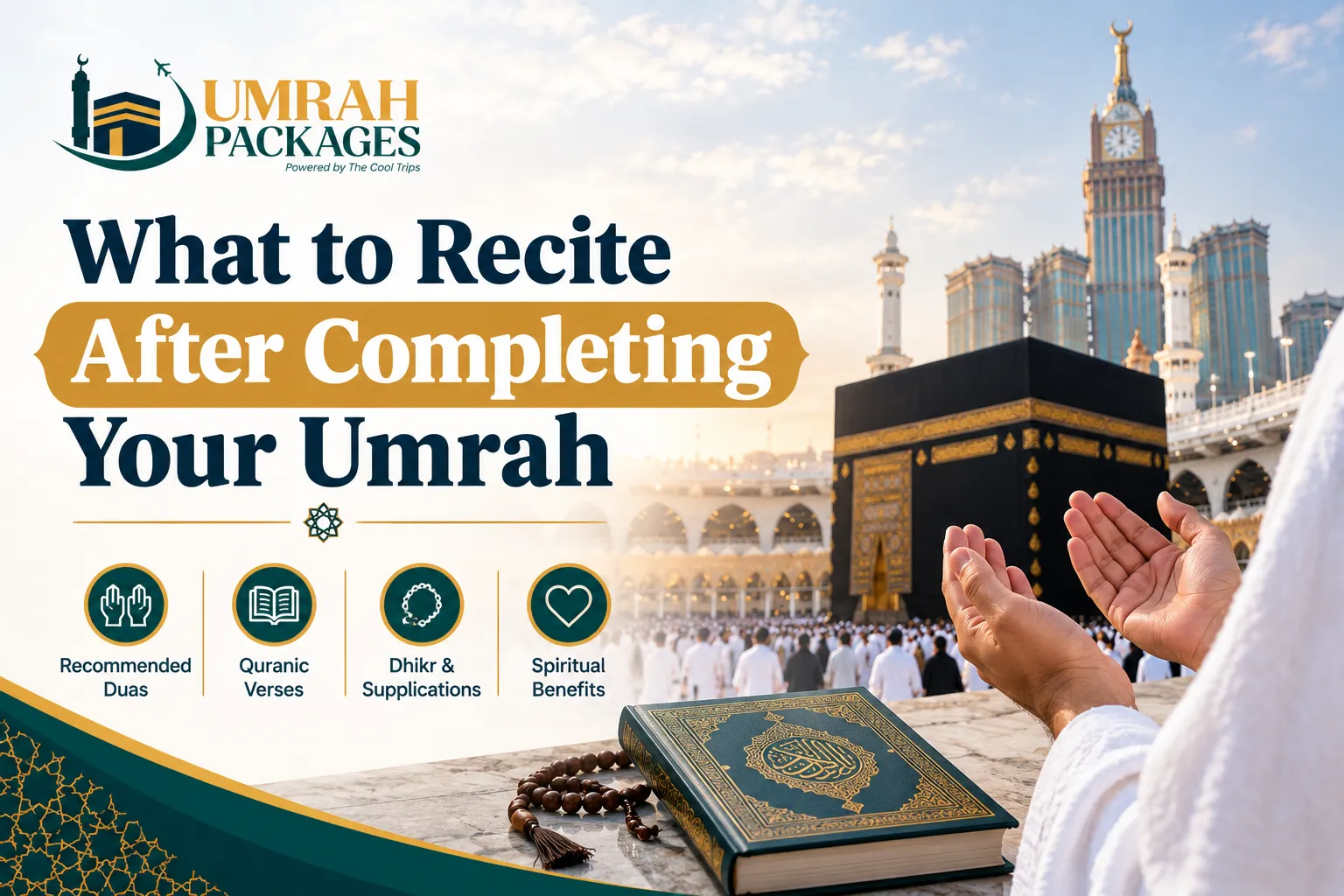
There’s no fixed dua to recite after completing your Umrah. Once sa’i is done and your hair is shaved or trimmed, the best things to say are “Astaghfirullah”, because scholars teach that good deeds are closed with seeking forgiveness, and “Rabbana taqabbal minna innakas-Sami’ul-‘Alim” (Qur’an 2:127). For the trip home, the Prophet ﷺ had a specific dhikr when returning from Umrah, recorded in Sahih al-Bukhari 1797.
So when you’re standing outside a barber’s shop near Marwah, wondering what you were meant to say, you haven’t missed anything. Your Umrah is complete. What’s left is how you close it, and how you carry it home.
This guide follows you from the end of your seventh lap of sa’i to your front door in the UK. At each stage it gives you what’s authentic, what’s a scholar’s suggestion, and what’s just a popular saying with no source, so you can tell them apart.
Moment | What to say or do | Source | How strong |
|---|---|---|---|
End of sa’i | Your own dua; no fixed wording | IslamQA 34744 | No fixed text exists |
At the barber | Start on the right side | Sahih Muslim 1305 | Sunnah |
While shaving | No dua from the Prophet ﷺ; some jurists suggested wordings | Al-Nawawi, al-Adhkar | Scholars’ suggestion |
Straight after | Astaghfirullah; Rabbana taqabbal minna | Muslim 591; Qur’an 2:127 | Authentic in principle |
Rest of your stay | Dhikr, prayer in the Haram, nafl tawaf | Qur’an 2:200 | Recommended |
Leaving Makkah | Farewell tawaf | Standing Committee; most schools | Sunnah, not obligatory, for Umrah |
Setting off home | The travel dua | Sahih Muslim 1342 | Sahih |
On the way back | “Ayibuna ta’ibuna…” | Sahih al-Bukhari 1797 | Sahih |
Arriving home | Two rak’ahs at the masjid | Sahih al-Bukhari 3088 | Sahih |
No. We couldn’t find any hadith giving a dua to recite once Umrah is finished. Anas counted four Umrahs of the Prophet ﷺ, including Hudaybiyyah, where he was turned back (Sahih al-Bukhari 1778), and none of the reports describe him reciting a particular formula after shaving his head.
You’ll see one wording shared widely online: “Allahumma taqabbal minna ‘umratana…”, O Allah, accept our Umrah from us. It’s a lovely thing to ask. But it doesn’t appear in the main hadith collections, and the pages that share it give no source. Say it as your own dua if you like. Just don’t pass it on as a sunnah.
IslamQA’s answer on the duas of Umrah makes the same point more broadly: outside the few fixed phrases, a pilgrim “should make dua as Allah inspires him”. That freedom covers the end of Umrah too.
What does exist is a set of authentic principles that point to what’s best to say, and a handful of sound hadiths about travelling home. That’s what the rest of this guide works through.
Shaving or trimming the hair is the last act of Umrah. For men, shaving the whole head is better, and trimming is allowed. Women take roughly a fingertip’s length off the ends. Once that’s done, you’re out of ihram.
The one clear sunnah for the haircut itself is where to begin. Anas described the Prophet ﷺ at Mina:
ثُمَّ قَالَ لِلْحَلاَّقِ “خُذْ” . وَأَشَارَ إِلَى جَانِبِهِ الأَيْمَنِ ثُمَّ الأَيْسَرِ
“Then he said to the barber, ‘Take’, and pointed to his right side, then the left.”
Source: Sahih Muslim 1305.
If the barber starts on the left, just ask him to begin on the right.
This is the hadith most often quoted at this point, and it’s usually quoted wrongly.
اللَّهُمَّ ارْحَمِ الْمُحَلِّقِينَ . قَالُوا وَالْمُقَصِّرِينَ يَا رَسُولَ اللَّهِ قَالَ اللَّهُمَّ ارْحَمِ الْمُحَلِّقِينَ . قَالُوا وَالْمُقَصِّرِينَ يَا رَسُولَ اللَّهِ قَالَ وَالْمُقَصِّرِينَ
“O Allah, have mercy on those who shave.” They said, “And those who trim, O Messenger of Allah?” He said, “O Allah, have mercy on those who shave.” They said, “And those who trim, O Messenger of Allah?” He said, “And those who trim.”
Source: Sahih al-Bukhari 1727; Sahih Muslim 1301.
Notice who’s speaking. This is the Prophet ﷺ praying for pilgrims who shaved or trimmed. It isn’t a dua the pilgrim was told to recite over himself, though several websites present it that way. What it does tell you is that shaving earns a fuller share of his dua, which is why scholars say shaving is better for men. Asking Allah to have mercy on everyone who shaved and trimmed that day is a good dua to make, as long as you know where it comes from.
Some Shafi’i scholars recommended words to say while being shaved and after it. None of them comes from the Prophet ﷺ, and the scholars who recorded them were open about that.
Al-Nawawi wrote that “some of our scholars” recommended saying takbir and words of praise during the shave, and on finishing:
الحمد لله الذي قضى عنا نسكنا، اللهم زدنا إيمانا ويقينا وعونا، واغفر لنا ولآبائنا وأمهاتنا والمسلمين أجمعين
Alhamdu lillahil-ladhi qada ‘anna nusukana. Allahumma zidna imanan wa yaqinan wa ‘awna, waghfir lana wa li-aba’ina wa ummahatina wal-muslimina ajma’in.
“Praise be to Allah, who has let us complete our rites. O Allah, increase us in faith, certainty and help, and forgive us, our fathers, our mothers and all the Muslims.”
He added that the same adhkar apply in Umrah wherever its acts match those of Hajj. We like this one. The meaning is beautiful and it fits the moment, but treat it as a scholar’s suggestion.
Another wording asks Allah to write a good deed for every hair, wipe away a sin with it and raise you a degree. Al-Ghazali gives it in the Ihya’, and the later Shafi’i jurist al-Shirbini repeats it. The hadith scholar al-‘Iraqi, who traced the reports in the Ihya’, didn’t list it as a hadith. No hadith source is known for it, though there’s nothing wrong in asking Allah for that.
Al-Mawardi listed takbir on finishing the shave among its sunnahs, and a couple of other Shafi’is agreed. Al-Nawawi accepted the rest of his list but called the takbir “gharib” in al-Majmu’, meaning unusual and not well established. If you say “Allahu akbar” out of joy, nobody will fault you. It just isn’t a fixed part of the rite.
Women trim, never shave. Gather the ends of your hair and cut roughly a fingertip’s length, either in your hotel room or with your mahram’s help, away from men who aren’t family. There’s no separate dua for women at this point; everything in this guide applies equally. Our guide to what women wear for Umrah covers what changes once you’re out of ihram, and if your period starts partway through, see Umrah during menstruation.
Two things are well grounded at this point: asking forgiveness, and asking Allah to accept the Umrah.
أَسْتَغْفِرُ اللَّهَ
Astaghfirullah.
“I seek Allah’s forgiveness.”
When the Prophet ﷺ finished his prayer, he sought forgiveness three times; al-Awza’i explained that this means saying “Astaghfirullah, astaghfirullah” (Sahih Muslim 591). Ibn Taymiyyah drew a general rule from this and similar texts:
وقد أمر الله سبحانه عباده أن يختموا الأعمال الصالحات بالاستغفار
“Allah has commanded His servants to close righteous deeds with seeking forgiveness.”
He pointed to the end of prayer, the night prayer, and the verse about Hajj, “Then depart from where the people depart, and ask Allah’s forgiveness” (Qur’an 2:199). He also cited Surat al-Nasr, revealed as the Prophet’s ﷺ mission drew to its close:
فَسَبِّحْ بِحَمْدِ رَبِّكَ وَاسْتَغْفِرْهُ ۚ إِنَّهُ كَانَ تَوَّابًا
“Then glorify your Lord with praise and ask His forgiveness. He is ever ready to accept repentance.”
Source: Qur’an 110:3.
Why seek forgiveness for something you’ve just done well? Because nobody performs worship perfectly. You lost count once, your mind wandered in sa’i, you snapped at your brother in the queue for the barber. Istighfar covers the gaps, and it keeps you from feeling pleased with yourself.
رَبَّنَا تَقَبَّلْ مِنَّا ۖ إِنَّكَ أَنْتَ السَّمِيعُ الْعَلِيمُ
Rabbana taqabbal minna, innaka antas-Sami’ul-‘Alim.
“Our Lord, accept it from us. You are the One who hears and knows everything.”
Source: Qur’an 2:127.
Ibn Abbas reported that Ibrahim and Isma’il were saying these words as they raised the walls of the Kaaba (Sahih al-Bukhari 3364). They asked for acceptance while they were still building the House. It’s a fitting thing to ask as your own Umrah ends.
Aisha once asked the Prophet ﷺ about the verse describing those who “give what they give with hearts fearful” (Qur’an 23:60). Were these people who drank or stole? He said no: they’re the ones who fast, pray and give charity, and fear it won’t be accepted from them (Jami’ al-Tirmidhi 3175, graded sahih by al-Albani). So a nagging worry that your Umrah wasn’t good enough isn’t a bad sign. Held alongside real hope in Allah’s generosity, it’s exactly the attitude the verse praises.
فَإِذَا قَضَيْتُمْ مَنَاسِكَكُمْ فَاذْكُرُوا اللَّهَ كَذِكْرِكُمْ آبَاءَكُمْ أَوْ أَشَدَّ ذِكْرًا
“And when you have completed your rites, remember Allah as you used to remember your fathers, or with even greater remembrance.”
Source: Qur’an 2:200.
The verse is about the end of Hajj at Mina. Its lesson carries over to Umrah easily: the end of the rituals isn’t the end of remembering Allah. The next verse praises those who ask for “good in this world and good in the Hereafter”, which is why “Rabbana atina…” (2:201) sits so naturally on your tongue at this point.
Most UK pilgrims finish their Umrah within a day of arriving and then have several more nights in Makkah. Here’s how we’d suggest using that time.
There isn’t. The two rak’ahs of Umrah come after tawaf, behind Maqam Ibrahim, not after the haircut. We found no report of a prayer to be offered once Umrah is finished.
Some people ask about a prostration of thanks. The Prophet ﷺ did fall into sujud when he received good news (Sunan Abi Dawud 2774, graded sahih by al-Albani), and Ibn Qudamah said the Shafi’is and Hanbalis recommend it on receiving a new blessing. Malik and Abu Hanifah disliked it. We didn’t find any classical scholar applying it specifically to completing Umrah, so if you do it, do it as a general act of thanks, not as a rite of Umrah.
With no fixed formula, you can choose authentic duas you’ll actually say. A few we’d point to, all graded authentic:
You’re a traveller for the whole trip, and that matters:
ثَلاَثُ دَعَوَاتٍ مُسْتَجَابَاتٌ لاَ شَكَّ فِيهِنَّ دَعْوَةُ الْوَالِدِ وَدَعْوَةُ الْمُسَافِرِ وَدَعْوَةُ الْمَظْلُومِ
“Three duas are answered, without doubt: the dua of a parent, the dua of a traveller and the dua of someone wronged.”
Source: Sunan Abi Dawud 1536, graded hasan by al-Albani.
That’s a better reason to make plenty of dua in Makkah than most of the “special moment” claims you’ll hear.
A single prayer in Masjid al-Haram is worth more than a hundred thousand prayed elsewhere, according to the hadith in Sunan Ibn Majah 1406 (graded sahih by Darussalam), so walk to the Haram for every prayer you reasonably can. Voluntary tawaf is open to you at any time without ihram. And when you drink Zamzam, make dua for what you need; the hadith “Zamzam water is for whatever it’s drunk for” is in Sunan Ibn Majah 3062, graded hasan by Darussalam.
If you have a spare morning, our Makkah ziyarat guide covers the historic sites beyond the Haram. Just remember that none of them has a set dua either. If you’d like a few extra nights in Makkah built into your next trip for exactly this kind of quiet time, message us on WhatsApp and we’ll work out the nights with you.
Ibn Abbas said:
أُمِرَ النَّاسُ أَنْ يَكُونَ آخِرُ عَهْدِهِمْ بِالْبَيْتِ، إِلاَّ أَنَّهُ خُفِّفَ عَنِ الْحَائِضِ
“The people were ordered to make their last act at the House, except that it was eased for the menstruating woman.”
Source: Sahih al-Bukhari 1755.
That instruction came during Hajj. For Umrah, most scholars hold the farewell tawaf isn’t obligatory. The Hanafi jurist al-Kasani said it isn’t required of an Umrah pilgrim because the Law tied it to Hajj, and Saudi Arabia’s Standing Committee, including Ibn Baz, said there’s no evidence it’s obligatory after Umrah but that it’s sunnah when leaving. A minority held otherwise: the Hanafi al-Hasan ibn Ziyad said it is obligatory, and in the Shafi’i school al-Baghawi, al-Mutawalli and al-Rafi’i treated it as a separate act owed by anyone leaving Makkah, which would include Umrah pilgrims.
Our advice is simple. If you can, make your last act in Makkah a final tawaf before you board the coach for Jeddah or Madinah. It’s a good way to say goodbye, and it satisfies every view. There’s no fixed dua for it; just pour out whatever’s left in your heart. Women on their period are excused even in Hajj, so don’t worry about it in that case.
Heading on to Madinah next? Our guides to the Haramain high-speed railway, the best hotels in Madinah near Masjid an-Nabawi and the Madinah ziyarat sites will help you plan that leg.
Say the ordinary travel dua when your coach pulls away or your plane taxis. Ibn Umar reported that the Prophet ﷺ, when he mounted to travel, said “Allahu akbar” three times and then began “Subhanalladhi sakhkhara lana hadha wa ma kunna lahu muqrinin…”, Glory be to the One who has placed this at our service (Sahih Muslim 1342). The same hadith says that on the way home he said it again and added “Ayibuna, ta’ibuna, ‘abiduna, li-rabbina hamidun”. The fuller return dhikr from al-Bukhari is below.
This is the one piece of dhikr tied by name to coming back from Umrah. Ibn Umar said that when the Prophet ﷺ returned from a campaign, Hajj or Umrah, he said “Allahu akbar” three times on every rise in the ground, then:
لاَ إِلَهَ إِلاَّ اللَّهُ وَحْدَهُ لاَ شَرِيكَ لَهُ، لَهُ الْمُلْكُ، وَلَهُ الْحَمْدُ، وَهُوَ عَلَى كُلِّ شَىْءٍ قَدِيرٌ، آيِبُونَ تَائِبُونَ عَابِدُونَ سَاجِدُونَ لِرَبِّنَا حَامِدُونَ، صَدَقَ اللَّهُ وَعْدَهُ وَنَصَرَ عَبْدَهُ وَهَزَمَ الأَحْزَابَ وَحْدَهُ
La ilaha illallahu wahdahu la sharika lah, lahul-mulku wa lahul-hamd, wa huwa ‘ala kulli shay’in qadir. Ayibuna, ta’ibuna, ‘abiduna, sajiduna, li-rabbina hamidun. Sadaqallahu wa’dah, wa nasara ‘abdah, wa hazamal-ahzaba wahdah.
“None has the right to be worshipped but Allah, alone, with no partner. To Him belong the dominion and the praise, and He has power over everything. Coming home, turning back to Him, worshipping Him, prostrating to Him, praising our Lord. Allah fulfilled His promise, gave victory to His servant, and on His own routed the allied tribes.”
Source: Sahih al-Bukhari 1797; Sahih Muslim 1344.
You won’t ride over many hills between Jeddah and Manchester. You could say the takbir and this dhikr as the plane takes off, on the drive home and again at your door. The four words in the middle, coming home, repenting, worshipping, prostrating, also make a decent checklist for the weeks ahead.
Bringing Zamzam back for family isn’t just a custom:
أَنَّهَا كَانَتْ تَحْمِلُ مِنْ مَاءِ زَمْزَمَ وَتُخْبِرُ أَنَّ رَسُولَ اللَّهِ صلى الله عليه وسلم كَانَ يَحْمِلُهُ
“She used to carry Zamzam water [home], and she said the Messenger of Allah ﷺ used to carry it.”
Source: Jami’ al-Tirmidhi 963 (Aisha), graded sahih by al-Albani.
Airlines set their own rules on Zamzam, and many only take the official sealed bottles, so check with yours before you fly. Our Umrah packing list for UK pilgrims covers luggage allowances.
The Sunnah has a small, practical routine for the end of a trip. It’s simple and easy to keep, even after a night flight into Manchester.
نَهَى النَّبِيُّ صلى الله عليه وسلم أَنْ يَطْرُقَ أَهْلَهُ لَيْلاً
“The Prophet ﷺ forbade coming upon one’s family at night.”
Source: Sahih al-Bukhari 1801.
Another wording explains it concerns someone who’s been away a long time turning up without warning. In 2026 that’s easy to honour: message the family group before your flight lands so nobody is caught off guard at three in the morning.
The Prophet ﷺ also said that travel “is a piece of torment” because it keeps you from your food, drink and sleep, and that once your purpose is fulfilled, “let him hasten back to his family” (Sahih al-Bukhari 1804). So don’t feel guilty about being glad to get home.
كَانَ إِذَا قَدِمَ مِنْ سَفَرٍ ضُحًى دَخَلَ الْمَسْجِدَ، فَصَلَّى رَكْعَتَيْنِ قَبْلَ أَنْ يَجْلِسَ
“When he came back from a journey in the morning, he would enter the mosque and pray two rak’ahs before sitting down.”
Source: Sahih al-Bukhari 3088 (Ka’b ibn Malik); Sahih Muslim 716.
Few people keep this one. If your local masjid is on the way home from the airport, stop and pray two rak’ahs before you go in to the family.
When the Prophet ﷺ arrived back in Madinah from his travels, he had a camel or a cow slaughtered and the meat shared (Sahih al-Bukhari 3089). Scholars call a meal on return the naqi’ah, and al-Nawawi said it’s recommended. So the dinner your family insists on throwing has a real basis, as long as it doesn’t turn into a show.
There’s no fixed greeting from the Prophet ﷺ for someone back from Umrah. Ibn Uthaymeen said there’s nothing wrong with honouring pilgrims when they return, and IslamQA treats congratulations as a matter of custom. “Umrah Mubarak”, “Taqabbal Allah” and “May Allah accept it” are all good wishes. None of them is a sunnah.
A greeting from Ibn Umar is often quoted: “Taqabbalallahu nusukak, wa a’zama ajrak, wa akhlafa nafaqatak”, may Allah accept your rites, make your reward great and replace what you spent. It’s in the Musannaf of Ibn Abi Shaybah, but one narrator in the chain isn’t named, so the chain is weak. It’s still a fine thing to say.
Keep it simple. “Ameen, wa minkum”, and from you too, or “Jazakallahu khayran, may Allah accept from all of us” works well. If someone asks you to pray for them, say you will, and then actually do it. Write their name down if you need to.
You’ll hear that people should rush to a returning pilgrim and ask him to seek forgiveness for them before he enters his house, because he’s forgiven. That report, in Musnad Ahmad, was graded fabricated by al-Albani and very weak by others. We also couldn’t find any source for the claim that a pilgrim’s dua is answered for forty days after returning.
What is authentic is this:
الْغَازِي فِي سَبِيلِ اللَّهِ وَالْحَاجُّ وَالْمُعْتَمِرُ وَفْدُ اللَّهِ دَعَاهُمْ فَأَجَابُوهُ وَسَأَلُوهُ فَأَعْطَاهُمْ
“The one who strives in Allah’s cause, the Hajj pilgrim and the Umrah pilgrim are Allah’s guests. He called them and they answered, and they asked Him and He gave to them.”
Source: Sunan Ibn Majah 2893, graded hasan by al-Albani.
So there’s no harm in asking someone who’s been on Umrah to pray for you; asking any Muslim for dua is fine. Just don’t attach promises to it that the hadith doesn’t make. A similar-sounding version in Ibn Majah 2892 (“if they call on Him, He answers them”) was graded weak by al-Albani.
The Prophet ﷺ said:
الْعُمْرَةُ إِلَى الْعُمْرَةِ كَفَّارَةٌ لِمَا بَيْنَهُمَا
“One Umrah to the next is an expiation for what comes between them.”
Source: Sahih al-Bukhari 1773.
That gives real hope, but it doesn’t mean what you do afterwards stops mattering. Ibn Taymiyyah quoted some of the early scholars as saying that part of the reward of a good deed is a good deed after it, and part of the punishment of a bad deed is a bad deed after it. If your Umrah is followed by better prayer, kinder speech and fewer old habits, that’s about as good a sign as anyone gets.
Hasan al-Basri, the early scholar of Basra, is reported to have described an accepted Hajj as one where “you return detached from this world and longing for the Hereafter”. Al-Ghazali said the same in his own words. Those are their sayings, not hadith, but the idea transfers well to Umrah.
Plenty of pilgrims feel flat a week or two after getting back. The Haram is gone, the alarm goes off for work, and the rain doesn’t stop. That’s normal. Pick one habit from the trip, Fajr in the masjid, a page of Qur’an a day, the morning adhkar, and protect that one thing. Keep “Ya muqallibal-qulub” on your tongue. It can also help to have a rough date in mind for the next trip.
We took the hadith wording from sunnah.com’s Arabic text and checked each reference number there. Gradings are al-Albani’s for Abu Dawud and Ibn Majah where we name him, and Darussalam’s where stated; reports outside the six books were checked on the Dorar encyclopaedia.
The shaving etiquette is drawn from the Arabic text of al-Nawawi’s al-Idah, al-Majmu’ and al-Adhkar, al-Ghazali’s Ihya’ and al-Shirbini’s Mughni al-Muhtaj. The farewell tawaf positions come from al-Kasani’s Bada’i’ al-Sana’i’, al-Nawawi’s al-Majmu’ and the Standing Committee’s fatwa via IslamQA. Ibn Taymiyyah’s rule on closing deeds with istighfar is from his Majmu’ al-Fatawa. We arrange Umrah for a living and don’t issue rulings, so if your own scholar says otherwise, go with them.
No fixed dua exists, so say what’s best by principle: “Astaghfirullah” a few times, since scholars teach closing good deeds with seeking forgiveness, and “Rabbana taqabbal minna innakas-Sami’ul-‘Alim” (Qur’an 2:127). Then make your own dua. On the way home, use the return dhikr from Sahih al-Bukhari 1797.
No hadith gives a specific dua for the end of Umrah. Popular wordings like “Allahumma taqabbal minna ‘umratana” are fine as personal duas but have no source as sunnah. Al-Nawawi recorded a wording some scholars recommended after shaving, “Alhamdulillahil-ladhi qada ‘anna nusukana…”, which is a scholarly suggestion.
Nothing specific is narrated for the end of sa’i. Many pilgrims finish on Marwah facing the Kaaba and make a final personal dua, then head to the barber. Thank Allah, ask Him to accept your Umrah, and ask for anything you need. Then go and complete the haircut.
Yes. Since no fixed Arabic wording exists for this moment, your dua can be in any language. Many pilgrims say “Astaghfirullah” and “Rabbana taqabbal minna” in Arabic, then talk to Allah in English, Urdu or Bengali. Allah understands every language.
You can. Raising the hands is a general etiquette of dua, and nothing restricts it at this point. Just be mindful of the crowd if you’re still inside the Haram. If you’re at the barber’s or walking back to the hotel, a quiet dua without raised hands is equally fine.
We couldn’t find it in any of the main hadith collections, and pages that share it give no source. It’s a good personal dua asking Allah to accept your Umrah. The closest authentic wording is Ibrahim and Isma’il’s “Rabbana taqabbal minna” from Qur’an 2:127, said while building the Kaaba.
No dua from the Prophet ﷺ is reported for the person being shaved. The sunnah is to start with the right side (Muslim 1305). Some Shafi’i scholars suggested wordings, recorded by al-Nawawi and al-Ghazali, but they’re jurists’ recommendations, not hadith.
It’s the Prophet’s ﷺ dua for pilgrims who shaved, repeated before he added those who trimmed (Bukhari 1727). He said it about them; it isn’t a dua you were told to recite over yourself. You can ask Allah to have mercy on everyone who shaved and trimmed, as long as you know its origin.
Al-Nawawi and the Shafi’i school recommended facing the qiblah during halq, and starting at the front of the head on the right side. Facing the qiblah isn’t from a hadith, so it’s an optional etiquette. Starting on the right side is the part that comes directly from the Sunnah.
Al-Mawardi, a Shafi’i jurist, counted takbir after the shave among its sunnahs, but al-Nawawi called that “gharib”, meaning unusual and not well established. Saying “Allahu akbar” out of happiness is fine. Just don’t treat it as a required part of the rite or tell others it’s a sunnah.
Yes. The Prophet ﷺ prayed twice for those who shaved before he included those who trimmed (Bukhari 1727), which scholars take as showing that shaving is better. Trimming is still valid if it covers the head reasonably. Women always trim and never shave.
About a fingertip’s length from the end of her hair, which is the measure IslamQA gives (answer 31819). She gathers the ends and trims them, ideally in private or with a mahram’s help. No separate dua is prescribed for women here; the same authentic duas apply.
Yes. Shaving or trimming is the final act of Umrah, so once it’s done the ihram restrictions lift. You can wear normal clothes, use perfume and, for married couples, resume intimacy. There’s no extra statement or dua needed to leave ihram.
No. The two rak’ahs behind Maqam Ibrahim belong to tawaf, and nothing is reported for after the haircut, so a special “Umrah completion” prayer has no basis. You can, of course, pray as many voluntary prayers in the Haram as you like.
The Prophet ﷺ prostrated in thanks at good news (Abu Dawud 2774, sahih per al-Albani), and Shafi’is and Hanbalis recommend it for new blessings, though Malik and Abu Hanifah disliked it. No classical scholar we found applied it to finishing Umrah specifically, so treat it as general gratitude, not a rite.
Pray in the Haram as often as you can, do voluntary tawaf, drink Zamzam with dua, read Qur’an and make plenty of dua as a traveller, whose dua is answered (Abu Dawud 1536). Visit the historic sites if you wish. Before leaving, try to make a farewell tawaf.
No. In Umrah, most scholars hold that the talbiyah stops at the start of tawaf, and it isn’t repeated once you’ve left ihram. From then on, ordinary dhikr such as “Subhanallah”, “Alhamdulillah”, “La ilaha illallah” and “Allahu akbar” fills the gap, along with your own dua.
No fixed wording is narrated, but the hadith “Zamzam water is for whatever it’s drunk for” (Ibn Majah 3062, hasan per Darussalam) encourages making dua for your needs as you drink. Say “Bismillah”, drink, and ask Allah for health, knowledge or anything else you need.
Scholars differ. Many allow it, going out to al-Tan’im or another point outside the Haram boundary to make the intention, as Aisha did, though her period had stopped her finishing her first. Others preferred extra tawaf, saying repeat Umrahs from Makkah weren’t the Companions’ practice.
Most scholars say no. The Hanafi jurist al-Kasani said it’s tied to Hajj, and the Saudi Standing Committee found no evidence it’s obligatory for Umrah, though it’s sunnah when leaving. A minority, including the Hanafi al-Hasan ibn Ziyad and some Shafi’is, required it. Doing it satisfies every view.
No fixed dua is narrated for the farewell tawaf. Do seven circuits as usual and make whatever dua you wish, perhaps asking Allah to let you return. Reports about clinging to the Multazam at this point are weak (Abu Dawud 1899 and Ibn Majah 2962).
No. The farewell tawaf is done in normal clothes, since you’ve already left ihram. Make sure you’re in wudu, as for any tawaf. Men simply wear their ordinary clothes; there’s no idtiba’ or brisk walking in this tawaf, which is only for the first tawaf of Umrah or Hajj.
You’re excused. Even in Hajj, Ibn Abbas said the farewell tawaf “was eased for the menstruating woman” (Bukhari 1755), and for Umrah most scholars don’t consider it obligatory at all. You can leave Makkah without it and with no penalty, and make your goodbye dua from outside the mosque instead.
For Umrah, most scholars don’t treat the farewell tawaf as obligatory, so this isn’t a strict rule. Scholars writing about Hajj allow buying food or travel needs on the way out. If you want the tawaf to be your farewell under every view, shop first and leave soon after it.
Say “Allahu akbar” three times, then “La ilaha illallahu wahdahu la sharika lah… ayibuna, ta’ibuna, ‘abiduna, sajiduna, li-rabbina hamidun…”. Ibn Umar reported the Prophet ﷺ saying this when returning from Hajj or Umrah (Bukhari 1797; Muslim 1344). You can say it at take-off and again at your front door.
It means “returning, repenting, worshipping”. The full line continues “sajiduna, li-rabbina hamidun”, prostrating and praising our Lord. It’s part of the Prophet’s ﷺ dhikr when coming home from Hajj, Umrah or a campaign (Bukhari 1797), and it makes a useful reminder of how to live after the trip.
Yes, ideally at the masjid before going home. Ka’b ibn Malik said the Prophet ﷺ, on returning from travel, would enter the mosque and pray two rak’ahs before sitting (Bukhari 3088; Muslim 716). It’s a sunnah of any journey, and it’s often forgotten.
The Prophet ﷺ forbade coming upon one’s family at night after a long absence (Bukhari 1801), and scholars explain the concern is turning up unannounced. If your flight lands late, simply message your family beforehand so they know roughly when you’ll walk through the door.
Yes, and it’s a sunnah. Aisha used to carry Zamzam home and said the Prophet ﷺ did too (Tirmidhi 963, sahih per al-Albani). Check your airline’s rules before you pack it, because many only accept the official sealed bottles, not containers you’ve filled yourself.
A meal on returning has a basis: the Prophet ﷺ had an animal slaughtered when he got back to Madinah (Bukhari 3089), and al-Nawawi said this naqi’ah is recommended. Keep it modest and grateful. It shouldn’t become an expensive display.
Any good wish works, such as “Umrah Mubarak” or “Taqabbal Allah”. None is a fixed sunnah greeting; Ibn Uthaymeen said honouring returning pilgrims is fine. A greeting from Ibn Umar, “Taqabbalallahu nusukak…”, is often quoted, though its chain is weak.
Something short like “Ameen, wa minkum” or “Jazakallah khayr, and from you” is enough. There’s no fixed reply in the Sunnah, so choose something warm and natural, and ask them to remember you in their duas too, since you’ll want their prayers as much as they want yours.
We found no source for that claim. A related report telling people to ask a returning pilgrim for forgiveness before he enters his house was graded fabricated by al-Albani. Ibn Majah 2893, graded hasan, calls Hajj and Umrah pilgrims Allah’s guests who asked and were given, but it sets no 40-day period.
Yes. Asking any Muslim to make dua for you is permitted, and someone just back from Umrah is a natural person to ask. Just avoid attaching weak or fabricated promises to it. And if you’re the one who’s back, take those requests seriously; note the names and pray for them.
No. “Hajji” refers to someone who has performed Hajj, and Umrah isn’t Hajj. There’s also no recognised title for someone who’s done Umrah, so most people simply carry on using your name, which is exactly as it should be for everyone.
The Prophet ﷺ said “One Umrah to the next is an expiation for what comes between them” (Bukhari 1773). Most scholars explain this covers minor sins; major sins need sincere repentance, and the rights of other people must be returned. So come back, repent fully and settle any debts.
Nobody can know for certain. Early scholars said a good deed followed by more good deeds is a hopeful sign, and Hasan al-Basri described an accepted pilgrimage as one after which you’re less attached to this world. Worrying a little is also healthy: the Prophet ﷺ praised those who fear their deeds won’t be accepted (Tirmidhi 3175).
It’s very common. You’ve gone from the Haram to a grey commute in a matter of hours. Hold on to one habit from the trip, keep saying “Ya muqallibal-qulub, thabbit qalbi ‘ala dinik” (Tirmidhi 2140), and stay close to your local masjid. The feeling usually settles within a few weeks.
Forgetting a dua doesn’t affect your Umrah at all. A missed obligatory act, such as part of sa’i or the haircut, may need correcting or a sacrifice, depending on the act and your madhhab. Contact a scholar with the details as soon as you notice, ideally while you’re still in Makkah.
Yes. Your Umrah rests on ihram, tawaf, sa’i and the haircut, not on any particular dua. The fixed phrases, like the talbiyah, are sunnah or wajib depending on your madhhab, and the rest is your own dua. Forgetting a dua or saying the wrong one doesn’t invalidate anything.
If you’re already thinking about another trip, perhaps with parents or children, have a look at our Umrah packages from Manchester Airport; we also fly from other UK airports, and we pick hotels within walking distance of the Haram.
For choosing dates, read the best month for Umrah from the UK, and every option is on our Umrah packages from the UK page. Once you’ve a rough idea of dates, drop us a WhatsApp and we’ll come back with options.
For the duas of the Umrah itself, see our complete Umrah duas guide, and for the last two steps before the barber, our guides to tawaf and sa’i between Safa and Marwah.
Packages Umrah works out of 7 Huxley Avenue, Manchester M8 0SJ, planning trips for British Muslim families in English and Urdu. Phone +44 7737 144335 or message the team on WhatsApp. If you want the source for any line on this page, just ask.
We’ve tried to show how strong each source is, so you can decide what to recite with confidence. For questions about your own Umrah, speak to a scholar of your school.
Verified Umrah Travel Specialist
Written By: Azeem Ali
A seasoned Umrah travel specialist with more than 10 years of experience in planning and managing Umrah journeys. Every article is carefully prepared by Azeem Ali, drawing on years of expertise in assisting thousands of pilgrims from the UK. Our goal is to provide reliable, up-to-date, and practical guidance to help you confidently prepare for your sacred journey.
PACKAGES UMRAH
SERVICES FROM UK

Latest Articles