

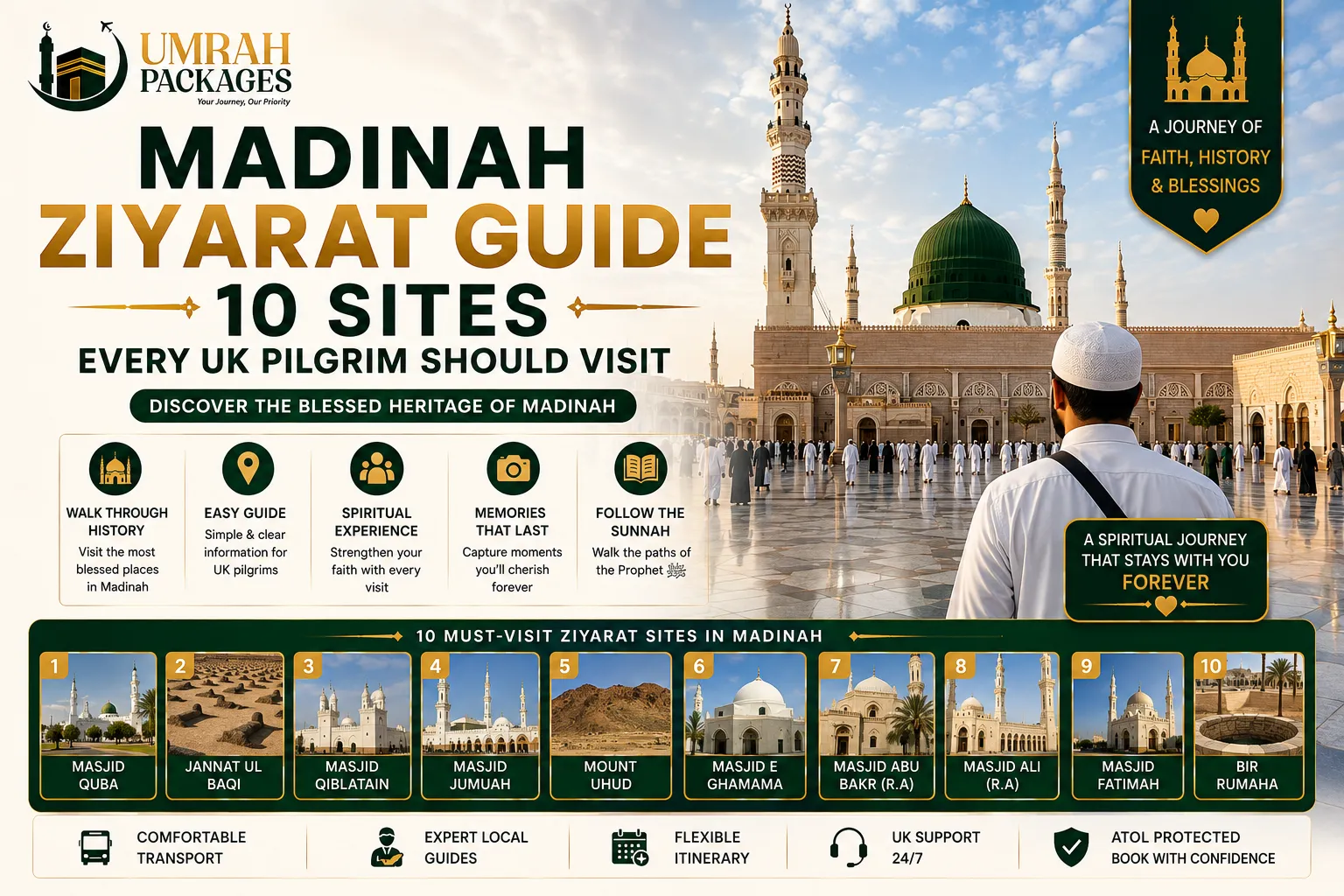
Madinah’s major Ziyarat sites are located 3–7km from Masjid al-Nabawi — taxi or tour bus required for all except the sites within walking distance of the mosque. A full Ziyarat day tour covers most major sites in 4–6 hours. Cost: approximately SAR 50–120 (£10–£24) per person for a shared tour, or SAR 80–150 (£16–£30) for a private taxi group tour. The sites are historical and spiritually significant — they are not entertainment venues. The appropriate attitude throughout is that of a visitor honouring the memory of the Prophet ﷺ and his Companions.
Madinah is not just the city you visit after Makkah. It is the city where Islam was built as a community, where the Prophet ﷺ lived for ten years, where the mosque he built with his own hands still stands, and where the companions who carried this religion across the earth are buried. Most UK Umrah packages include 3–6 nights in Madinah — and most UK pilgrims spend those nights in Masjid al-Nabawi without ever leaving to see the city that surrounds it.
This is not a criticism — the mosque is why you are there, and there is no inadequacy in spending your Madinah time entirely in prayer and salawat. But for UK pilgrims who have the time and energy, the sites of Madinah offer something that Masjid al-Nabawi itself cannot: the physical landscape of early Islamic history. Standing at the foot of Uhud, where seventy companions fell. Praying two Rakaat in Quba, the first mosque on earth. Looking at Masjid al-Qiblatain and understanding what it meant for the Companions to turn mid-prayer from Jerusalem to Makkah. These are not tourist experiences. They are encounters with the real events of the Seerah, in the places where those events happened.
Packages Umrah (7 Huxley Avenue, Manchester M8 0SJ). All-inclusive Umrah packages from £645/pp with 3–6 Madinah nights included. WhatsApp +44 7737 144335 — same-day quote.
# | Site | Distance from Masjid Nabawi | Time to Allow | Key Hadith Reward |
1 | The Rawdah al-Sharif | Within Masjid al-Nabawi — walk | 30–60 mins (pre-booked slot) | ‘A garden from the gardens of Paradise’ — Bukhari 1196 |
2 | Masjid Quba | ~3.5–4km south | 45–60 mins | ‘Equal to the reward of Umrah’ — Tirmidhi 324 |
3 | Mount Uhud and Shuhada’ Cemetery | ~6–7km north | 60–90 mins | Prophet ﷺ loved Uhud — Bukhari 4083 |
4 | Masjid al-Qiblatain | ~4–5km northwest | 20–30 mins | Site of the Qibla change — Quran 2:144 |
5 | Jannat al-Baqi’ | Directly adjacent to Masjid Nabawi | 20–40 mins | Sunnah to visit — Muslim 974 |
6 | The Seven Mosques (Sab’ah Masajid) | ~4–5km northwest | 30–45 mins | Battle of Khandaq sites |
7 | Masjid al-Ghamamah | ~500m south of Masjid Nabawi (walk) | 15–20 mins | Prophet ﷺ prayed Eid here |
8 | Well of Uthman (Bi’r Uthman) | ~4km from centre | 20–30 mins | Companion’s generosity — historical |
9 | The Date Palm Farms (Al-‘Awali District) | ~5km south | 30 mins drive-through | Madinah’s agricultural heritage |
10 | Masjid Abu Bakr al-Siddiq | ~4km south near Quba | 15–20 mins | Named for the closest Companion |
The Prophet ﷺ said: ‘Between my house and my pulpit is a garden from the gardens of Paradise, and my pulpit is upon my fountain (Hawdh).’ — Sahih Bukhari 1196
The Rawdah al-Sharif — literally ‘the Noble Garden’ — is the blessed area inside Masjid al-Nabawi between the Prophet’s ﷺ house (where he lived, where he passed, and where he is buried) and his minbar (the pulpit from which he delivered his khutbahs). It is marked by a distinct green carpet and green columns that differentiate it from the rest of the mosque’s red carpet and white columns. The area is approximately 22 metres by 15 metres — small relative to the vast mosque that surrounds it.
This small rectangle of green carpeted floor is among the most spiritually significant physical spaces on earth for Muslims. The Prophet ﷺ himself described it as a garden of Paradise. Standing within it — making salawat, offering prayer, making dua — is an experience that returning UK pilgrims describe as unlike anything else in their lives. Quiet for some. Overwhelming for others. But never insignificant.
The Rawdah is managed through the Saudi Nusuk app. Every pilgrim must have a pre-booked visiting slot — men and women at separate times. We book your Rawdah slot before your departure from the UK, so you arrive in Madinah with a confirmed time rather than attempting to obtain a slot on arrival. The visiting windows are allocated in advance and are in high demand, particularly during Ramadan and school holiday periods. For 7-night packages (3 Madinah nights), you typically have one Rawdah visiting slot. For 10-night packages (4 Madinah nights), the scheduling allows for more flexibility.
At your allocated time, you enter the Rawdah through the designated gender-appropriate entrance. Inside, you offer two Rakaat if space allows, or any voluntary prayer, and make dua. The time is limited by the crowd management system — typically 15–30 minutes per slot. The specific experience of being in the Rawdah at your allocated time — particularly for women who visit during the quieter women’s windows — is described by most UK pilgrims as the most emotionally significant moment of the entire Madinah stay.
The Prophet ﷺ said: ‘Whoever purifies himself at home and then comes to Masjid Quba and prays there, he will have a reward like that of Umrah.’ — Tirmidhi 324, Ibn Majah 1412
Masjid Quba is not merely the oldest mosque in Islamic history — it is the first mosque built by the Prophet ﷺ himself, laid with his own hands when he arrived in Madinah during the Hijra from Makkah in 622 CE. The Quran itself references it: ‘A mosque founded on righteousness from the first day is more worthy that you should stand in it.’ (Al-Tawbah 9:108). For UK pilgrims who have prayed in mosques built by later generations of Muslims, Quba is the origin — the first physical place where Muslims gathered in a purpose-built space for the worship of Allah.
The current Quba mosque is a modern building on the same site — significantly expanded and rebuilt over centuries, most recently in the 1980s. The ancient foundation stones from the Prophet’s ﷺ original construction are not visible, but the site itself is unchanged. The mosque is large, cool (fully air-conditioned), and well-maintained. It has separate entrances and prayer areas for men and women.
The hadith is unambiguous: two Rakaat prayed at Masjid Quba carries the reward of one Umrah. This is one of the most specific and significant reward narrations associated with any site outside the two Harams. For UK pilgrims who have come to Madinah after performing Umrah in Makkah, performing Wudu at their hotel and going to Quba to pray two Rakaat is an action that the Prophet ﷺ himself performed every Saturday (Sahih Bukhari 1193) — sometimes walking, sometimes riding.
Masjid Quba is approximately 3.5–4km south of Masjid al-Nabawi. Taxi: 10–15 minutes, approximately SAR 10–20 (£2–£4) each way. The mosque is open throughout the day and accessible outside prayer times. Best visiting times: after Fajr (cooler, less crowded) or mid-morning (9:00–11:00am). Allow 45–60 minutes for a meaningful visit — prayer, reflection, and the brief walk around the mosque’s exterior courtyard.
The Prophet ﷺ said: ‘Uhud is a mountain that loves us and we love it.’ — Sahih Bukhari 4083. He ﷺ also said: ‘Hamza is the master of the martyrs.’ — Hakim, authenticated by al-Albani
The Battle of Uhud was fought on Saturday, 23 Shawwal 3 AH (approximately March 625 CE), at the foot of the mountain now known as Jabal Uhud, 6–7km north of central Madinah. The Quraysh of Makkah — still reeling from their defeat at Badr the previous year — arrived with 3,000 fighters against a Muslim army of approximately 700. The early stages of the battle went in the Muslims’ favour. Then a critical error: a group of archers left their positions on a small hillock against the Prophet’s ﷺ explicit instruction, believing the battle was won. The Quraysh cavalry commander Khalid ibn al-Walid (not yet Muslim) exploited the gap, the tide turned, and seventy Muslims were martyred — including Hamza ibn Abd al-Muttalib (RA), the Prophet’s ﷺ uncle, known as ‘the Lion of Allah.’
The Prophet ﷺ himself was wounded at Uhud — a stone struck him, breaking the visor of his helmet and injuring his face. He ﷺ bled. He ﷺ was temporarily rendered unconscious by the press of the battle, and a rumour spread through the Muslim ranks that he ﷺ had been killed. The moment when the companions realised he ﷺ was alive — ‘The Messenger of Allah is alive!’ — is one of the most emotionally described moments in the entire Seerah.
The physical landscape of Uhud has not changed significantly since the battle. The mountain itself is the same mountain. The small hillock where the archers stood (Jabal al-Rumah, the Mount of the Archers) is visible. The field where the battle was fought is the open ground at the mountain’s southern foot. The cemetery of the martyrs — Maqbarat al-Shuhada’ — contains the graves of the seventy companions who fell, with the grave of Hamza ibn Abd al-Muttalib (RA) specifically identifiable.
For UK pilgrims who have studied the Seerah, standing at Uhud is a specific kind of encounter. The story is known. The site is in front of you. The mountain that the Prophet ﷺ said he loves, that loves him, is the same physical mountain. The graves of the companions who chose to stand and die here rather than retreat are in the ground beneath your feet. The intellectual knowledge of the Seerah becomes something felt rather than understood in a different way at this specific site.
Mount Uhud is approximately 6–7km north of Masjid al-Nabawi. Taxi: 15–20 minutes, approximately SAR 15–25 (£3–£5) each way. Best visiting time: early morning (7:00–9:00am) before the heat builds. In summer months, morning visits are essential — the site is largely outdoors and 40°C+ afternoon heat makes extended visits uncomfortable. Allow 60–90 minutes for a meaningful Uhud visit including the cemetery and the battlefield area.
‘We have certainly seen the turning of your face toward the heaven, and We will surely turn you toward a Qibla with which you will be pleased. So turn your face toward al-Masjid al-Haram.’ — Al-Baqarah 2:144. This verse was revealed while the Prophet ﷺ was mid-prayer at this mosque.
Masjid al-Qiblatain — ‘the Mosque of the Two Qiblas’ — marks the site of one of the most significant single moments in Islamic worship history. For approximately 17 months after the Hijra to Madinah, the direction of prayer (Qibla) for Muslims was Jerusalem (Bayt al-Maqdis). The Prophet ﷺ prayed facing Jerusalem while longing for the Qibla to be changed to Makkah — and his desire was recorded in his face frequently turning toward the sky (Al-Baqarah 2:144).
The revelation came during the Dhuhr prayer — specifically while the congregation was in the middle of the prayer at this mosque. The verse was revealed, the Prophet ﷺ turned mid-prayer from Jerusalem to Makkah, and the entire congregation followed — turning 180 degrees within the prayer, without breaking it. The mosque was subsequently named ‘the Mosque of the Two Qiblas’ to commemorate this moment. The original mosque had two mihrabs (prayer niches) — one facing Jerusalem, one facing Makkah. The modern rebuilt mosque preserves only the Makkah-facing mihrab, but the historical significance of the site is unchanged.
For UK Muslims who face the Qibla toward Makkah every day — in their homes, in their mosques, in the direction of prayer that structures every moment of their religious life — standing at Masjid al-Qiblatain is the place where that direction was established. The revelation that fixed the Qibla came here. The companions who turned mid-prayer at this site, without hesitation, in immediate obedience to divine command — their action is the model of what the Qibla turn has meant in every Muslim’s prayer since.
The site is approximately 4–5km northwest of Masjid al-Nabawi. Taxi: 12–18 minutes. Allow 20–30 minutes for a visit — prayer, reflection, and viewing the mosque’s architecture.
The Prophet ﷺ said: ‘Peace be upon you, O people of the abodes (graves), from among the believers and Muslims. Indeed we are, if Allah wills, to follow you. I ask Allah for wellbeing for us and you.’ — Sahih Muslim 974
Jannat al-Baqi’ — ‘the Garden of Baqi” — is the main cemetery of Madinah, located immediately adjacent to Masjid al-Nabawi (accessible through the mosque’s eastern gates). It is one of the most significant burial sites in Islamic history. Among those buried here: Uthman ibn Affan (RA) — the third Caliph of Islam. The wives of the Prophet ﷺ, including Aisha (RA) and Umm Salamah (RA). His daughters — Ruqayyah, Umm Kulthum, and Zainab (RA). His son Ibrahim (RA), who died in infancy. Thousands of the Companions (RA). The Prophet’s ﷺ aunt Safiyyah (RA) and foster mother Halimah al-Sa’diyyah (RA) according to some narrations.
The Prophet ﷺ regularly visited Jannat al-Baqi’ — particularly at night, making the specific Salam dua for the dead (narrated in Sahih Muslim 974 above). He ﷺ predicted: ‘I wish that I could meet my brothers’ — meaning the later Muslims who would come after his generation. The Muslims who visit Jannat al-Baqi’ are among those he ﷺ spoke of.
Jannat al-Baqi’ has specific visiting hours — it is not open continuously. Men’s visiting times are typically in the morning (approximately 8:00–11:00am) and evening (after Isha). Women’s visiting hours are more restricted — typically a brief morning window. The current Saudi policy on women’s cemetery visits has been subject to varying interpretations; confirm the current visiting arrangements with your agent before departure.
The appropriate etiquette at Jannat al-Baqi’: enter quietly, walk respectfully, offer the Salam dua for the dead (as taught by the Prophet ﷺ), and make dua for the deceased and for yourself and your family. Do not touch graves or pray toward them — these are specifically prohibited. The visit is one of respectful remembrance and supplication, not of seeking the dead’s intercession through the grave itself.
The Seven Mosques complex — Masjid al-Sab’ah — marks the area where the Battle of Khandaq (the Battle of the Trench) was fought in 5 AH (approximately 627 CE). This battle is one of the most strategically significant in early Islamic history: a confederation of Arab tribes, Persians, and Jewish tribes of Madinah, totalling approximately 10,000 fighters, besieged Madinah. The strategic masterstroke of the Muslim response was proposed by Salman al-Farisi (RA) — who suggested digging a trench around the exposed northern approaches of Madinah, a defensive tactic previously unknown in Arabia. The trench was dug by the companions themselves, including the Prophet ﷺ, over six days. The confederation, unable to cross the trench and finding their alliance fracturing, withdrew after approximately 27 days.
The Seven Mosques complex contains several small mosques built on sites associated with specific events of the battle — including Masjid al-Fath (Mosque of the Victory) where the Prophet ﷺ made dua and received the revelation of victory, and individual mosques associated with Abu Bakr (RA), Umar (RA), and other companions. The complex is approximately 4–5km northwest of Masjid al-Nabawi, near Masjid al-Qiblatain — most Ziyarat tours visit both on the same trip.
Masjid al-Ghamamah — ‘the Cloud Mosque’ — is one of the most accessible Ziyarat sites from Masjid al-Nabawi, located approximately 500 metres to the southwest and reachable on foot. It is built on the site where the Prophet ﷺ performed the outdoor Eid prayers — the congregational Eid al-Fitr and Eid al-Adha prayers were held in this open ground. The mosque’s name refers to a tradition that a cloud (ghamamah) would appear to shade the Prophet ﷺ while he led the prayer here in the open sun.
Masjid al-Ghamamah is a small, simple mosque with historical resonance far beyond its physical size. For UK pilgrims who perform Eid prayers in parks and fields in the UK — the outdoor communal prayer tradition — this is the original outdoor Eid prayer ground where the Prophet ﷺ led the community. The site is walkable from the mosque area and can be visited between prayers without a taxi. Allow 15–20 minutes for a brief prayer and reflection.
When the Muslims arrived in Madinah, the city’s freshwater supply was largely controlled by a Jewish owner who sold water to pilgrims and residents. The Prophet ﷺ said: ‘Whoever buys the Well of Rumah and donates it to the Muslims, he will have a place in Paradise.’ Uthman ibn Affan (RA) purchased the well for a significant personal sum and gifted it to the Muslim community — making its water freely available to all Muslims in Madinah.
The site of Bi’r Uthman (also called Bi’r Rumah) has been preserved and is now a functioning date farm owned and operated as a charitable endowment. The specific tradition of the well — an individual act of extraordinary generosity that benefited the entire Muslim community — resonates with a specific contemporary meaning: Uthman (RA) bought and donated a physical resource to make it freely available to Muslims. The well continues as a point of historical and spiritual reflection for pilgrims who visit.
The Prophet ﷺ said: ‘Whoever eats seven Ajwa dates in the morning will not be affected by poison or magic on that day.’ — Sahih Bukhari 5779
The Madinah date market — located near the Prophet’s Mosque and in the broader central market district — is one of the most practically enjoyable Ziyarat-adjacent experiences in Madinah for UK pilgrims. It is not a historical site in the strict sense — it is a living continuation of Madinah’s date culture that has existed since the Prophet’s ﷺ time. Madinah’s agricultural identity is deeply rooted in the date palm — the city’s surrounding oases sustained early Muslim life and the date’s specific Islamic significance (from Suhoor to Iftar, from the Prophet’s ﷺ dietary preference to the specific narration about Ajwa) is woven through the Seerah.
The Ajwa date — grown specifically in the al-Alia and al-Qasim districts around Madinah — is available at the Madinah date market fresh and packaged, in qualities and varieties that UK halal shops cannot replicate. Medjool, Sukkari, Safawi, and the specific Ajwa date — darker, softer, and more complex in flavour than the pressed Ajwa available in UK shops — are all available. UK pilgrims consistently return home with 2–5kg of Madinah dates as gifts for family. Budget approximately SAR 30–100 per 500g depending on variety and quality.
Near Masjid Quba, the historic Quba district of Madinah contains several smaller mosques and sites associated with the Prophet’s ﷺ companions and the early Muslim community. Masjid Abu Bakr al-Siddiq (RA) is one of these — a mosque named for the Prophet’s ﷺ closest companion and the first Caliph of Islam. The Quba district as a whole represents the southern approaches of Madinah where the Prophet ﷺ first arrived from Makkah — the first neighbourhood of Madinah he entered, the first mosque he built, the beginning of the Muslim city.
For UK pilgrims who have a particular connection to the Companions’ stories — who have grown up hearing about Abu Bakr’s role in the Hijra, hiding in the cave of Thawr with the Prophet ﷺ, pledging his wealth to the early Muslim community — visiting the mosque that bears his name in the city where he lived and served connects that biographical knowledge to a physical place.
The number of Madinah nights in your UK Umrah package determines how much Ziyarat is realistic. Here are honest itinerary frameworks:
Three Madinah nights (typically part of a 7-night Umrah) allow for the Rawdah visit and one focused Ziyarat half-day. Priority:
Four Madinah nights (typical for a 10-night Umrah) allow for thorough Ziyarat coverage without rushing any site:
Five to six Madinah nights (12-night or 14-night packages) give the rarest gift of Madinah: time. Time to sit in the mosque gardens at different hours across different days. Time for the Rawdah visit to feel complete rather than hurried. Time for all Ziyarat sites including the lesser-visited ones. Time for the date market, the local neighbourhood, and the evenings that returning UK pilgrims describe as Madinah’s most peaceful and lasting memory — sitting in the gardens of Masjid al-Nabawi at 10pm, salawat on the lips, the dome visible above the mosque walls, in the city where he ﷺ lived.
Option | Cost (approx.) | Best For | Notes |
Shared Ziyarat tour bus | SAR 30–60/person (£6–12) | Groups of pilgrims, cost-conscious | Fixed route, multiple stops. Organised from hotels. Ask your hotel reception or Packages Umrah agent. |
Private taxi (group) | SAR 80–150 total (£16–30) | Families, groups of 4+, elderly pilgrims | More flexible timing. Negotiate before getting in — agree total fare, not per-person. |
Walking (Nabawi area) | Free | Masjid Ghamamah, Baqi’ | Only Masjid al-Ghamamah (~500m) and Jannat al-Baqi’ (adjacent) are walkable from Masjid al-Nabawi. |
Ride-hailing apps | SAR 10–25 each way (£2–5) | Solo pilgrims, flexible timing | Apps operate in Madinah. More expensive than pre-negotiated taxis but convenient. |
Site | Best Time | Why | Avoid |
Rawdah | Pre-booked slot — any time | Slot is fixed | N/A — attend at your booked time |
Masjid Quba | 7:00–9:00am | Cool, less crowded | Midday summer heat |
Mount Uhud | 7:00–9:30am | Cool outdoor site; cemetery most reflective in morning | Afternoon in summer (40°C+) |
Masjid al-Qiblatain | 9:00–11:00am or evening | Any cool period. Taxi drop-in site. | Prayer time closures (15–30 mins) |
Jannat al-Baqi’ | Men: 8:00–11:00am. Women: confirm current hours. | Specific visiting hours apply | Outside designated hours — closed |
Seven Mosques | 9:00am–12:00pm | Combine with al-Qiblatain (nearby) | Not a must-do for time-limited pilgrims |
Date Market | After Asr (4:00–6:00pm) or evening | Busy and vibrant; good light for buying | Prayer time closures |
Madinah’s climate is drier and slightly cooler than Makkah in most months. In October and November (recommended Umrah months), Madinah daytime temperatures are approximately 28–35°C — comfortable for outdoor Ziyarat with appropriate hydration. In summer (June–August), Madinah reaches 40–42°C — outdoor sites like Uhud and the Seven Mosques require early morning visits. The mosque gardens of Masjid al-Nabawi are shaded with large parasols that open automatically during the day — creating comfortable outdoor prayer and reflection space even in summer.
All our packages include Madinah nights as part of the standard itinerary. Madinah hotels are named and confirmed before deposit — distance from Masjid al-Nabawi stated in metres.
Package | Duration | Makkah Nights | Madinah Nights | Price Per Person |
3★ — 7 Nights | 7 Nights (4 Makkah + 3 Madinah) | 4 Nights | 3 Nights | From £645/pp |
3★ — 10 Nights | 10 Nights (6 Makkah + 4 Madinah) | 6 Nights | 4 Nights | From £695/pp |
3★ — 12 Nights | 12 Nights (7 Makkah + 5 Madinah) | 7 Nights | 5 Nights | From £735/pp |
3★ — 14 Nights | 14 Nights (8 Makkah + 6 Madinah) | 8 Nights | 6 Nights | From £775/pp |
4★ — 10 Nights | 10 Nights (6 Makkah + 4 Madinah) | 6 Nights | 4 Nights | From £845/pp |
Off-peak months (Nov, Jan, Oct, Sep). All-inclusive: flights, visa, hotels, Rawdah booking, all transport. ATOL protected. Group (10+): from £625/pp.
How do I book the Rawdah visit?
Through the Saudi Nusuk app. We register every pilgrim on Nusuk and pre-book the Rawdah slot before UK departure. You arrive in Madinah with a confirmed visiting time — no queuing for slots on arrival. Rawdah visiting times for women and men are separate.
Can I visit the Rawdah more than once?
Multiple Rawdah visits can sometimes be arranged in longer stays — subject to Nusuk availability. For 10-night and 12-night packages with 4–5 Madinah nights, we attempt to secure multiple slots where the app permits. This is not guaranteed but is more likely in off-peak months.
What is the difference between visiting the Rawdah and visiting the Prophet’s grave?
The Rawdah encompasses both areas — the designated green-carpeted area includes access to the vicinity of the Prophet’s ﷺ grave (marked by the green dome visible from outside the mosque). Visitors make Salam at the grille of the grave enclosure and offer salawat facing it. You are not in the same room as the grave — you are offering Salam from the designated greeting position at the enclosure.
What is the reward for praying at Masjid Quba?
Two Rakaat prayed at Masjid Quba carries the reward of one Umrah — based on the narration in Tirmidhi 324 and Ibn Majah 1412. The Prophet ﷺ himself visited Quba every Saturday and prayed there (Sahih Bukhari 1193).
How far is Masjid Quba from Masjid al-Nabawi?
Approximately 3.5–4km south. A 10–15 minute taxi ride. The mosque is not walkable from Masjid al-Nabawi in summer heat; in cool months (October–January), it is a 40–50 minute walk for those who prefer walking.
Is Masjid Quba open to women?
Yes — Masjid Quba has separate entrances and prayer areas for men and women. Women can visit and pray there at the same time as men.
Why should UK pilgrims visit Mount Uhud?
Because it is where 70 companions of the Prophet ﷺ — including his uncle Hamza ibn Abd al-Muttalib (RA) — were martyred in one day for the sake of Islam. The physical landscape of the battle is unchanged. Standing there connects the Seerah that UK Muslims know from books to a physical, historical reality. The Prophet ﷺ himself loved Uhud and visited the martyrs’ graves.
Can I climb Mount Uhud?
Yes — there are designated paths for pilgrims to ascend part of the mountain. The view from the lower slopes provides the landscape of the battlefield. The climb is moderate in difficulty — suitable for most adults in good health in the cooler months. Not recommended in summer heat or for elderly pilgrims with limited mobility.
Who is buried at Uhud?
Approximately 70 companions who fell in the Battle of Uhud (3 AH). The most prominent grave is that of Hamza ibn Abd al-Muttalib (RA) — the Prophet’s ﷺ uncle — who was specifically mourned by the Prophet ﷺ. The Prophet ﷺ said about him: ‘Hamza is the master of the martyrs.’ (Hakim, authenticated).
How long does a full Madinah Ziyarat tour take?
A comprehensive Madinah Ziyarat tour covering Masjid Quba, Masjid al-Qiblatain, the Seven Mosques, Bi’r Uthman, and Mount Uhud takes approximately 4–6 hours as a full day tour. Some pilgrims split this across two half-days. Budget 60–90 minutes at Uhud and 45–60 minutes at Quba for meaningful visits.
Is Ziyarat obligatory?
No — Ziyarat in Madinah is voluntary worship (nafl), not obligatory. The obligatory elements of Umrah are performed in Makkah. Ziyarat enhances the spiritual experience and follows the Sunnah of visiting the graves of the righteous, but a pilgrim whose health or energy does not permit Ziyarat is not missing a religious obligation.
How much does a Madinah Ziyarat tour cost?
Shared Ziyarat tour organised through the hotel or a local tour service: approximately SAR 30–60 per person (£6–12). Private taxi for a group: SAR 80–150 total for the group (£16–30). Most tours include Quba, al-Qiblatain, Seven Mosques, and Uhud in one circuit.
Can elderly and wheelchair-using pilgrims do Ziyarat?
Yes — with planning. The Rawdah and Jannat al-Baqi’ are accessible within or adjacent to Masjid al-Nabawi. Masjid Quba is a modern accessible building. Uhud’s cemetery area (the main focus for most pilgrims) is accessible on flat ground near the base of the mountain — the steep climb is optional. A private taxi (rather than shared tour bus) gives elderly pilgrims more control over timing and access.
Is it permissible to visit the graves at Jannat al-Baqi’ and Uhud?
Yes — visiting the graves of Muslims and offering the Salam dua for the deceased is Sunnah. The Prophet ﷺ specifically visited Jannat al-Baqi’ and the martyrs of Uhud and taught his companions to do the same. The specific etiquette is to offer the Salam dua, make general dua for the deceased and for oneself, and avoid touching graves or praying toward them.
What should I say at the graves in Madinah?
The Salam dua narrated from the Prophet ﷺ: ‘As-salamu alaykum ahl al-diyar min al-mu’minina wal-Muslimin, wa inna in sha’Allahu bikum lahiqun, as’alu Allaha lana wa lakum al-afiyah’ — ‘Peace be upon you, O people of the abodes, from among the believers and Muslims. Indeed we are, if Allah wills, to follow you. I ask Allah for wellbeing for us and you.’ (Sahih Muslim 974).
Should I visit Madinah before or after Makkah?
Both orders are practised. Many UK Umrah packages route through Madinah first (flying into Madinah, then transferring to Makkah). Others do Makkah first (flying into Jeddah) and visit Madinah at the end. Neither order is obligatory. The Prophet’s ﷺ own journey was Makkah to Madinah (the Hijra), but the Miqat for those entering Madinah first (Dhul Hulayfah) allows the Ihram to be entered for Umrah upon departure from Madinah to Makkah.
How many Madinah nights do UK Umrah packages include?
7-night packages: 3 Madinah nights. 10-night packages: 4 Madinah nights. 12-night packages: 5 Madinah nights. 14-night packages: 6 Madinah nights. For thorough Ziyarat, 4 Madinah nights (10-night package) is our recommendation — enough for the Rawdah, Jannat al-Baqi’, a full Ziyarat day tour, and unhurried Masjid al-Nabawi time.
How much does a 10 nights Umrah package cost from UK?
From £695/pp (3-star, off-peak months, all-inclusive). Includes 4 Madinah nights — sufficient for all major Ziyarat sites.
Is the Madinah hotel included in the package price?
Yes — every Packages Umrah quote includes the named Madinah hotel for the full Madinah leg. The hotel name and distance from Masjid al-Nabawi in metres are confirmed before deposit. The Madinah hotel is never an optional extra.
How do I book a package with Madinah Ziyarat included?
WhatsApp +44 7737 144335. Tell us your preferred month, group size, departure airport, star rating preference, and duration. We return a full itemised quote the same day with Madinah hotel and all components confirmed.
Madinah is where the mosque was built and the community was formed. It is where the companions lived, prayed, argued, reconciled, and died. It is where the Prophet ﷺ — the most beloved human being to every Muslim who will ever live — spent ten years of his life, received revelation, led an Ummah, and rests. No guide can fully prepare you for what it means to be in that city.
What a guide can do is point you toward the places that give the biggest portions of what Madinah offers: the Rawdah, where his ﷺ description of Paradise is made physical; Quba, where he ﷺ built with his own hands; Uhud, where the companions who believed without seeing gave their lives; al-Qiblatain, where the direction of prayer itself was fixed; Baqi’, where those who are waiting for us are buried.
Our packages include 3–6 Madinah nights depending on duration — all with named hotels at confirmed distances from Masjid al-Nabawi, Rawdah slot pre-booked, and 24/7 agent support throughout. From £645/pp all-inclusive. 7, 10, 12, and 14 nights. All UK airports.
📲 WhatsApp for your Umrah quote: +44 7737 144335 — Same-Day Response
📍 7 Huxley Avenue, Manchester M8 0SJ | 🗣 English & Urdu | All UK Airports | ATOL Protected
Packages Umrah — UK Umrah specialists. Madinah included in every package. From £645/pp. Same-day quotes.

Verified Umrah Travel Specialist
Written By: Azeem Ali
A seasoned Umrah travel specialist with more than 10 years of experience in planning and managing Umrah journeys. Every article is carefully prepared by Azeem Ali, drawing on years of expertise in assisting thousands of pilgrims from the UK. Our goal is to provide reliable, up-to-date, and practical guidance to help you confidently prepare for your sacred journey.
PACKAGES UMRAH
SERVICES FROM UK
Latest Articles