

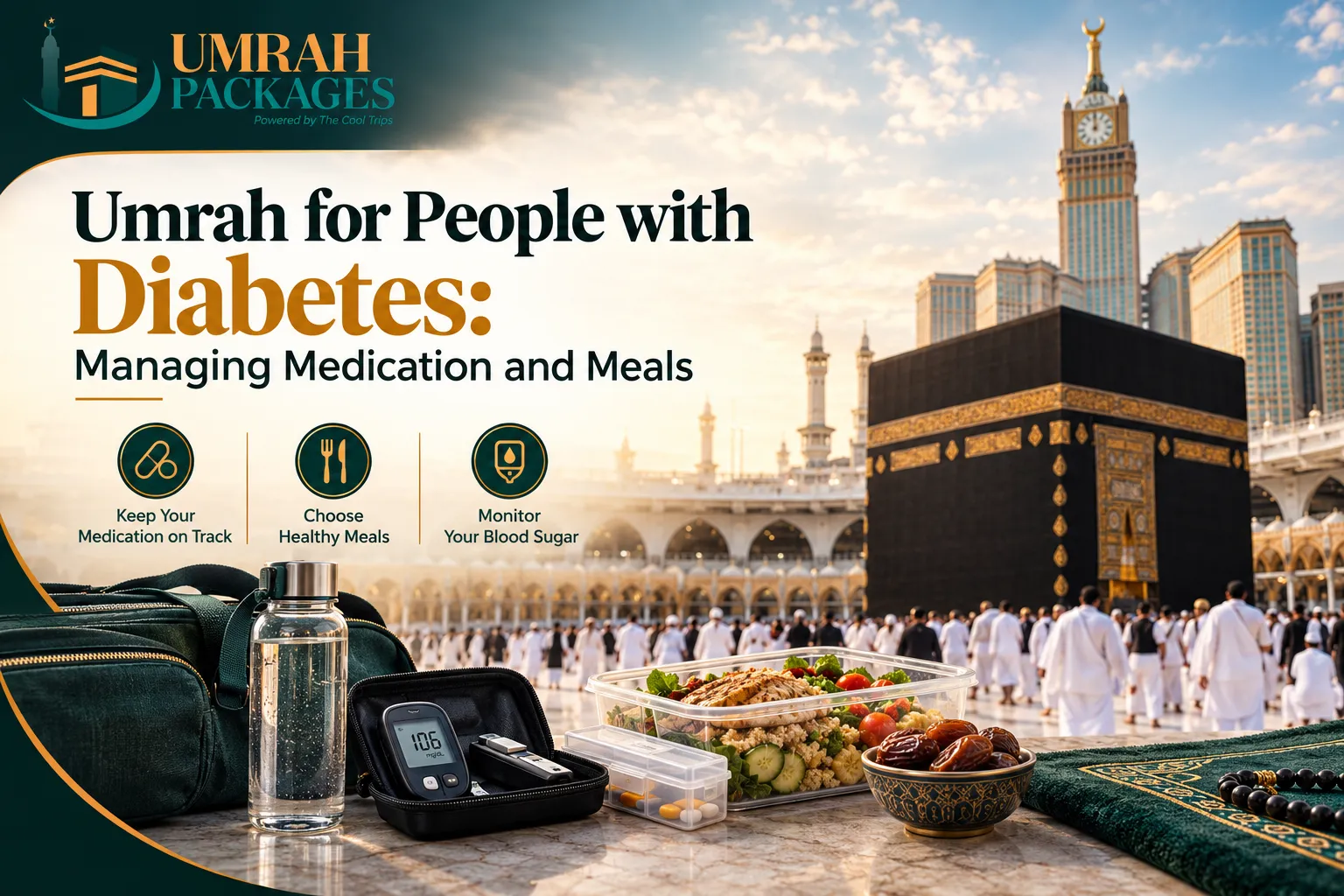
The clinical questions are not ours. Dosing, timing, what to eat and what to do if something goes wrong all belong with your diabetes team, and they need asking before you book.
The things a travel company actually knows and that nobody in this market writes about.
It is the finding on this page. For anybody with reduced sensation in the feet, barefoot walking on hot marble is a specific feature of this trip and it appears nowhere else in this market.
We are not going to tell you what to do about it. We are telling you it exists so you can raise it with your team.
The short version Ask your diabetes team before booking. All of the clinical questions, none of which are ours. Insulin in hand luggage, never the hold. Holds get cold enough to damage it. Ask us to confirm a fridge in your specific room. Not standard at every property. Saudi Arabia is UTC+3, three hours ahead of the UK. Everybody walks barefoot inside, and the marble outside is hot in summer. Raise it with your team. |
Ask us to confirm a fridge for your dates
Dosing, timing across time zones, what to carry, what to eat, what to do about the heat, what to do if something goes wrong, and whether the trip is advisable at all.
All of it. None of it is ours and we will not offer a view on any of it.
Before you book, not after the deposit is paid.
A diabetes review before you commit is a considerably better position than a cancellation at four weeks.
Specifics rather than a general question about Umrah. Give them the facts below and they can give you something useful.
Fact | Detail |
|---|---|
The time difference | Saudi Arabia is three hours ahead of the UK |
The flight | Around seven hours each way |
The transfers | Ninety minutes Jeddah to Makkah, four and a half hours between cities |
The walking | Sa’i is around three kilometres, plus the hotel walk five times a day |
The temperature | 20 to 32 in winter, 38 to 45 in July and August |
The trip length | Whatever you are considering, so they can plan supplies |
Ask whether they will provide one listing your medication and the condition. It costs a small fee, it removes any question at a border, and it is useful if you need to see a doctor abroad.
Asking early. Appointments are not always available at short notice and a letter arranged the week before you fly is a stressful week.
The ACWY certificate is a visa requirement for every traveller. Whether it is suitable for you is a question for your GP or diabetes team, and it must be dated at least ten days before you arrive.
That we cannot advise on it and that we will build whatever trip your team is comfortable with.
Factual, and it is the thing that catches people.
Insulin goes in hand luggage. Never the hold.
Aircraft holds can get cold enough to freeze, and freezing damages insulin. It is also the bag that gets delayed or lost.
Medication, needles and monitoring equipment are permitted in hand luggage. Carry the pharmacy labels and your doctor’s letter, and declare it at security rather than hoping it goes through.
Keep it in a separate clear bag you can hand over rather than digging through a case at the scanner.
Medically necessary liquids are treated differently to the general 100ml rule, and the documentation is what makes that work.
Rules vary by airport and they change. Check your specific airport before you fly rather than relying on a general article, including this one.
More than the trip needs. Enough for the days you are away plus several extra, because delays happen and replacing anything abroad is harder than carrying it.
If you are travelling with somebody, splitting supplies between two bags means a lost bag is an inconvenience rather than a crisis.
Insulated wallets and cooling cases are widely available and a great many travellers use one for the journey. Whether you need one and which type is a question for your team or your pharmacist.
Crew are used to passengers with medical needs. Tell them at boarding if you need anything, including access to a fridge, and they will tell you what they can do.
The same rules apply coming home. Keep everything in hand luggage in both directions rather than repacking at the end.
The single most useful thing a travel company can actually do here.
A fridge is not standard at every three star property and it is not always listed accurately when it is.
People book, arrive, and find there is nowhere to keep anything cool.
Tell us at the enquiry and we confirm it for your specific hotel before you book. Not a general assurance, the actual property on your actual dates.
We tell you and we quote a different one. It is not a difficult problem to solve at the booking stage and it is a genuinely difficult one to solve at check-in.
Whether a hotel fridge is suitable for storing your medication is a question for your pharmacist or team. We can tell you whether there is one, not whether it is right.
Most hotels will store something at reception if the room has no fridge. Ask at check-in rather than assuming, and label it clearly.
A fridge is more common at four star and above, which is one reason a diabetic traveller might take the £130 step even in a cool month where the distance does not require it.
This is the sort of thing that gets treated as a detail and it is not a detail. Raise it at the enquiry and it takes us five minutes. Raise it on arrival and it may not be solvable.
Saudi Arabia is three hours ahead of the UK during British winter time, and two hours ahead during British summer time.
Saudi Arabia does not change its clocks, so the gap shifts when the UK does.
Because a trip in October crosses the UK clock change, and a trip in March does too. The difference is not the same at the start and end of those trips.
Whether your travel dates span the last Sunday in October or the last Sunday in March. If they do, mention it to your team.
Tell you anything about adjusting medication around it. That is entirely a question for your diabetes team and it is one they deal with routinely for travellers.
The day is structured round five prayers rather than three meals, and in summer many people invert it entirely, sleeping in the morning and staying up much of the night.
A trip in November with a normal day is a different proposition to a trip in July where the whole schedule inverts. Tell your team which you are planning.
The summer schedule is set out in our summer post.
Take the dates, the destination time, the flight times and the planned day structure to your review. Those four things let them give you something specific.
Factual, and considerably more useful than most people expect.
Both cities have extensive food available at every price point and at almost every hour. Around the Haram there are food courts, restaurants and shops open very late and very early.
Included on most of our packages. Typically a buffet, typically served early enough for people coming back from Fajr, and typically substantial.
The serving times at your specific hotel, because they vary and a breakfast that finishes at nine is different to one that finishes at eleven.
Everything. Both cities cater to pilgrims from every country, so the range is enormous. Rice, grilled meat, bread, salads, fruit, and a great deal of everything else.
Knowing exactly what is in something when you do not share a language with the person serving it. Worth being aware of rather than being surprised by.
Shops and supermarkets are everywhere around both mosques. If you would rather manage your own food, that is entirely practical.
A fridge, which is the section above, and it is another reason to confirm one at booking.
We generally advise against it. It adds £15 to £30 per person per day, it ties you to fixed serving times, and both cities have extensive options at every hour.
For somebody managing meal timing, being tied to a hotel schedule is usually a disadvantage rather than a convenience. Detail on the all inclusive page.
Completely different. Restaurants are shut during daylight hours and food is available before Fajr and after Maghrib.
If you are travelling in Ramadan and you are not fasting, food is still available through hotel room service and some shops, and the choice during the day is limited.
Whether to fast with diabetes is both a clinical question and a religious one. It goes to your diabetes team and to someone qualified, and we will say nothing else about it.
The section nobody in this market has written.
You remove your shoes at the gates and walk barefoot inside both mosques. That is how it works and everybody does it.
Inside the main areas the flooring is cooled. In the surrounding courtyards and plazas, in summer, the marble is genuinely hot underfoot in daylight.
Tawaf is under a kilometre at ground level. Sa’i is around three kilometres. Plus the distance from the gate to wherever you are praying, five times a day.
Because for anybody with reduced sensation in the feet, or who has been advised to take particular care of them, this is a specific and material feature of the trip.
It is not something a travel article should advise on and it is absolutely something you should know exists before you book.
Telling you what to do about it. Whether you can, what precautions apply, and what to watch for are all questions for your diabetes team or a podiatrist.
The hotel distance, which decides how much walking there is outside the mosque. On a seven night trip a hotel at 200 metres means around 8 kilometres and one at 1.2 kilometres means around 48.
Book closer than you otherwise would. It is the one part of this we can actually change for you.
November, December, January and March are 20 to 32 degrees. July and August are 38 to 45. The marble reflects that.
That difference is worth taking to your review rather than deciding on price alone.
Declare the diabetes and every medication. An undeclared condition is the commonest reason a claim fails.
Not just mentioning it. Answering the medical screening questions fully, listing every medication, and declaring any related conditions or complications.
A claim for anything the insurer decides is related can be refused entirely, and medical treatment abroad is expensive.
Cover with a declared condition costs more than the cheapest comparison-site policy. Shop for cover rather than for price.
They exist and they are widely available. A policy written for travellers with medical conditions is frequently better value than a standard one with an add-on.
Arrange or recommend insurance, or tell you what a policy covers. It is a separate regulated activity.
Tell you plainly that you need it, tell you what to check, and give you the booking details you need to arrange it properly.
Arrange it when you book rather than before you fly. Cancellation cover only helps if it exists before the thing you might cancel for.
Numbers rather than opinion, so your review can be about something specific.
Rite | Approximate distance |
|---|---|
Tawaf, ground level | Under a kilometre |
Tawaf, upper levels | Around one and a half kilometres or more |
Sa’i | Around three kilometres |
On a seven night trip with four Makkah nights, attending most prayers means around forty one-way walks.
Hotel distance | Total walking across the trip |
|---|---|
200 metres | Around 8 km |
400 metres | Around 16 km |
700 metres | Around 28 km |
1.2 kilometres | Around 48 km |
Forty kilometres of difference between the closest and furthest bands, across a single week.
20 to 32 degrees in November through March. 38 to 45 in July and August.
Dry heat evaporates sweat immediately so you do not register the loss. That is a factual feature of the climate and what it means for you is a question for your team.
Five prayers rather than three meals, and in summer the whole day inverts with sleep in the morning.
Seven hours flying each way, ninety minutes to Makkah, and four and a half hours between the cities.
Take it to your review. A general question about whether Umrah is suitable gets a general answer. These numbers get you something you can plan around.
November to March | July and August | |
|---|---|---|
Makkah temperature | 20 to 32 | 38 to 45 |
Walking at midday | Comfortable | Not advisable |
Marble underfoot | Manageable | Genuinely hot |
Isha to Fajr | Over ten hours | Around eight |
Day structure | Normal | Inverted |
Crowds | The quietest of the year | The busiest outside Ramadan |
7 nights, 3 star | From £499 | From £699 |
The cool months are cheaper, quieter, cooler and structurally simpler. For somebody managing a condition on a schedule, the inverted summer day is a separate complication on top of the heat.
November, December, January or mid to late March. All at £499 and all considerably easier on every measure.
Madinah nights are cold in December and January, dropping toward ten degrees. Pack a proper layer.
Detail in our winter packing guide.
A separate question entirely, and one that involves fasting. Both the clinical and the religious sides belong elsewhere and we are not going to summarise either.
Ten nights rather than seven, at £545. A slower pace, room for rest days, and less compression.
November, December, January or mid to late March. All at £499.
Closer than you otherwise would. Under 400 metres if you can, because it is the one part of the walking we can control for you.
Four star at £629 as a working position, partly for the distance and partly because a fridge is more common at four star and above.
Ten nights at £679 in four star. Enough time for a slower pace and rest days rather than compressing everything into four Makkah nights.
Whatever suits, with a fridge confirmed and a low floor requested.
Confirm the fridge in writing, put you as close as the budget allows, tell you the distance in metres and the nearest gate by name, and flag anything about the route that seems relevant.
Offer any view on whether you should travel, what to carry, or how to manage anything. We will build whatever trip your team is comfortable with.
If you are | Book | From |
|---|---|---|
Travelling alone | 10 nights, 4 star, shared quad | £679 |
Travelling as a couple | 10 nights, 4 star double | £929 each |
Travelling with family | 10 nights, 4 star quad | £679 each |
Wanting the shortest walk | 10 nights, Haram facing | £975 each |
On a tighter budget | 7 nights, 4 star under 500 m | £629 |
Logistics rather than medicine. What to carry is a question for your team.
More than the trip needs. Enough for the days away plus several extra, because delays happen and replacing anything abroad is harder than carrying it.
If you are travelling with somebody, split supplies between two bags. A lost bag becomes an inconvenience rather than a crisis.
Comfortable shoes you have already worn, with grip, and shoe bags so you carry them rather than leaving them at the gates.
A pair left among thousands is not coming back, and walking back to your hotel without shoes is not what you want.
Ask us to confirm a fridge and a kettle. Both matter more over ten nights than people expect.
Photograph everything and store the images where you can reach them without data. Passport, visa, insurance, letter and vaccination certificate.
Some people carry something that identifies the condition in case of an emergency. Whether and what is a question for your team.
Tier | 7 nights | 10 nights | 14 nights |
|---|---|---|---|
3 Star | From £499 | From £545 | From £625 |
4 Star | From £629 | From £679 | From £769 |
Haram facing, under 200 m | From £879 | From £975 | From £1,129 |
Per person, quad sharing, off-peak. A couple sharing a double pays from £679 for seven nights at three star. Includes return flights, both hotels named in writing with the distance in metres and the nearest gate, the Saudi Umrah visa, all three transfers and guided Ziyarat in both cities.
Ten nights at four star, £679. Closer in, a fridge more likely, and enough time for a slower pace.
Four star to Haram facing. It takes you under 200 metres with covered access at several properties, which cuts the walking substantially.
The distance. Three star at 1.2 kilometres is £499 and it is 48 kilometres of walking across a week. That is the wrong saving on this booking.
£99 per person, and it fixes your price in writing.
Interest free across the months to eight weeks before departure, when you book four or more months ahead.
We check comparable UK packages every month and sit £20 under the lowest we can find for the same nights and the same hotel tier.
The review. Everything else on this page assumes your team is comfortable, and if they are not then none of it applies.
The fifth. It takes us five minutes at the enquiry and it may not be solvable at check-in.
Dosing, timing, meals, heat and whether to travel all belong with your diabetes team, and they need asking before you book.
Holds get cold enough to damage it and it is the bag that gets delayed. Carry pharmacy labels and a letter, and split supplies if you can.
Not standard at every property and not always listed accurately. Five minutes at the enquiry and possibly unsolvable at check-in.
Sa’i alone is around three kilometres, and in summer the marble outside is genuinely hot. Raise it with your team, because nobody else will mention it.
November through March at £499. Cheaper, quieter, cooler, and the day structure is normal rather than inverted.
Ask us to confirm a fridge for your dates
We will not offer a view on whether you should travel or on anything clinical, and we will build whatever trip your team is comfortable with.
Tell us you need a fridge and roughly when you want to go, and we will confirm the property, tell you the distance in metres, and give you the temperature you will actually be walking in.
Packages Umrah WhatsApp or call: +44 7737 144 335 Office: 7 Huxley Avenue, Manchester, M8 0SJ English and Urdu. Same-day quotes. Four star from £629pp, ten nights from £679pp. £99 deposit fixes your price. Trading name of Uraan Travel Ltd. |
Grouped by topic. Direct answer first. Every clinical question here is answered by pointing you to your diabetes team, and that is not a formality.
A question for your diabetes team, and it needs asking before you book.
No. Not on dosing, timing, meals, the heat, or what to do if something goes wrong.
The fridge, the flight, the time difference, what food is available and when, and the walking distances.
Before you book. A review before you commit is a better position than a cancellation at four weeks.
The time difference, the flight length, the transfers, the walking distances, the temperature and the trip length.
Because a general question about Umrah gets a general answer. Specific numbers get you something you can plan around.
Ask whether they will provide one listing your medication and the condition. Ask early, because appointments are not always available at short notice.
The ACWY certificate is a visa requirement. Whether it is suitable for you is a question for your GP or team.
Hand luggage. Never the hold.
Holds can get cold enough to freeze, and freezing damages insulin. It is also the bag that gets delayed.
Medication, needles and monitoring equipment are permitted in hand luggage. Carry pharmacy labels and your letter, and declare it rather than hoping.
Keeping it in a separate clear bag you can hand over rather than digging through a case at the scanner.
Medically necessary liquids are treated differently, and the documentation is what makes that work. Rules vary by airport so check yours.
More than the trip needs. Enough for the days away plus several extra, because replacing anything abroad is harder than carrying it.
If you are travelling with somebody, splitting supplies between two bags means a lost bag is an inconvenience rather than a crisis.
Many travellers use one for the journey. Whether you need one and which type is a question for your team or pharmacist.
They are used to passengers with medical needs. Tell them at boarding and they will say what they can do.
The same rules both directions. Keep everything in hand luggage rather than repacking at the end.
Not standard at every three star property, and not always listed accurately when they are.
Tell us at the enquiry and we confirm it for your specific hotel before you book.
We tell you and quote a different one. Easy at booking, difficult at check-in.
A fridge in the room rather than a stocked minibar, whether it actually runs, whether reception can store something as a fallback, and the temperature setting.
A question for your pharmacist or team. We can tell you whether there is one, not whether it is right.
Most hotels will if the room has no fridge. Ask at check-in rather than assuming, and label it clearly.
Yes, which is one reason to take the £130 step even in a cool month where the distance does not require it.
It gets treated as a detail and it is not one. Five minutes at the enquiry, possibly unsolvable on arrival.
Three hours ahead of the UK in British winter time, two hours ahead in British summer time.
Saudi Arabia does not change its clocks, so the gap shifts when the UK does.
If your trip spans the last Sunday in October or the last Sunday in March, the difference is not the same at the start and end. Mention it to your team.
No. Entirely a question for your diabetes team, and one they deal with routinely for travellers.
Around five prayers rather than three meals, and in summer many people invert it entirely.
A November trip with a normal day is a different proposition to a July trip where the schedule inverts. Tell your team which you are planning.
Extensive, at every price point and almost every hour. Food courts, restaurants and shops open very late and very early around both mosques.
On most of our packages. Typically a buffet, typically served early enough for people returning from Fajr.
The serving times at your specific hotel. A breakfast finishing at nine is different to one finishing at eleven.
Both cities cater to pilgrims from every country, so the range is enormous.
Knowing exactly what is in something when you do not share a language with the person serving it.
Shops and supermarkets are everywhere around both mosques, and it is entirely practical if you have a fridge.
We generally advise against it. It adds £15 to £30 per person per day and ties you to fixed serving times.
For somebody managing meal timing, being tied to a hotel schedule is usually a disadvantage rather than a convenience.
Restaurants are shut during daylight and food is available before Fajr and after Maghrib.
Food is still available through hotel room service and some shops, and the choice during the day is limited.
No. It is both a clinical question and a religious one. Your diabetes team, and someone qualified.
You remove your shoes at the gates and walk barefoot inside both mosques. That is how it works and everybody does it.
Tawaf is under a kilometre and Sa’i is around three, plus the distance from the gate to wherever you pray, five times a day.
The main areas are cooled. The surrounding courtyards and plazas are genuinely hot underfoot in summer daylight.
Because for anybody with reduced sensation in the feet it is a specific and material feature of the trip, and nobody in this market mentions it.
Raise it with your diabetes team or a podiatrist. It is not something a travel article should advise on.
About the barefoot walking, hot surfaces in summer, whether the month matters, foot checks while away, and whether anything should be seen before you fly.
The hotel distance, which decides the walking outside the mosque. From 200 metres it is around 8 kilometres a week and from 1.2 kilometres it is 48.
November through March is 20 to 32 degrees and July and August is 38 to 45. The marble reflects that.
Yes, and every medication. An undeclared condition is the commonest reason a claim fails.
No. Answer the medical screening fully, list every medication, and declare any related conditions.
A claim for anything the insurer decides is related can be refused entirely.
Whether the condition is covered rather than excluded, the medical limit, repatriation, cover for lost medication, cancellation, and the emergency number.
Yes. Shop for cover rather than for price on this one.
Widely available, and frequently better value than a standard policy with an add-on.
No. It is a separate regulated activity and we will tell you plainly that you need it rather than selling it.
When you book. Cancellation cover only helps if it exists before the thing you might cancel for.
Around three kilometres. Seven lengths at roughly 450 metres each.
Under a kilometre at ground level for seven circuits.
Around forty one-way walks on a seven night trip. From 200 metres that is 8 kilometres and from 1.2 kilometres it is 48.
Seven hours flying each way, ninety minutes to Makkah, and four and a half hours between the cities.
Dry heat evaporates sweat immediately so you do not register the loss. What that means for you is a question for your team.
November, December, January or mid to late March. All at £499 and all considerably easier on every measure.
Ten nights rather than seven. A slower pace and room for rest days.
Four star at £629 as a working position, partly for the distance and partly because a fridge is more common.
Closer than you otherwise would. Under 400 metres if you can.
The distance. Three star at 1.2 kilometres is £499 and 48 kilometres of walking across a week.
That you need a fridge, whether you need a low floor, your dates, and anything your team has raised.
The fridge, the property name, the distance in metres and the nearest gate by name.
Offer any view on whether you should travel or how to manage anything. We build whatever trip your team is comfortable with.
£99 per person, and it fixes your price in writing.
Interest free when you book four or more months ahead.
We will not offer a view on whether you should travel or on anything clinical, and we will build whatever trip your team is comfortable with.
Tell us you need a fridge and roughly when you want to go, and we will confirm the property, tell you the distance in metres, and give you the temperature you will actually be walking in.
Packages Umrah WhatsApp or call: +44 7737 144 335 Office: 7 Huxley Avenue, Manchester, M8 0SJ English and Urdu. Same-day quotes. Four star from £629pp, ten nights from £679pp. £99 deposit fixes your price. |
Verified Umrah Travel Specialist
Written By: Azeem Ali
A seasoned Umrah travel specialist with more than 10 years of experience in planning and managing Umrah journeys. Every article is carefully prepared by Azeem Ali, drawing on years of expertise in assisting thousands of pilgrims from the UK. Our goal is to provide reliable, up-to-date, and practical guidance to help you confidently prepare for your sacred journey.
PACKAGES UMRAH
SERVICES FROM UK
Latest Articles