


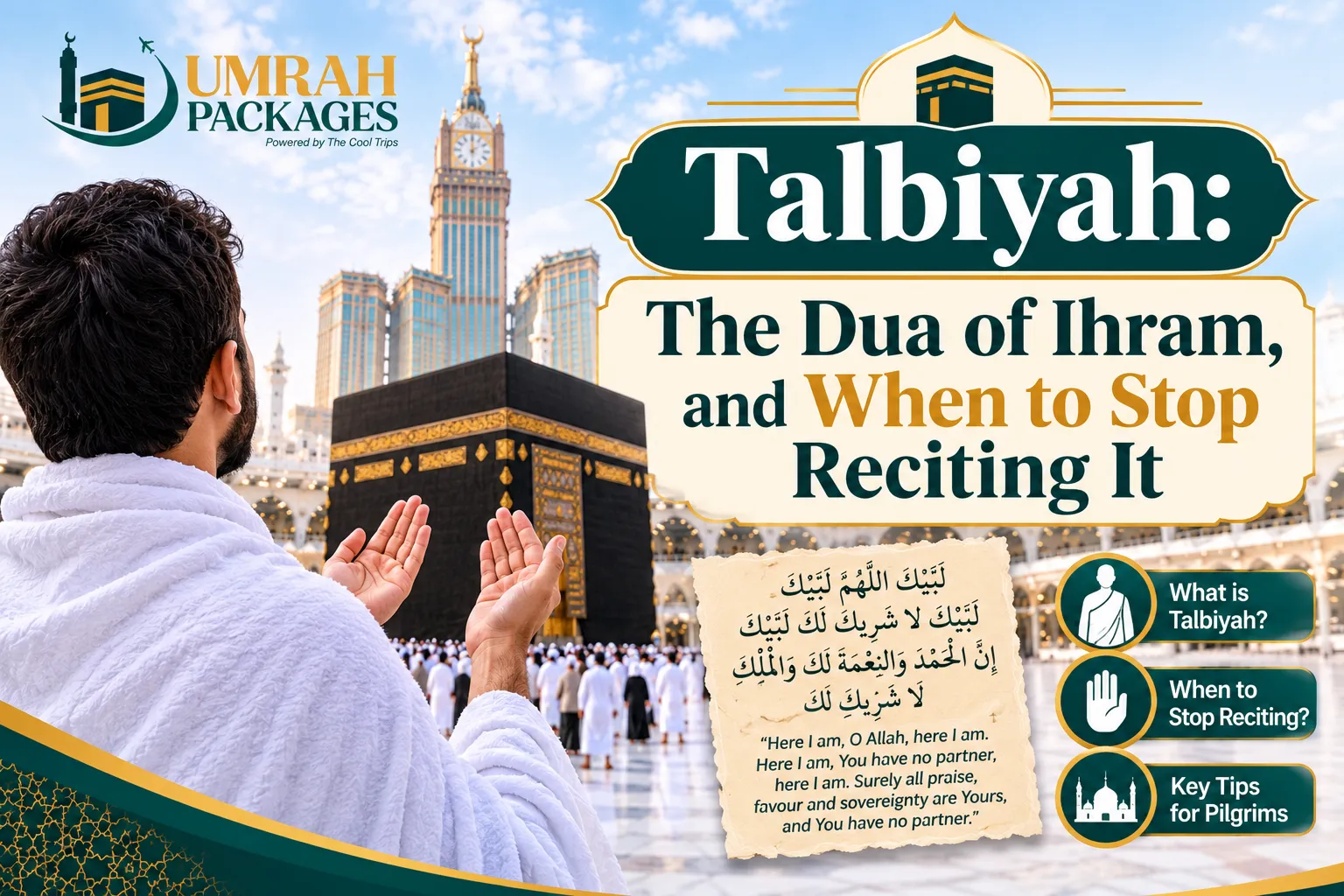
The talbiyah is the dua of ihram: “Labbayk Allahumma labbayk, labbayka la sharika laka labbayk, innal-hamda wan-ni’mata laka wal-mulk, la sharika lak.” You begin it as soon as you make your intention at the miqat. In Umrah, most scholars say stop when you start tawaf at the Black Stone. In Hajj, keep saying it until you stone Jamrat al-Aqabah on the morning of Eid.
There’s more to it than that, though. The four schools don’t agree on whether the talbiyah is compulsory, Malikis stop at different points, women are told to keep their voices down, and a lot of pilgrims stop the moment they see the Kaaba, which isn’t what the reports say. Below we go through each point with its evidence and grading, so you can check it against what your own madhhab teaches.
Question | Short answer |
|---|---|
What is it? | The words a pilgrim repeats after entering ihram, declaring that he or she has answered Allah’s call |
When do I start? | Straight after making the intention at the miqat |
When do I stop in Umrah? | At the start of tawaf, by the Black Stone (Hanafi, Shafi’i, Hanbali); on entering the Haram if you came from a miqat (Maliki) |
When do I stop in Hajj? | When you begin stoning Jamrat al-Aqabah on 10 Dhul Hijjah (majority); after midday on the Day of Arafah (Maliki) |
Men or women? | Both say it. Men raise their voices; women say it quietly |
Is it compulsory? | Sunnah for Shafi’is and Hanbalis; obligatory for Malikis; needed to enter ihram for Hanafis |
During tawaf and sa’i? | No. In Umrah it has already ended; in Hajj it pauses for them |
On my period? | Yes, keep saying it |
لَبَّيْكَ اللَّهُمَّ لَبَّيْكَ، لَبَّيْكَ لاَ شَرِيكَ لَكَ لَبَّيْكَ، إِنَّ الْحَمْدَ وَالنِّعْمَةَ لَكَ وَالْمُلْكَ، لاَ شَرِيكَ لَكَ
Labbayk Allahumma labbayk, labbayka la sharika laka labbayk, innal-hamda wan-ni’mata laka wal-mulk, la sharika lak.
“Here I am, O Allah, here I am. Here I am, You have no partner, here I am. Truly, all praise and blessing are Yours, and all sovereignty. You have no partner.”
Source: Sahih al-Bukhari 1549 and Sahih Muslim 1184. Jabir’s long description of the Prophet’s Hajj in Sahih Muslim 1218 gives the same words.
Most UK pilgrims learn it from a parent or an imam as one long breath. It’s easier to learn in four parts: the double “here I am”, then “no partner” with another “here I am”, then the line about praise, blessing and sovereignty, and finally “no partner” once more.
Ibn al-Qayyim, the 14th-century scholar, listed eight shades of meaning for labbayk. The first is “an answer to You after an answer”, which is why the word is repeated. Arabic lexicographers also link the root to staying at a place and not leaving it. Put together, you’re saying something like: I’ve heard You, I’m here, and I’m not going anywhere.
“Here I am” works well enough in English, as long as you remember it’s the reply to a call. Someone called you by name, and you came.
Jabir described the Prophet’s talbiyah with a striking phrase: “ahalla bit-tawhid”, he raised his voice with the declaration of Allah’s oneness (Sahih Muslim 1218). Ibn Abbas explains why, in his report of what the Makkan polytheists used to say.
كَانَ الْمُشْرِكُونَ يَقُولُونَ لَبَّيْكَ لاَ شَرِيكَ لَكَ – قَالَ – فَيَقُولُ رَسُولُ اللَّهِ صلى الله عليه وسلم وَيْلَكُمْ قَدْ قَدْ . فَيَقُولُونَ إِلاَّ شَرِيكًا هُوَ لَكَ تَمْلِكُهُ وَمَا مَلَكَ
“The polytheists used to say, ‘Labbayka, You have no partner.’ The Messenger of Allah ﷺ would say, ‘Woe to you, enough, enough!’ But they would carry on: ‘except a partner who is Yours. You own him and whatever he owns.'”
Source: Sahih Muslim 1185, narrated by Ibn Abbas. They said this while circling the Kaaba.
Their version opened the same way and then undid itself. The Prophet ﷺ kept the opening and dropped the exception, which is why “la sharika lak” comes twice in ours.
Passing through a valley on the way to Makkah, the Prophet ﷺ said: “It’s as if I’m looking at Musa coming down from the mountain pass, calling out loudly to Allah with the talbiyah.” At another pass he described Yunus ibn Matta on a red camel, wearing a woollen cloak, “and he is saying the talbiyah” (Sahih Muslim 166).
Worth remembering when you’re squeezed into seat 34C out of Manchester. In the Prophet’s own description, Musa and Yunus answered Allah with the talbiyah too.
The answer depends on your madhhab, and here the difference does matter.
School | Ruling | If it’s left out |
|---|---|---|
Hanafi | A condition for entering ihram: the talbiyah, or a dhikr that takes its place | Ihram doesn’t begin without it or a substitute dhikr |
Maliki | Obligatory (wajib) | Ihram is valid, but a sacrifice (dam) is due |
Shafi’i | Sunnah, strongly recommended | Ihram is valid, nothing is due |
Hanbali | Sunnah, strongly recommended | Ihram is valid, nothing is due |
Sources: Egypt’s Dar al-Ifta (fatwas 8242 and 8925), citing al-Zayla’i for the Hanafis, al-Dardir for the Malikis, al-Nawawi’s al-Majmu’ for the Shafi’is and Ibn Qudamah for the Hanbalis. Al-Nawawi also reported that scholars agree the talbiyah is at least recommended.
Whatever your school, say it. It takes seconds, and leaving it out could mean a sacrifice or, for Hanafis, an ihram that never properly began.
You begin the talbiyah from the moment you enter ihram, which means straight after making your intention. All four schools recommend starting at that point.
The reports describe the start of his journey from Dhul Hulayfah, near Madinah. Jabir said his talbiyah began “when his mount stood up straight carrying him” (Sahih al-Bukhari 1515), and Ibn Umar said the same (Bukhari 1552). In Jabir’s longer account, he raised his voice with it once his camel reached the open ground of al-Bayda’ (Muslim 1218).
Why the different places? A report attributed to Ibn Abbas says each group of Companions heard him at a different moment: after his prayer, as his camel rose, and again on the high ground. Al-Albani graded that explanation weak (Sunan Abi Dawud 1770), so we’d treat it as a reasonable guess rather than a settled fact. But all the reports point to the same thing: he started as he set off in ihram.
Most UK flights into Jeddah pass level with the miqat of al-Juhfah, the one near Rabigh, which the Saudi religious authority’s Umrah guide assigns to travellers coming from Europe. You can put on the ihram clothes at the airport or on the plane. Make the intention when the crew announce you’re level with the miqat, then start the talbiyah straight away.
If you make your intention at Heathrow, you’re in ihram from that moment, and every restriction applies for the whole six-hour flight: no perfume, no cutting nails, no covering the head for men. It’s valid, though some schools dislike entering ihram long before the miqat, and most people find it easier to dress at the airport and wait for the miqat before saying the words. Our guide to what ihram is and how to wear it covers the clothing side.
So you don’t start yet. Fly in as normal, enjoy your days at Masjid an-Nabawi and the sites in our Madinah ziyarat guide, and begin the talbiyah when you make your intention at Dhul Hulayfah on the road to Makkah. That’s the same miqat the Prophet ﷺ used.
Not sure which routing suits your family? Message our team on WhatsApp and we’ll explain how Jeddah-first and Madinah-first trips change your ihram plans.
Men say it aloud and women say it softly, as often as they can, each at their own pace.
The Prophet ﷺ said: “Jibril came to me and commanded me to order my Companions and those with me to raise their voices with the talbiyah” (Sunan Abi Dawud 1814, graded sahih by al-Albani). Al-Nawawi noted that raising the voice is recommended by agreement, though not to the point of straining yourself.
There’s also a famous short hadith. Asked which Hajj is best, the Prophet ﷺ said “al-‘ajj wath-thajj”, raising the voice in talbiyah and offering the sacrifice (Jami’ at-Tirmidhi 827). Its grading is disputed: al-Albani graded it sahih, while the Darussalam editors grade it weak. You’ll hear it quoted often. But the point doesn’t depend on it.
Women say exactly the same words, softly enough that they can hear themselves. The classical Maliki scholar Ibn Abd al-Barr reported that scholars agree the sunnah for a woman is not to raise her voice, and Ibn Umar is reported to have said the same. On a coach, a sister reciting under her breath is doing exactly what the sunnah asks of her, however loud the brothers at the front are.
There’s no fixed number. Scholars simply say to repeat it as much as you can. Al-Nawawi recommended saying it three times or more each time you start, without breaking off for chat in the middle, though we found no hadith that fixes the number at three.
Scholars also recommend renewing it whenever your situation changes:
A report attributing this list to the Prophet ﷺ has no known chain, so treat it as the advice of scholars like al-Nawawi rather than a hadith. The habit also keeps the talbiyah going through a long coach ride, rather than fading out after the first ten minutes.
Some groups have a leader call out each line and everyone repeat it in chorus. The Saudi Standing Committee said reciting it in unison is not permissible and called it an innovation, and IslamQA lists it among common mistakes. Ibn Uthaymeen pointed out that the Companions clearly didn’t recite in unison:
كَانَ يُهِلُّ مِنَّا الْمُهِلُّ فَلاَ يُنْكِرُ عَلَيْهِ، وَيُكَبِّرُ مِنَّا الْمُكَبِّرُ فَلاَ يُنْكِرُ عَلَيْهِ
“Some of us would say the talbiyah, and no one objected to him, and some of us would say takbir, and no one objected to him.”
Source: Sahih al-Bukhari 1659, Anas describing the journey from Mina to Arafah with the Prophet ﷺ.
Some scholars are reported to be more lenient, so don’t be surprised if your group does it. But a group leader teaching the words once and then letting everyone recite at their own pace is closer to what the Companions did.
Saying it together slowly to teach someone the words is a different thing from performing it in chorus, and nobody objects to teaching. Children pick it up fast if you explain the meaning first: “We’re telling Allah, here I am, I’ve come.” Reverts on their first Umrah often prefer to learn it line by line in the weeks before. Recording an imam reciting it on your phone helps.
You can add words of praise, but sticking mainly to the Prophet’s wording is better. He allowed others to add, and kept to his own.
Umar ibn al-Khattab used to add these lines after the main talbiyah:
لَبَّيْكَ اللَّهُمَّ لَبَّيْكَ لَبَّيْكَ وَسَعْدَيْكَ وَالْخَيْرُ فِي يَدَيْكَ لَبَّيْكَ وَالرَّغْبَاءُ إِلَيْكَ وَالْعَمَلُ
Labbayk Allahumma labbayk, labbayka wa sa’dayk, wal-khayru fi yadayk, labbayka war-raghba’u ilayka wal-‘amal.
“Here I am, O Allah, here I am. Here I am, ready to serve You. All good is in Your hands. Here I am. To You is the longing, and for You the deeds.”
Source: Sahih Muslim 1184. The same hadith notes that the Prophet ﷺ himself didn’t add to his own words.
Jabir reported that people added phrases such as “dhal-ma’arij”, O Possessor of the ascending ways, and the Prophet ﷺ heard them and said nothing (Sunan Abi Dawud 1813, sahih). He let them do it and kept to his own talbiyah (Muslim 1218).
There’s also one short addition reported from the Prophet ﷺ himself:
لَبَّيْكَ إِلَهَ الْحَقِّ لَبَّيْكَ
Labbayka ilahal-haqq, labbayk.
“Here I am, O God of Truth, here I am.”
Source: Sunan Ibn Majah 2920 and Sunan al-Nasa’i 2752, graded sahih, though al-Nasa’i noted that one narrator alone connected the chain.
In Umrah, stop the talbiyah when you begin tawaf at the Black Stone. That’s the position of the Hanafi, Shafi’i and Hanbali schools, and Ibn al-Mundhir reported it as the view of most scholars.
The strongest basis is a statement from Ibn Abbas himself: “The person doing Umrah keeps saying the talbiyah until he begins tawaf.” Ibn Hajar described its chain as good. A version attributed to the Prophet ﷺ, “until he touches the Stone”, is in Sunan Abi Dawud 1817 and Jami’ at-Tirmidhi 919. Al-Albani and the Darussalam editors grade it weak, though Tirmidhi called it sahih and noted that most scholars act on it.
Ibn Umar used to stop earlier, as soon as he crossed into the Haram:
كَانَ ابْنُ عُمَرَ ـ رضى الله عنهما ـ إِذَا دَخَلَ أَدْنَى الْحَرَمِ أَمْسَكَ عَنِ التَّلْبِيَةِ
“When Ibn Umar entered the nearest part of the Haram, he would stop the talbiyah.”
Source: Sahih al-Bukhari 1573. The same report says he then spent the night at Dhu Tuwa and bathed before entering Makkah, and that the Prophet ﷺ used to do that, which most naturally refers to the night and the bath.
Imam Malik built on this. In the Muwatta he said that someone who entered ihram at one of the mawaqit stops on reaching the Haram, while someone who entered ihram at al-Tan’im stops when they see the Kaaba. So if you’re a Maliki, your stopping point is earlier than your Hanafi, Shafi’i or Hanbali friends’.
We see this mix-up every season: pilgrims fall silent as soon as the Kaaba comes into view and walk to the Black Stone without a word. The majority view keeps the talbiyah going right up to the start of tawaf. The only “seeing the Kaaba” rule we found is Malik’s, and it’s specifically for someone who entered ihram at al-Tan’im.
If another guide told you otherwise, it has probably mixed up Malik’s al-Tan’im ruling with the general rule. For that first glimpse itself, see our page on what to do when you first see the Kaaba; the tawaf guide picks up from the Black Stone.
Many UK pilgrims do a second Umrah during their stay, entering ihram at Masjid Aisha in al-Tan’im. The talbiyah starts there and, for the majority, stops at tawaf as before. It’s a short taxi ride, so say the talbiyah the whole way rather than saving it for the last few minutes. For Malikis, this is the case where you stop on seeing the Kaaba.
In Hajj, the Prophet ﷺ kept up the talbiyah until he stoned Jamrat al-Aqabah on the morning of the 10th. Two Companions who rode behind him on his camel, Usamah and al-Fadl, both reported it:
لَمْ يَزَلِ النَّبِيُّ صلى الله عليه وسلم يُلَبِّي، حَتَّى رَمَى جَمْرَةَ الْعَقَبَةِ
“The Prophet ﷺ did not stop saying the talbiyah until he stoned Jamrat al-Aqabah.”
Source: Sahih al-Bukhari 1544 and 1685; also in Sahih Muslim 1281.
The majority (Hanafi, Shafi’i and Hanbali) say you stop with the first pebble. Al-Nawawi wrote, “he stops the talbiyah with the first pebble”, and switches to takbir with each throw. Ishaq ibn Rahawayh, one narration from Imam Ahmad and Ibn Hazm held that you stop after the last pebble, citing a report in Sahih Ibn Khuzaymah. Al-Nawawi added, for the Shafi’is, that if you do Tawaf al-Ifadah (or shave) before stoning, the talbiyah ends when you start that act.
The Maliki school stops much earlier. Ali ibn Abi Talib used to stop the talbiyah once the sun passed its zenith on the Day of Arafah, and Imam Malik said that was the practice of the scholars of Madinah (Muwatta Malik, Book of Hajj). Ibn Umar, in another Muwatta report, stopped when he set out from Mina to Arafah.
Type of Hajj | When the talbiyah starts | When it stops |
|---|---|---|
Tamattu’ | At the miqat for Umrah | At the Umrah tawaf; then again from ihram on 8 Dhul Hijjah until Jamrat al-Aqabah |
Qiran | At the miqat, for Umrah and Hajj together | At Jamrat al-Aqabah (pausing during tawaf and sa’i) |
Ifrad | At the miqat, for Hajj | At Jamrat al-Aqabah (pausing during tawaf and sa’i) |
Times follow the majority view. Malikis stop after midday on the Day of Arafah.
Most UK Hajj pilgrims do tamattu’, which means two separate spells of talbiyah: one for the Umrah, one for Hajj.
After your Umrah you come out of ihram and live normally in Makkah for a few days. On the morning of 8 Dhul Hijjah, the day of Tarwiyah, you enter ihram again for Hajj from your hotel, and the talbiyah starts again. Anas reported that the Companions who had done Umrah “began the talbiyah for Hajj on the day of Tarwiyah”. From then on it runs through Mina, Arafah and Muzdalifah until the stoning.
The talbiyah carries on through the Day of Arafah for the majority. Some pilgrims assume Arafah is only for personal dua and drop it. Go back and forth between the talbiyah and your own duas through the day.
The talbiyah pauses during tawaf and sa’i. Al-Nawawi said it isn’t recommended there because those rites have their own dhikr. Ibn Umar, according to the Muwatta, stopped on reaching the Haram until he’d done tawaf and sa’i, then started saying it again. So if you’re doing qiran or ifrad and perform Tawaf al-Qudum on arrival, go quiet for the tawaf and sa’i, then pick the talbiyah back up afterwards. You’re still in ihram.
A woman on her period should keep saying the talbiyah. When Aisha’s period started on the way to Hajj, the Prophet ﷺ told her: “Undo your hair and comb it, begin the talbiyah for Hajj, and leave the Umrah” (Sahih al-Bukhari 1556, Sahih Muslim 1211). He also told her to “do as the pilgrim does, except do not do tawaf of the House until you are pure” (Bukhari 1650).
So she enters ihram, says the talbiyah, makes dhikr and dua, and simply waits for tawaf. Al-Nawawi listed the talbiyah as recommended in every state, including janabah and menstruation. Our full guide to performing Umrah during menstruation explains how to plan dates around it, and sisters choosing what to wear will find our Umrah dress guide for women useful.
For Shafi’is and Hanbalis, your ihram is valid by intention alone and nothing is due, so start saying it as soon as you remember. For Malikis, ihram is valid but a sacrifice is due for leaving it out entirely. For Hanafis, ihram depends on the talbiyah or a substitute dhikr; a Hanafi fatwa counted the two rak’ahs of ihram prayer as such dhikr.
If you forgot, your Umrah almost certainly still stands. Start the talbiyah now if you’re still in ihram, and if you’re a Maliki or Hanafi, speak to a scholar of your school about whether anything is owed.
We couldn’t find a reliable source setting out each school’s position on saying the talbiyah in English or Urdu, so we won’t guess. The words are short. Learn them in Arabic before you fly, and if someone in your group genuinely can’t pronounce them, have them say what they can and ask a scholar. Your personal duas after the talbiyah can be in any language.
Number 4 is the serious one: passing the miqat without ihram means most schools require you to go back to a miqat or offer a sacrifice. The others don’t affect validity, but they take something away from the talbiyah.
We took the hadith Arabic from the collections on sunnah.com and checked the reference numbers and gradings against those pages wherever they loaded. Where a grading is disputed, we’ve given both sides, usually al-Albani and the Darussalam editors. The madhhab positions come from Egypt’s Dar al-Ifta and the Dorar fiqh encyclopaedia, which quote the standard texts of each school; we haven’t opened every one of those classical books ourselves, and we’ve said so.
The note on group chanting comes from IslamQA, quoting the Saudi Standing Committee and Ibn Uthaymeen. For the miqat on UK flights, we followed the Saudi Presidency of Religious Affairs and its How to Do Umrah booklet. We aren’t a fatwa body. If your madhhab is Maliki or Hanafi, some answers here differ for you, so check with a scholar of your school.
The talbiyah is the phrase a pilgrim repeats after entering ihram for Umrah or Hajj: “Labbayk Allahumma labbayk, labbayka la sharika laka labbayk, innal-hamda wan-ni’mata laka wal-mulk, la sharika lak.” It declares that you’ve answered Allah’s call and that He has no partner. It’s in Sahih al-Bukhari 1549 and Sahih Muslim 1184.
“Here I am, O Allah, here I am.” Labbayk is a reply to a call, and its doubled form carries the sense of answering again and again. Ibn al-Qayyim described it as “an answer after an answer”. Some translators use “At Your service, O Allah”, which keeps the same idea.
“Truly, all praise and all blessing are Yours, and all sovereignty.” Said with “inna”, the reading most scholars prefer, it’s a general statement rather than a reason: praise, every favour you’ve ever had and all dominion belong to Allah, whatever your situation. The line closes with “la sharika lak” once more.
Mostly a dhikr. Nothing in it is a request; it declares that you’ve answered Allah and that He has no partner. People call it “the dua of ihram” loosely, the way any short Arabic formula gets called a dua. Your requests come after it, in your own words.
Because it’s the phrase that marks your entry into ihram and stays with you throughout it. Hanafi scholars treat it, or an equivalent dhikr, as part of entering ihram itself, and the Maliki school makes it obligatory. Jabir described the Prophet’s talbiyah as a declaration of tawhid.
In a hadith in Sahih Muslim 166, the Prophet ﷺ described Musa, as if he could see him, coming down a mountain pass calling out the talbiyah, and Yunus on a red camel reciting it. The Makkan polytheists had their own version too, with an exception for partners that Islam removed.
Yes. Umar added “labbayka wa sa’dayk, wal-khayru fi yadayk…” (Muslim 1184), and the Prophet ﷺ heard others add phrases like “dhal-ma’arij” without objecting (Abu Dawud 1813). He also said “labbayka ilahal-haqq”. Scholars still say keeping mainly to the Prophet’s own wording is better.
There’s no single answer, because the schools split three ways. It’s a recommended sunnah for Shafi’is and Hanbalis, an obligation carrying a sacrifice if missed for Malikis, and part of what makes ihram begin for Hanafis. Check the table in the section on rulings for the detail.
For Shafi’is and Hanbalis, yes: ihram is valid by intention alone and nothing is due. Malikis say it’s valid but a sacrifice is owed. Hanafis link the start of ihram to the talbiyah or another dhikr, and one Hanafi fatwa counted the two rak’ahs of ihram as that dhikr. Ask a scholar of your school if this applies to you.
For the majority, ihram begins with the intention in your heart, and the talbiyah is said straight after it. Hanafis add that the talbiyah, or a dhikr in its place, is needed alongside the intention for ihram to begin. In practice, make the intention and start the talbiyah at the same moment, and every school is satisfied.
We couldn’t find a reliable source setting out each school’s view on the talbiyah in other languages, so learn the Arabic if you possibly can. It’s only four short lines. If someone really can’t manage it, they should say what they can and ask a scholar. Personal duas can be in any language.
The talbiyah is the slogan of ihram, and the reports describe pilgrims saying it after entering ihram. Saying it to teach children or to practise before your trip is clearly fine. Beyond that, ask a scholar; we haven’t found a clear source either way on reciting it as general dhikr at home.
Straight after making your intention at the miqat. On a flight from the UK to Jeddah, that’s when the crew announce you’re level with the miqat, al-Juhfah. If you’re flying to Madinah first, start when you make your intention at Dhul Hulayfah on the way to Makkah.
Practising at the hotel is fine. The real thing starts once you’ve made your intention at Dhul Hulayfah, on the road out of Madinah. Most coaches and taxis stop there so pilgrims can pray and make their intention. Start it then, and keep going until tawaf.
Plan for it. Ask the cabin crew after take-off roughly when the plane will be level with al-Juhfah. If you can’t get an answer, make your intention well before landing; about an hour before your scheduled arrival is a cautious margin, since there’s no fixed figure and some airlines don’t announce it at all.
For Hanafis, Shafi’is and Hanbalis, keep going until you reach the Black Stone and begin your first circuit. Malikis finish sooner, at the Haram boundary for anyone who came from a miqat. Either way, it doesn’t continue into tawaf or the sa’i that follows.
Not unless you’re a Maliki who entered ihram at al-Tan’im. For everyone else the sight of the Kaaba isn’t the cut-off. Keep reciting as you walk through the mosque, and finish when you’re standing at the Black Stone ready to start tawaf.
On Eid morning, 10 Dhul Hijjah, as you begin stoning Jamrat al-Aqabah, for most scholars. Al-Fadl, riding behind the Prophet ﷺ, reported that he kept it up until that stoning (Bukhari 1685). Some say after the seventh pebble; Malikis finish after midday on the Day of Arafah.
At the start of tawaf, exactly as on your first Umrah, for the majority. Enter ihram at the mosque in al-Tan’im, begin the talbiyah there and keep it going until the Black Stone. The taxi only takes about 15 to 20 minutes, so it’s easy to keep up the whole way.
No. In Umrah it has already ended by the time tawaf starts. In Hajj qiran or ifrad, it pauses for Tawaf al-Qudum and sa’i, as al-Nawawi explained those rites have their own dhikr, and you pick it up again afterwards because you’re still in ihram.
Yes. Tamattu’ means two separate spells of talbiyah. The first ends at your Umrah tawaf. The second begins when you put on ihram for Hajj on the day of Tarwiyah, 8 Dhul Hijjah, usually from your hotel, and lasts until the stoning on Eid morning.
Yes, for Hanafis, Shafi’is and Hanbalis. Arafah is the day for long personal duas, but the talbiyah keeps going alongside them. Malikis are the exception: they stop once the sun passes its zenith, following the practice of Ali ibn Abi Talib recorded in the Muwatta.
In Umrah, “Allahu akbar” at the Black Stone, then whatever dhikr and dua you like during tawaf. In Hajj, scholars say switch to takbir with each pebble at Jamrat al-Aqabah. After that, many scholars recommend takbir through the days of Tashriq, 11 to 13 Dhul Hijjah, especially after the prayers.
It’s valid, but think it through. Saying it with your intention at Heathrow puts you in ihram for the whole flight, and some schools dislike entering ihram long before the miqat. Wearing the clothes at the airport and waiting for the miqat before the intention and talbiyah is the easier route.
Not loudly. A woman says it so that she can hear herself, and Ibn Abd al-Barr reported that scholars are agreed on this. Ibn Umar is reported to have said it too. The wording doesn’t change at all; only the volume does.
Yes, and you should. When Aisha’s period started on the way to Hajj, the Prophet ﷺ told her to begin the talbiyah anyway (Bukhari 1556). You wait only for tawaf, and in Umrah that means the sa’i waits too, because it comes after tawaf.
The Saudi Standing Committee said chanting it in unison is not permissible and called it an innovation, and Ibn Uthaymeen pointed to Anas’s report that some Companions said the talbiyah while others said takbir (Bukhari 1659). Teaching it together is fine; recite it on your own afterwards.
Yes, his talbiyah still counts, but raising the voice is the sunnah for men. Jibril told the Prophet ﷺ to have his Companions raise their voices (Abu Dawud 1814). Loud doesn’t mean shouting, though. Al-Nawawi said not to strain yourself, and on a quiet plane at 3am, a normal speaking voice is plenty.
Yes. Children in ihram say it like adults, and boys can say it aloud. Explaining the meaning first tends to make it stick. For a child too young to understand, scholars such as Ibn Qudamah say the parent makes the intention and says the talbiyah on the child’s behalf.
Yes. After your intention, say “Labbayka ‘an” followed by their name, then the normal talbiyah. The basis is Sunan Abi Dawud 1811, about Hajj for Shubrumah, which scholars apply to Umrah. Shafi’is and Hanbalis require that you’ve done your own first; Hanafis and Malikis consider it valid but disliked.
As often as you can; no number is fixed. Al-Nawawi suggested at least three at a time, though we found no hadith setting that figure. Renew it whenever things change around you: the coach climbs a hill, a prayer ends, the sun comes up, or another group of pilgrims passes.
The Prophet ﷺ said that whenever a Muslim says the talbiyah, the stones, trees and earth to his right and left say it with him, to the ends of the land (Tirmidhi 828, Ibn Majah 2921, graded hasan). Another hadith calls raising the voice in talbiyah part of the best Hajj, though its grading is disputed.
There is a report in Sunan Ibn Majah 2925 saying that a muhrim who spends the day in talbiyah until sunset has his sins set with the sun. The Darussalam editors grade it weak, so don’t pass it on as authentic. The hasan hadith about stones and trees joining your talbiyah is the safer one to share.
Best not to. Like other dhikr, scholars consider it disliked in the toilet. Change into your ihram clothes, step out, then make your intention and start the talbiyah in your seat. If the crew announce the miqat while you’re in there, make the intention in your heart and say the words once you’re out.
Yes, in any position. Al-Nawawi listed standing, sitting, walking, riding and lying down as all fine for the talbiyah. Saying it as you nod off on the coach, or as soon as you wake for Fajr in your Makkah hotel, is a good habit to build while you’re in ihram.
It’s recommended. Al-Nawawi and the schools list the end of each prayer as a moment to renew the talbiyah. The report attributing this to the Prophet ﷺ has no known chain, but the scholars’ advice is consistent, so make it a habit while you’re in ihram.
If you’d like help planning the trip itself, we arrange Umrah from airports across the UK, and we’re happy to explain which flights pass the miqat when and whether a Madinah-first trip suits your family. Send us a WhatsApp message with your preferred months.
Most families start with our 4 star Umrah packages, or compare the best hotels in Makkah near the Haram, and every departure is listed on our Umrah packages from the UK page. For the rest of the rites, there’s our complete Umrah duas guide, the step-by-step guide to sa’i between Safa and Marwah and, for the suitcase, a month-by-month Umrah packing list. If you’re still choosing dates, the best month for Umrah from the UK compares the options.
Packages Umrah is based at 7 Huxley Avenue, Manchester M8 0SJ, and helps British Muslims plan Umrah in English and Urdu. Call us on +44 7737 144335 or chat with us on WhatsApp. We wrote this because “when do I stop the talbiyah?” is one of the questions we’re asked most in the week before people fly, and the answer differs between the schools.
This guide explains the talbiyah and the main scholarly positions. It isn’t a fatwa. Where the schools differ, follow your own madhhab and ask a scholar you trust.

Verified Umrah Travel Specialist
Written By: Azeem Ali
A seasoned Umrah travel specialist with more than 10 years of experience in planning and managing Umrah journeys. Every article is carefully prepared by Azeem Ali, drawing on years of expertise in assisting thousands of pilgrims from the UK. Our goal is to provide reliable, up-to-date, and practical guidance to help you confidently prepare for your sacred journey.
PACKAGES UMRAH
SERVICES FROM UK

Latest Articles