

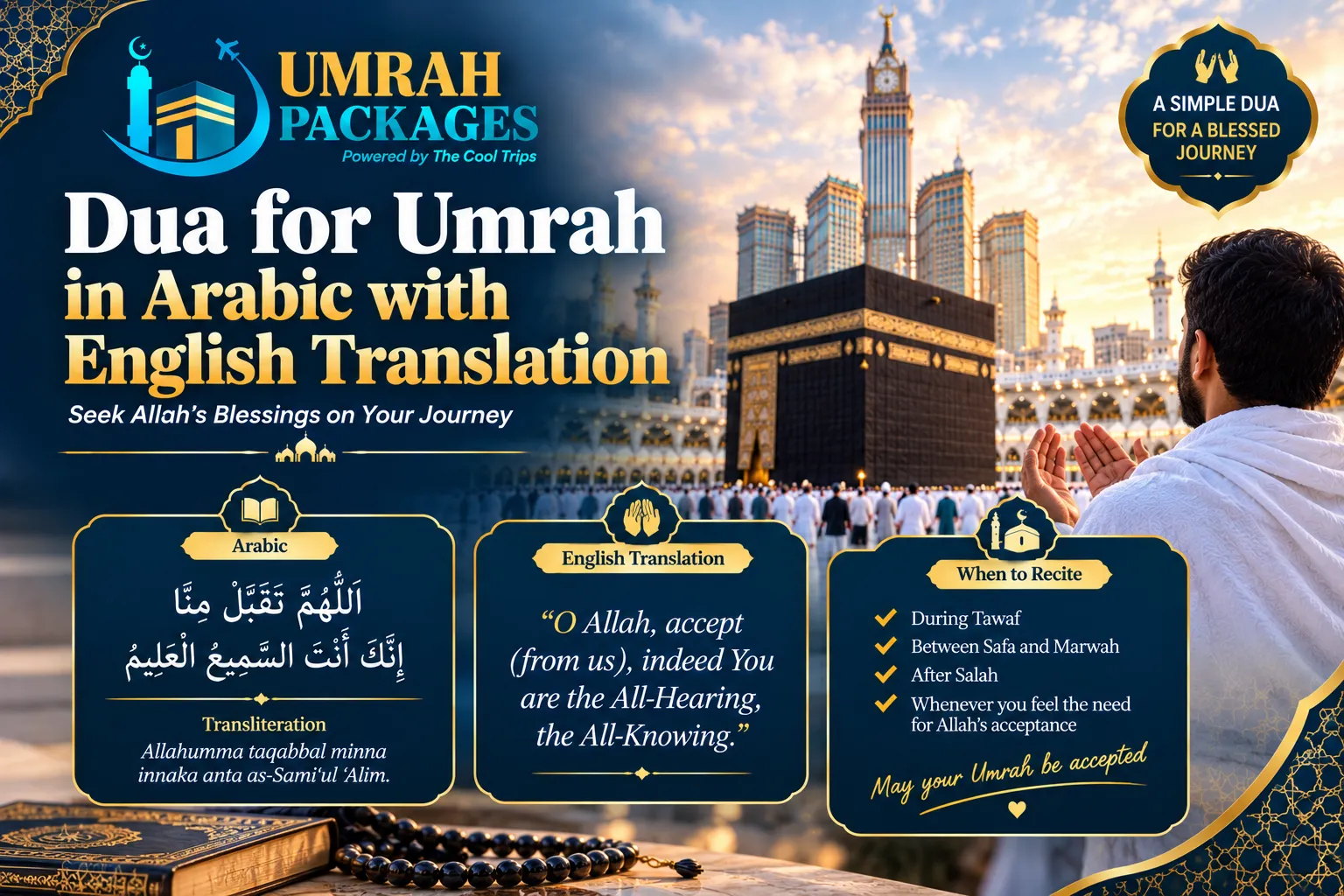
The main dua for Umrah is the talbiyah: “Labbayk Allahumma labbayk”, meaning “Here I am, O Allah, here I am”. But the phrase “dua for Umrah” also covers what comes before and after it: asking Allah for the chance to go, the farewell your family says, Ibrahim’s prayer for acceptance (Qur’an 2:127), and the return dua the Prophet ﷺ said coming home from Umrah (Bukhari 1797).
Most pages on this topic print a block of Arabic with a line of English under it. That’s fine for reading along, but it won’t tell you what each word means as you say it.
Here we’ve split the core Umrah duas into single words, so you can see what “Rabbana atina fid-dunya hasanah” is actually asking for. We’ve also added the duas around the trip (before you book, at the front door, on the way home), which the laminated cards usually leave out. If you’re after the rites in order, use our Umrah dua step-by-step guide. For a bigger library sorted by topic, there’s our complete Umrah duas guide.
Umrah needs surprisingly little Arabic. Below are the three passages pilgrims repeat most, taken apart word by word.
لَبَّيْكَ اللَّهُمَّ لَبَّيْكَ، لَبَّيْكَ لاَ شَرِيكَ لَكَ لَبَّيْكَ، إِنَّ الْحَمْدَ وَالنِّعْمَةَ لَكَ وَالْمُلْكَ، لاَ شَرِيكَ لَكَ
Labbayk Allahumma labbayk, labbayka la sharika laka labbayk, innal-hamda wan-ni’mata laka wal-mulk, la sharika lak.
“Here I am, O Allah, here I am. Here I am, You have no partner, here I am. All praise and all blessings are Yours, and all sovereignty. You have no partner.”
Source: Sahih al-Bukhari 1549 and Sahih Muslim 1184.
Arabic | Sounds like | Meaning |
لَبَّيْكَ | labbayk | here I am, answering You, again and again |
اللَّهُمَّ | Allahumma | O Allah |
لاَ شَرِيكَ لَكَ | la sharika lak | You have no partner |
إِنَّ | inna | truly |
الْحَمْدَ | al-hamd | all praise |
وَالنِّعْمَةَ | wan-ni’mah | and every blessing |
لَكَ | lak | belong to You |
وَالْمُلْكَ | wal-mulk | and all sovereignty |
Most grammarians, following Sibawayh, treat labbayk as a dual form. They explain that the doubling isn’t about the number two. It stresses repetition, so the sense is “I answer You, and answer You again”. “Here I am” is the usual English. “At Your service” is close too. But neither quite gets the feeling of someone who has been called by name and comes running.
Notice what the talbiyah doesn’t contain. No request. You aren’t asking for anything at the miqat. You’re turning up.
رَبَّنَا آتِنَا فِي الدُّنْيَا حَسَنَةً وَفِي الْآخِرَةِ حَسَنَةً وَقِنَا عَذَابَ النَّارِ
Rabbana atina fid-dunya hasanatan wa fil-akhirati hasanatan wa qina ‘adhaban-nar.
“Our Lord, give us good in this world and good in the Hereafter, and protect us from the punishment of the Fire.”
Source: Qur’an 2:201. Said between the Yemeni Corner and the Black Stone (Sunan Abi Dawud 1892, graded hasan by al-Albani, though some scholars weakened it), and the dua the Prophet ﷺ made most often (Sahih al-Bukhari 6389, Sahih Muslim 2690).
Arabic | Sounds like | Meaning |
رَبَّنَا | Rabbana | our Lord |
آتِنَا | atina | give us |
فِي الدُّنْيَا | fid-dunya | in this world |
حَسَنَةً | hasanah | something good |
وَفِي الْآخِرَةِ | wa fil-akhirah | and in the Hereafter |
حَسَنَةً | hasanah | something good |
وَقِنَا | wa qina | and shield us |
عَذَابَ النَّارِ | ‘adhaban-nar | from the punishment of the Fire |
It’s tempting to read “good in this world” as something vague. The classical commentator Ibn Kathir explained it as every worldly thing a person could want: good health, a spacious home, a good spouse, plentiful provision, useful knowledge, good deeds, an easy ride and a good name. All of that sits inside the single word hasanah, which is a lot to ask for in the few steps between the Yemeni Corner and the Black Stone.
اللَّهُ أَكْبَرُ، اللَّهُ أَكْبَرُ، اللَّهُ أَكْبَرُ، لاَ إِلَهَ إِلاَّ اللَّهُ وَحْدَهُ لاَ شَرِيكَ لَهُ، لَهُ الْمُلْكُ وَلَهُ الْحَمْدُ، يُحْيِي وَيُمِيتُ، وَهُوَ عَلَى كُلِّ شَيْءٍ قَدِيرٌ، لاَ إِلَهَ إِلاَّ اللَّهُ وَحْدَهُ، أَنْجَزَ وَعْدَهُ، وَنَصَرَ عَبْدَهُ، وَهَزَمَ الأَحْزَابَ وَحْدَهُ
Allahu akbar, Allahu akbar, Allahu akbar. La ilaha illallahu wahdahu la sharika lah, lahul-mulku wa lahul-hamd, yuhyi wa yumit, wa huwa ‘ala kulli shay’in qadir. La ilaha illallahu wahdah, anjaza wa’dah, wa nasara ‘abdah, wa hazamal-ahzaba wahdah.
“Allah is the Greatest (three times). There is no god but Allah alone, without partner. His is the dominion and His is the praise. He gives life and causes death, and He has power over all things. There is no god but Allah alone. He fulfilled His promise, helped His servant and defeated the confederates alone.”
Source: Sahih Muslim 1218, with “yuhyi wa yumit” from Sunan Abi Dawud 1905 and Sunan al-Nasa’i 2974 (both sahih). The three opening takbirs follow the Saudi Presidency’s Umrah guide; Muslim’s wording says he declared Allah’s oneness and greatness. Said three times on each hill, with your own dua in between.
Pilgrims tend to hurry the second half, so here it is phrase by phrase:
Arabic | Sounds like | Meaning |
أَنْجَزَ وَعْدَهُ | anjaza wa’dah | He fulfilled His promise |
وَنَصَرَ عَبْدَهُ | wa nasara ‘abdah | and helped His servant |
وَهَزَمَ الأَحْزَابَ | wa hazamal-ahzab | and defeated the confederates |
وَحْدَهُ | wahdah | by Himself alone |
“The confederates” are the tribes who besieged Madinah at the Battle of the Trench. The Prophet ﷺ said these words on Safa during his Farewell Hajj, two years after Makkah had been opened. Standing where he stood, praising Allah for promises already kept, is a good moment to bring your own unfinished worries.
The rest of the set wording in Umrah is short. Our step-by-step dua guide gives each one at the point you’ll need it, with its evidence.
Phrase | Meaning | Where |
Labbayka ‘umratan | Here I am for Umrah | At the miqat |
Allahummaftah li abwaba rahmatik | O Allah, open the gates of Your mercy for me | Entering the mosque |
Allahu akbar | Allah is the Greatest | At the Black Stone |
Wattakhidhu min maqami Ibrahima musalla | Take the standing place of Ibrahim as a place of prayer | Approaching Maqam Ibrahim |
Abda’u bima bada’allahu bih | I begin with what Allah began with | Approaching Safa, first time |
Allahumma inni as’aluka min fadlik | O Allah, I ask You of Your bounty | Leaving the mosque |
We couldn’t find a narrated dua specifically for being granted Umrah. Phrases like “Allahummarzuqni hajja baytik” circulate widely online, but none of the ones we checked traced back to a hadith collection. So ask in your own words, in whatever language you pray in at home.
Ibn Taymiyyah wrote that supplicating in languages other than Arabic is permissible, and outside the prayer you aren’t limited to narrated wording. Allah hears “Ya Allah, please let me see Your House this year” in Mirpuri just as clearly as in classical Arabic.
Many people longing for Makkah recite the dua Ibrahim made after leaving Hajar and Isma’il in the valley:
رَبَّنَا إِنِّي أَسْكَنْتُ مِنْ ذُرِّيَّتِي بِوَادٍ غَيْرِ ذِي زَرْعٍ عِنْدَ بَيْتِكَ الْمُحَرَّمِ رَبَّنَا لِيُقِيمُوا الصَّلَاةَ فَاجْعَلْ أَفْئِدَةً مِنَ النَّاسِ تَهْوِي إِلَيْهِمْ وَارْزُقْهُمْ مِنَ الثَّمَرَاتِ لَعَلَّهُمْ يَشْكُرُونَ
Rabbana inni askantu min dhurriyyati bi-wadin ghayri dhi zar’in ‘inda baytikal-muharram, rabbana li-yuqimus-salata faj’al af’idatan minan-nasi tahwi ilayhim warzuqhum minath-thamarati la’allahum yashkurun.
“Our Lord, I have settled some of my descendants in an uncultivated valley near Your sacred House, our Lord, that they may establish prayer. So make hearts among the people incline towards them, and provide for them from the fruits, that they might be grateful.”
Source: Qur’an 14:37.
Linking this verse to your own wish to visit is a personal reflection, not a ruling. And yet every pilgrim in Makkah today is, in a sense, part of the answer to “make hearts incline towards them”. Plenty of people find that a comforting thought.
There’s nothing narrated here, so treat this as a starting point, not a formula: “O Allah, invite me to Your House. Make the way easy, make the money halal and enough, keep my family safe while I’m gone, and accept it from me.” Add the names of the people you’d want to take with you.
Some people make this dua for years. A scholar answering exactly this worry once advised patience and good intention, reminding the questioner not to despair that a dua hasn’t been answered yet. A sincere intention to go is itself rewarded.
An Umrah payment plan with instalments spreads the cost over several months. Ask us on WhatsApp how ours works if you’d like the details.
First-timers often ask us what the hadith actually say about Umrah. These three come up most.
الْعُمْرَةُ إِلَى الْعُمْرَةِ كَفَّارَةٌ لِمَا بَيْنَهُمَا، وَالْحَجُّ الْمَبْرُورُ لَيْسَ لَهُ جَزَاءٌ إِلاَّ الْجَنَّةُ
Al-‘umratu ilal-‘umrati kaffaratun lima baynahuma, wal-hajjul-mabruru laysa lahu jaza’un illal-jannah.
“An Umrah is an expiation for what comes between it and the next, and an accepted Hajj has no reward but Paradise.”
Source: Sahih al-Bukhari 1773 and Sahih Muslim 1349.
The Prophet ﷺ told a woman who had missed Hajj that Umrah in Ramadan is equal to Hajj in reward (Sahih Muslim 1255; Sahih al-Bukhari 1782). Scholars explain it matches Hajj in reward, not in replacing the obligation. If Ramadan suits your family, our Ramadan Umrah packages page explains how far ahead to book.
تَابِعُوا بَيْنَ الْحَجِّ وَالْعُمْرَةِ فَإِنَّهُمَا يَنْفِيَانِ الْفَقْرَ وَالذُّنُوبَ كَمَا يَنْفِي الْكِيرُ خَبَثَ الْحَدِيدِ وَالذَّهَبِ وَالْفِضَّةِ
Tabi’u baynal-hajji wal-‘umrah, fa-innahuma yanfiyanil-faqra wadh-dhunuba kama yanfil-kiru khabathal-hadidi wadh-dhahabi wal-fiddah.
“Perform Hajj and Umrah one after the other, for they remove poverty and sins as the bellows removes impurity from iron, gold and silver.”
Source: Jami’ at-Tirmidhi 810 and Sunan al-Nasa’i 2631, graded hasan.
If cost is what’s holding you back, read this one twice. It isn’t a promise of sudden wealth. What it does say is that money spent on Hajj and Umrah isn’t money lost.
You don’t need istikhara to decide whether Umrah is good. It’s an act of worship, and Ibn Hajar, quoting Ibn Abi Jamrah, noted that obligatory and recommended acts aren’t the subject of istikhara. Where it helps is in the choices around Umrah: which month, which group, whether to take a child out of school, or whether a voluntary Umrah should wait while you deal with a family duty. Ibn Uthaymeen gave the same advice about voluntary Hajj and Umrah.
Pray two rak’ahs that aren’t fard, then say:
اللَّهُمَّ إِنِّي أَسْتَخِيرُكَ بِعِلْمِكَ وَأَسْتَقْدِرُكَ بِقُدْرَتِكَ، وَأَسْأَلُكَ مِنْ فَضْلِكَ الْعَظِيمِ، فَإِنَّكَ تَقْدِرُ وَلاَ أَقْدِرُ وَتَعْلَمُ وَلاَ أَعْلَمُ وَأَنْتَ عَلاَّمُ الْغُيُوبِ، اللَّهُمَّ إِنْ كُنْتَ تَعْلَمُ أَنَّ هَذَا الأَمْرَ خَيْرٌ لِي فِي دِينِي وَمَعَاشِي وَعَاقِبَةِ أَمْرِي فَاقْدُرْهُ لِي وَيَسِّرْهُ لِي ثُمَّ بَارِكْ لِي فِيهِ، وَإِنْ كُنْتَ تَعْلَمُ أَنَّ هَذَا الأَمْرَ شَرٌّ لِي فِي دِينِي وَمَعَاشِي وَعَاقِبَةِ أَمْرِي فَاصْرِفْهُ عَنِّي وَاصْرِفْنِي عَنْهُ، وَاقْدُرْ لِي الْخَيْرَ حَيْثُ كَانَ ثُمَّ أَرْضِنِي بِهِ
Allahumma inni astakhiruka bi-‘ilmika, wa astaqdiruka bi-qudratika, wa as’aluka min fadlikal-‘azim, fa-innaka taqdiru wa la aqdir, wa ta’lamu wa la a’lam, wa anta ‘allamul-ghuyub. Allahumma in kunta ta’lamu anna hadhal-amra khayrun li fi dini wa ma’ashi wa ‘aqibati amri, faqdurhu li wa yassirhu li thumma barik li fih. Wa in kunta ta’lamu anna hadhal-amra sharrun li fi dini wa ma’ashi wa ‘aqibati amri, fasrifhu ‘anni wasrifni ‘anh, waqdur liyal-khayra haythu kan, thumma ardini bih.
“O Allah, I ask You to guide my choice by Your knowledge, and to give me ability by Your power, and I ask You of Your great bounty. You have power and I have none. You know and I don’t. You are the Knower of the unseen. O Allah, if You know that this matter is good for me in my religion, my livelihood and how my affairs turn out, then decree it for me, make it easy for me and bless me in it. And if You know that this matter is bad for me in my religion, my livelihood and how my affairs turn out, then turn it away from me and turn me away from it, and decree for me what is good wherever it is, and make me content with it.”
Source: Sahih al-Bukhari 1166. When you reach “hadhal-amra” (“this matter”), name it, for example “booking Umrah for the February half term”.
People sometimes wait for a dream after istikhara. That isn’t required. Scholars advise going ahead with what seems best: if things fall into place, carry on, and if plans keep falling through, take that as your answer.
The Sunnah has three short farewell duas, and almost nobody uses them. Two are for the family to say to the traveller; the third either side can say.
أَسْتَوْدِعُ اللَّهَ دِينَكَ وَأَمَانَتَكَ وَخَوَاتِيمَ عَمَلِكَ
Astawdi’ullaha dinaka wa amanataka wa khawatima ‘amalik.
“I place your religion, your trusts and the last of your deeds in Allah’s keeping.”
Source: Sunan Abi Dawud 2600, graded sahih by al-Albani; Ibn Umar said it to a man named Qaza’ah as he set off, “as the Messenger of Allah ﷺ bid me farewell”.
Arabic | Sounds like | Meaning |
أَسْتَوْدِعُ اللَّهَ | astawdi’ullah | I entrust to Allah |
دِينَكَ | dinak | your religion |
وَأَمَانَتَكَ | wa amanatak | and your trusts (what you’re responsible for) |
وَخَوَاتِيمَ عَمَلِكَ | wa khawatima ‘amalik | and how your deeds end |
When seeing off a whole coach from the mosque car park, the plural form is used: “Astawdi’ullaha dinakum wa amanatakum wa khawatima a’malikum.”
There’s a second dua for the traveller, from a man who asked the Prophet ﷺ for something to take on his journey and kept asking for more:
زَوَّدَكَ اللَّهُ التَّقْوَى، وَغَفَرَ ذَنْبَكَ، وَيَسَّرَ لَكَ الْخَيْرَ حَيْثُمَا كُنْتَ
Zawwadakallahut-taqwa, wa ghafara dhanbak, wa yassara lakal-khayra haythuma kunt.
“May Allah give you taqwa as your provision, forgive your sins and make good easy for you wherever you are.”
Source: Jami’ at-Tirmidhi 3444, graded hasan.
It’s one of our favourites. The man asked for provision for the road and was given taqwa, which outlasts anything your aunt packs for the plane.
أَسْتَوْدِعُكَ اللَّهَ الَّذِي لاَ تَضِيعُ وَدَائِعُهُ
Astawdi’ukallahal-ladhi la tadi’u wada’i’uh.
“I leave you in the care of Allah, whose trusts are never lost.”
Source: Sunan Ibn Majah 2825, graded sahih by the Darussalam editors. In that hadith the Prophet ﷺ said it while seeing Abu Hurayrah off. Another report in Musnad Ahmad has the traveller saying it to those staying behind, and the commentator al-Munawi noted that each may say it to the other.
You might be saying it to parents too frail to travel, children staying with their grandparents, or a spouse keeping things going at home. Leaving them with Allah, whose trusts are never lost, makes the goodbye a little easier.
You’ll also say the everyday dua for leaving home and the travel dua as you set off. We haven’t repeated them here; they’re in full, with sources, in our step-by-step guide.
The best dua for acceptance is the one Ibrahim and Isma’il made while raising the walls of the Kaaba. You’ll be standing where they stood.
رَبَّنَا تَقَبَّلْ مِنَّا إِنَّكَ أَنْتَ السَّمِيعُ الْعَلِيمُ
Rabbana taqabbal minna innaka antas-Sami’ul-‘Alim.
“Our Lord, accept this from us. You are the All-Hearing, the All-Knowing.”
Source: Qur’an 2:127.
And the verse straight after it:
رَبَّنَا وَاجْعَلْنَا مُسْلِمَيْنِ لَكَ وَمِنْ ذُرِّيَّتِنَا أُمَّةً مُسْلِمَةً لَكَ وَأَرِنَا مَنَاسِكَنَا وَتُبْ عَلَيْنَا إِنَّكَ أَنْتَ التَّوَّابُ الرَّحِيمُ
Rabbana waj’alna muslimayni laka wa min dhurriyyatina ummatan muslimatan lak, wa arina manasikana wa tub ‘alayna, innaka antat-Tawwabur-Rahim.
“Our Lord, make us submissive to You, and from our descendants a nation submissive to You. Show us our rites and accept our repentance. You are the Accepting of repentance, the Merciful.”
Source: Qur’an 2:128.
“Show us our rites”, wa arina manasikana. A prophet asking to be shown how to worship. First-timers who worry about getting it wrong are in very good company.
Ibrahim’s dua in Surah Ibrahim has a line for the next generation:
رَبِّ اجْعَلْنِي مُقِيمَ الصَّلَاةِ وَمِنْ ذُرِّيَّتِي رَبَّنَا وَتَقَبَّلْ دُعَاءِ
Rabbij’alni muqimas-salati wa min dhurriyyati, rabbana wa taqabbal du’a’.
“My Lord, make me one who establishes prayer, and from my descendants. Our Lord, accept my supplication.”
Source: Qur’an 14:40.
Some parents say this at the Kaaba with their teenagers beside them, and the children tend to remember that moment long after the trip.
What you ask for at the Kaaba is up to you. These authentic duas cover the big themes, and you can add your own words to each.
اللَّهُمَّ إِنِّي أَسْأَلُكَ الْعَفْوَ وَالْعَافِيَةَ فِي الدُّنْيَا وَالآخِرَةِ
Allahumma inni as’alukal-‘afwa wal-‘afiyata fid-dunya wal-akhirah.
“O Allah, I ask You for pardon and wellbeing in this world and the Hereafter.”
Source: Sunan Ibn Majah 3871, graded sahih. Ibn Umar said the Prophet ﷺ never left this dua, morning or evening.
Scholars explain ‘afw as Allah erasing a sin entirely, so no trace of it remains, and ‘afiyah as being kept safe in your health, faith, family and wealth. If you only get a moment at the Multazam, it’s a sensible dua to choose.
رَبَّنَا لَا تُزِغْ قُلُوبَنَا بَعْدَ إِذْ هَدَيْتَنَا وَهَبْ لَنَا مِنْ لَدُنْكَ رَحْمَةً إِنَّكَ أَنْتَ الْوَهَّابُ
Rabbana la tuzigh qulubana ba’da idh hadaytana wa hab lana min ladunka rahmah, innaka antal-Wahhab.
“Our Lord, don’t let our hearts swerve after You have guided us, and grant us mercy from Yourself. You are the Giver.”
Source: Qur’an 3:8.
It’s common to come home feeling changed and find the feeling fading within weeks. This verse asks Allah to keep your heart steady after guidance.
رَبَّنَا لَا تُؤَاخِذْنَا إِنْ نَسِينَا أَوْ أَخْطَأْنَا رَبَّنَا وَلَا تَحْمِلْ عَلَيْنَا إِصْرًا كَمَا حَمَلْتَهُ عَلَى الَّذِينَ مِنْ قَبْلِنَا رَبَّنَا وَلَا تُحَمِّلْنَا مَا لَا طَاقَةَ لَنَا بِهِ وَاعْفُ عَنَّا وَاغْفِرْ لَنَا وَارْحَمْنَا أَنْتَ مَوْلَانَا فَانْصُرْنَا عَلَى الْقَوْمِ الْكَافِرِينَ
Rabbana la tu’akhidhna in nasina aw akhta’na. Rabbana wa la tahmil ‘alayna isran kama hamaltahu ‘alal-ladhina min qablina. Rabbana wa la tuhammilna ma la taqata lana bih. Wa’fu ‘anna, waghfir lana, warhamna. Anta mawlana fansurna ‘alal-qawmil-kafirin.
“Our Lord, don’t hold us to account if we forget or make mistakes. Our Lord, don’t lay on us a burden like the one You laid on those before us. Our Lord, don’t burden us with more than we can bear. Pardon us, forgive us and have mercy on us. You are our Protector, so help us against those who reject faith.”
Source: Qur’an 2:286.
رَبَّنَا اغْفِرْ لِي وَلِوَالِدَيَّ وَلِلْمُؤْمِنِينَ يَوْمَ يَقُومُ الْحِسَابُ
Rabbanaghfir li wa li-walidayya wa lil-mu’minina yawma yaqumul-hisab.
“Our Lord, forgive me, my parents and the believers on the Day the reckoning takes place.”
Source: Qur’an 14:41.
Then name them, aloud if you can; few people get through it dry-eyed. If your parents have passed away, ask for their graves to be made spacious and full of light. If they’re alive, ask for their health, and for you to be the kind of child they deserve.
Speak plainly here. “O Allah, give me a righteous spouse who will help me in my deen.” “O Allah, bless us with a child.” “O Allah, cure my mother’s illness.” “O Allah, give me halal work that covers my family’s needs.” Allah already knows what you need, but putting it into exact words helps you mean each one.
Write these on a single folded sheet before you fly, in the language you think in. Our packing list for Umrah has a spot for it, between the unscented soap and the spare ihram.
Asking someone going to Umrah to pray for you is permissible, and there’s a strong reason to do it. The Prophet ﷺ said that those performing Hajj and Umrah are “the delegation of Allah: if they call on Him He answers them, and if they ask His forgiveness He forgives them.”
الْحُجَّاجُ وَالْعُمَّارُ وَفْدُ اللَّهِ إِنْ دَعَوْهُ أَجَابَهُمْ وَإِنِ اسْتَغْفَرُوهُ غَفَرَ لَهُمْ
Al-hujjaju wal-‘ummaru wafdullah, in da’awhu ajabahum, wa inistaghfaruhu ghafara lahum.
Source: Sunan Ibn Majah 2892, graded hasan by the Darussalam editors. A similar report, Ibn Majah 2893, describes pilgrims as Allah’s delegation who asked Him and were given.
Three popular claims don’t hold up, and you’ll hear all of them at the airport.
None of that stops you asking. A pilgrim is a traveller, and the traveller’s dua is answered (Sunan Abi Dawud 1536, graded hasan). Just don’t pass on the weak versions as if they were sahih.
Write each name down as soon as someone asks. These requests are a trust, and by the time you reach the mataf you’ll have forgotten half of them. A running note on your phone, printed before you fly, works well.
The Prophet ﷺ had a specific dhikr for coming home from Hajj or Umrah. Ibn Umar reported that on every rise in the ground he would say “Allahu akbar” three times, then:
لاَ إِلَهَ إِلاَّ اللَّهُ وَحْدَهُ لاَ شَرِيكَ لَهُ، لَهُ الْمُلْكُ، وَلَهُ الْحَمْدُ، وَهُوَ عَلَى كُلِّ شَيْءٍ قَدِيرٌ، آيِبُونَ تَائِبُونَ عَابِدُونَ سَاجِدُونَ لِرَبِّنَا حَامِدُونَ، صَدَقَ اللَّهُ وَعْدَهُ، وَنَصَرَ عَبْدَهُ، وَهَزَمَ الأَحْزَابَ وَحْدَهُ
La ilaha illallahu wahdahu la sharika lah, lahul-mulku wa lahul-hamd, wa huwa ‘ala kulli shay’in qadir. Ayibuna, ta’ibuna, ‘abiduna, sajiduna, li-rabbina hamidun. Sadaqallahu wa’dah, wa nasara ‘abdah, wa hazamal-ahzaba wahdah.
“There is no god but Allah alone, without partner. His is the dominion and His is the praise, and He has power over all things. We return, repenting, worshipping, prostrating and praising our Lord. Allah kept His promise, helped His servant and defeated the confederates alone.”
Source: Sahih al-Bukhari 1797, in the Book of Umrah, under the chapter on what to say when returning from Hajj, Umrah or a campaign.
Arabic | Sounds like | Meaning |
آيِبُونَ | ayibun | returning |
تَائِبُونَ | ta’ibun | repenting |
عَابِدُونَ | ‘abidun | worshipping |
سَاجِدُونَ | sajidun | prostrating |
لِرَبِّنَا حَامِدُونَ | li-rabbina hamidun | praising our Lord |
You won’t pass many hills on the flight home, so most people say it as they set off and again at their front door.
There’s no fixed sunnah greeting for someone returning from Umrah. Scholars permit congratulating them, as long as no particular wording is treated as a sunnah. Shafi’i jurists recommended “Taqabbalallahu hajjaka, wa ghafara dhanbaka, wa akhlafa nafaqatak” for returning pilgrims. Adapted for Umrah, it reads:
تَقَبَّلَ اللَّهُ عُمْرَتَكَ، وَغَفَرَ ذَنْبَكَ، وَأَخْلَفَ نَفَقَتَكَ
Taqabbalallahu ‘umrataka, wa ghafara dhanbaka, wa akhlafa nafaqatak.
“May Allah accept your Umrah, forgive your sins and replace what you spent.”
“Umrah Mubarak” and “Taqabbal Allah” are fine too. They’re good wishes, nothing more and nothing less. Musannaf Ibn Abi Shaybah even has a chapter on what to say to someone back from Umrah, where the Successor Abu Qilabah greets a man back from Umrah with “burra al-‘amal, burra al-‘amal”, roughly “may the deed be accepted” (no. 16552).
The returning dua says “repenting, worshipping”, words that work as a plan for the weeks after you land. Choose one habit from the trip and keep it up at home.
English translations of Umrah duas often drift, and some add words that aren’t in the Arabic. These are the slips we see most often.
You’ll see “O Allah, I am coming” in some booklets. It’s well meant, but it loses the sense of answering a call. Labbayk is a reply, not a travel update. “Here I am” or “At Your service” is closer.
It’s an indefinite noun: a good thing, something good. “Give us good in this world” or “give us what is good” keeps the sense. “Give us goodness” makes it sound like a feeling.
Some booklets add lines to the Safa dhikr that aren’t in the hadith. If a translation runs noticeably longer than the Arabic, check it against a reliable edition.
A common one: the return dua printed with “sajidun” in the English letters but missing from the Arabic above it, or the other way round. Both forms exist in different chains of Bukhari, so neither is wrong, but the Arabic and the transliteration should match each other.
The hadith Arabic on this page comes from the collections as published on sunnah.com, and we checked the reference numbers and gradings there. Qur’anic Arabic comes from a standard edition, with the English adapted from the Saheeh International translation so it reads naturally. Each grading comes from Shaykh al-Albani or from the Darussalam editors whose grades sunnah.com displays, and we’ve said which where it matters.
On the doubtful reports about pilgrims, the verdicts come from the Dorar hadith encyclopaedia, which gathers the views of al-Albani, Shu’ayb al-Arna’ut and Ahmad Shakir in one place. The note on istikhara comes from Ibn Hajar’s Fath al-Bari and a fatwa of Ibn Uthaymeen. The word-by-word tables are our own, kept as literal as English allows.
We’re an Umrah agency, not a fatwa body. If something here touches your own madhhab, especially on greetings or istikhara, ask a scholar you trust.
The central dua for Umrah is the talbiyah: “Labbayk Allahumma labbayk, labbayka la sharika laka labbayk, innal-hamda wan-ni’mata laka wal-mulk, la sharika lak.” In English: here I am, O Allah, here I am; You have no partner; all praise, blessings and sovereignty are Yours. It comes from Sahih al-Bukhari 1549 and Sahih Muslim 1184.
It means “Here I am, O Allah, here I am”, in the sense of answering a call. “Labbayk” is a dual form in Arabic that stresses repetition, so it carries the idea of responding again and again. Some translators prefer “At Your service, O Allah”. Both are closer than “I am coming”, which you’ll sometimes see printed.
“Our Lord, give us good in this world.” The full verse, Qur’an 2:201, continues “and good in the Hereafter, and protect us from the punishment of the Fire.” Ibn Kathir explained that “good in this world” includes health, a home, a righteous spouse, provision, knowledge and good deeds, so it’s a very wide request.
“He fulfilled His promise and helped His servant.” It’s part of the dhikr on Safa and Marwah from Sahih Muslim 1218. The line continues “wa hazamal-ahzaba wahdah”, He defeated the confederates alone, which refers to the tribes that besieged Madinah at the Battle of the Trench.
“I place your religion in Allah’s keeping.” The full farewell, “Astawdi’ullaha dinaka wa amanataka wa khawatima ‘amalik”, adds your trusts and the last of your deeds. Ibn Umar used it to see people off, saying the Prophet ﷺ had bid him farewell the same way (Abu Dawud 2600). It’s ideal at the airport or the mosque car park.
“Rabbana taqabbal minna innaka antas-Sami’ul-‘Alim”, our Lord, accept this from us (Qur’an 2:127), followed by 2:128, which asks Allah to make us and our children submissive to Him, show us our rites and accept our repentance. Ibrahim and Isma’il said it while raising the Kaaba’s foundations, a few metres from where you’ll stand.
Both, if you can, but meaning matters more than most people think. Reciting the talbiyah while knowing that you’re answering a call feels completely different. Start with the three core texts on this page, plus the dua for entering the mosque. A week of five minutes a day is usually enough.
Yes. Plenty of British Muslims read duas from transliteration, and Allah accepts sincere effort. Try to listen to the talbiyah and the Safa dhikr recited a few times before you go, so the sounds are familiar. For personal dua, you don’t need Arabic at all.
No specific dua for this is narrated in the hadith collections. Ask Allah in your own words and language, as often as you like. Many people also recite Ibrahim’s dua in Qur’an 14:37, “make hearts among the people incline towards them”, and couple it with a practical plan to save or book.
You don’t need istikhara to decide whether Umrah is good, since it’s an act of worship. Scholars say istikhara is for the choices around it: which month, which group, which package, or whether to delay a voluntary Umrah for a family commitment. Pray two rak’ahs and recite the dua from Sahih al-Bukhari 1166.
The sunnah farewell is “Astawdi’ullaha dinaka wa amanataka wa khawatima ‘amalik”: I place your religion, your trusts and the last of your deeds in Allah’s keeping (Abu Dawud 2600). You can add “Zawwadakallahut-taqwa, wa ghafara dhanbak, wa yassara lakal-khayra haythuma kunt” from Tirmidhi 3444. Then ask them to remember you in their duas.
“Astawdi’ukallahal-ladhi la tadi’u wada’i’uh”: I leave you in the care of Allah, whose trusts are never lost. It’s from Sunan Ibn Majah 2825, graded sahih. Al-Munawi noted that either the traveller or the person staying behind can say it, so it’s fine whichever way round you use it.
Nothing is narrated specifically for it. Ask for halal provision and barakah in your own words, and use “Allahumma inni as’aluka min fadlik”, I ask You of Your bounty, from the mosque-exit dua in Muslim 713. Tirmidhi 810 says Hajj and Umrah remove poverty, which helps when the budget feels tight.
Settle debts or tell someone about them, ask family to forgive any wrongs, and write your dua list. Say the dua for leaving home at the door and the travel dua as you set off. Make sure your passport, visa and Nusuk details are sorted well before the day so you can travel calmly.
There’s no single “best” one, but two stand out. “Rabbana atina…” was the Prophet’s most frequent dua, and “Allahumma inni as’alukal-‘afwa wal-‘afiyah fid-dunya wal-akhirah” (Ibn Majah 3871) covers pardon and wellbeing in both worlds. After those, ask for what you personally need, in plain words.
Recite “Rabbanaghfir li wa li-walidayya wa lil-mu’minina yawma yaqumul-hisab” (Qur’an 14:41) and “Rabbirhamhuma kama rabbayani saghira” (17:24). Then name them and ask for specific things: health, ease, forgiveness, or for those who’ve passed away, mercy in the grave. Many people dedicate a whole circuit to their parents.
No dua for marriage is fixed to the Kaaba. Ask directly in your own words for a righteous spouse who will help your deen. The Qur’anic dua “Rabbana hab lana min azwajina wa dhurriyyatina qurrata a’yun” (25:74) is often recited, as it asks for comfort in spouses and children.
For those hoping for children, ask Allah plainly. For children you already have, Ibrahim’s dua “Rabbij’alni muqimas-salati wa min dhurriyyati” (14:40), asks that you and your descendants keep up the prayer. Hard to think of a better one for a parent. Saying it with your children standing beside you is something they tend to remember.
“Rabbana taqabbal minna innaka antas-Sami’ul-‘Alim”, our Lord, accept this from us, You are the All-Hearing, the All-Knowing (Qur’an 2:127). Ibrahim and Isma’il said it while building the Kaaba. The next verse, 2:128, adds “show us our rites and accept our repentance”, which suits pilgrims worried they’ve made mistakes.
Yes. Name them and ask Allah for their cure. The dua for pardon and wellbeing fits, and so does the Zamzam dua attributed to Ibn Abbas, which asks for “shifa’an min kulli da'”, healing from every illness, though its chain is weak. Keep the request specific.
You can pray for their guidance and their wellbeing in this life. Asking forgiveness for someone who died as a non-Muslim is not permitted, according to the Qur’an (9:113), but praying for the living to be guided is fine. Many reverts ask for exactly this for their families.
Say “Allahu akbar” three times, then “La ilaha illallahu wahdahu la sharika lah… ayibuna, ta’ibuna, ‘abiduna, sajiduna, li-rabbina hamidun, sadaqallahu wa’dah, wa nasara ‘abdah, wa hazamal-ahzaba wahdah.” It’s in Sahih al-Bukhari 1797, in the chapter on returning from Hajj or Umrah. Say it as you set off home and when you arrive.
There’s no fixed sunnah greeting. “Taqabbalallahu ‘umrataka, wa ghafara dhanbaka, wa akhlafa nafaqatak”, may Allah accept your Umrah, forgive your sins and replace what you spent, follows a wording recommended by Shafi’i scholars. “Umrah Mubarak” and “Taqabbal Allah” are also fine as good wishes.
It means “blessed Umrah”, a simple congratulation for someone who has done or is about to do Umrah. It isn’t a narrated phrase, and there’s no special reward attached to it, but scholars permit congratulating pilgrims in any good words. “Taqabbal Allah”, may Allah accept it, says the same thing as a dua.
“May Allah accept it.” People say it to pilgrims, and to each other after Ramadan and Eid, as a short dua that the worship is accepted. The fuller “Taqabbal Allahu minna wa minkum” means “may Allah accept from us and from you”. It’s a good wish rather than a fixed sunnah phrase. You can’t really go wrong with it.
It isn’t a sunnah, but scholars say a meal to thank Allah for a safe return is permissible, as long as nobody treats it as required or overspends. Many UK families invite relatives round for dates and Zamzam. Keep it simple and avoid turning it into an obligation for those with less.
We couldn’t find any narration supporting the “40 days” idea. What is authentic is that those performing Hajj and Umrah are the delegation of Allah whose duas are answered (Ibn Majah 2892 and 2893, graded hasan by the Darussalam editors), and that the traveller’s dua is answered (Abu Dawud 1536). So ask them during the trip.
You can ask anyone for dua, but the specific narration telling you to ask a returning pilgrim before he enters his house is graded fabricated by al-Albani and very weak by others. Ask them before they leave, so they remember you while they’re travelling, since that’s when the authentic evidence about answered duas applies.
Choose something small and repeatable rather than something heroic: a regular prayer at the mosque, a page of Qur’an, a weekly sadaqah. Recite “Rabbana la tuzigh qulubana ba’da idh hadaytana” (3:8), asking Allah not to let your heart slip. And plan the next visit; having a date to aim for helps more than people expect.
Yes. A woman on her period can say the talbiyah and make all the dhikr and dua in this guide. She waits only for tawaf, and normally sa’i, until she’s pure (Sahih al-Bukhari 294). Most scholars say she shouldn’t recite the Qur’an aloud, so Qur’anic duas can be said as supplication rather than recitation.
Yes. A child can enter ihram, say the talbiyah and have a valid, rewarded Umrah (compare the child’s Hajj in Sahih Muslim 1336), though scholars who hold Umrah obligatory say it doesn’t replace the adult one. Explaining it simply, “Here I am, Allah!”, sticks better than drilling Arabic.
No dua is narrated specifically for landing. The travel dua you said on departure covers the journey, and if you’re going straight to Makkah you should already be in ihram and saying the talbiyah by then, since the plane crosses the miqat before landing.
Yes. It’s allowed, though many pilgrims find a printed sheet less distracting. If you use your phone, put it on airplane mode and make the text large. Keep the duas you’ll say at fixed points memorised if possible, as stopping to scroll in a crowd isn’t easy.
No. Your Umrah is valid without any memorised Arabic beyond what you can manage. The talbiyah is at least a strongly emphasised sunnah, and Hanafi scholars treat it as part of entering ihram. The fixed phrases are best said in Arabic, but your personal duas can be in English, Urdu, Bengali, Somali or any language you speak.
Short enough to read in one sitting, usually a single side of paper. Group it by yourself, family, friends, the people who asked, and the ummah. Long lists tend to get skimmed, while a short, specific list gets prayed with real attention, and you can repeat it on different days.
A dua is a request: you’re asking Allah for something. A dhikr is remembrance: praising and glorifying Allah, like “SubhanAllah” or the talbiyah. Umrah has both. The talbiyah and the Safa words are mostly dhikr, while “Rabbana atina” and your personal requests are duas.
No dua is narrated for the Multazam, the wall between the Black Stone and the Kaaba door. Ibn Abbas is reported to have pressed himself against it, though the reports traced to the Prophet ﷺ are weak. Reaching it is hard in the crowds, and the same dua from further back loses nothing.
If you’ve been asking Allah for years to invite you, we’d be glad to help you plan the trip. We arrange Umrah from airports across the UK, with hotels close enough to walk to every prayer, so you’ve got time for all the duas on this page. Send us a WhatsApp message with your airport and preferred months.
Not sure when to go? Our guide to the best month for Umrah from the UK compares weather, crowds and prices. Families often start with our 4 star Umrah packages, and you’ll find every departure on our Umrah packages from the UK page. Before you book, check the Umrah visa requirements for 2027 and what the Nusuk permit involves.
We’re Packages Umrah, based at 7 Huxley Avenue, Manchester M8 0SJ. Our team helps British Muslims plan Umrah in English and Urdu, from first enquiry to the drive home from the airport. Call us on +44 7737 144335 or message us on WhatsApp. We wrote this page because pilgrims often ask us for the Arabic of these duas but rarely for what they mean, and the meaning is what makes them stay with you.
This guide explains the duas and the evidence behind them. It isn’t a fatwa, and scholars may differ on gradings and details. Check matters of your own madhhab with a scholar you trust.
Verified Umrah Travel Specialist
Written By: Azeem Ali
A seasoned Umrah travel specialist with more than 10 years of experience in planning and managing Umrah journeys. Every article is carefully prepared by Azeem Ali, drawing on years of expertise in assisting thousands of pilgrims from the UK. Our goal is to provide reliable, up-to-date, and practical guidance to help you confidently prepare for your sacred journey.
PACKAGES UMRAH
SERVICES FROM UK

Latest Articles