

Before a single step of Tawaf. Before the first lap of Sa’i. Before you set eyes on the Kaaba for the first time — you are already in a state of worship. That state is called Ihram, and for most UK Muslims preparing for Umrah, it is also one of the most misunderstood parts of the entire journey.
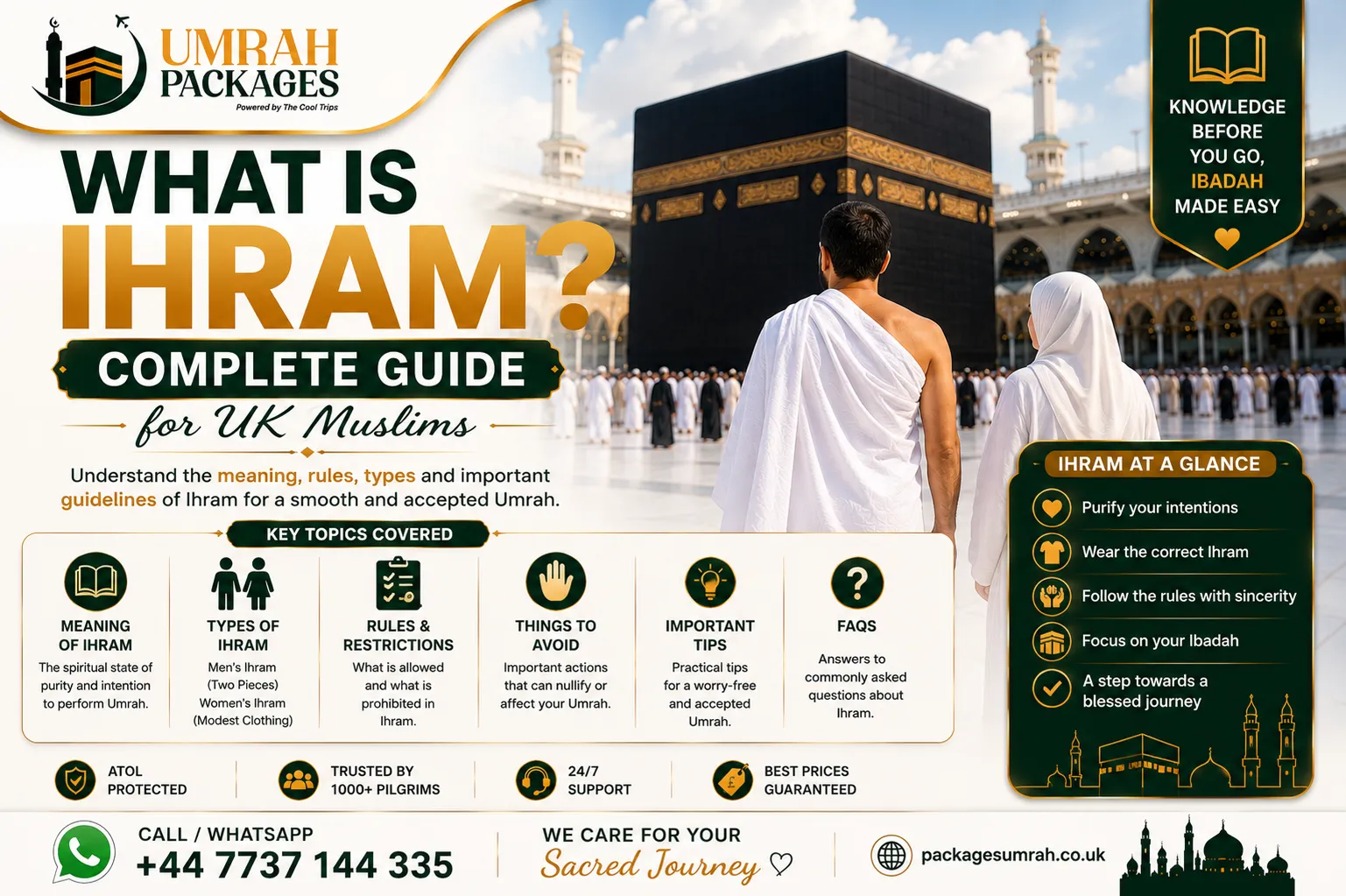
Ihram is not simply a white cloth. It is a sacred state of spiritual purity and intention that a Muslim enters before performing Hajj or Umrah. Everything from the moment of intention to the moment of its release — every step, every dua, every Talbiyah — is ibadah (worship) in its purest form.
This guide covers everything UK pilgrims need to know: what Ihram is, how to enter it correctly, what men and women wear, the Miqat points relevant to UK departures, the full list of prohibitions, what happens if you break Ihram, and practical airport tips. Everything in one place, written clearly for first-time and returning UK pilgrims.
The word Ihram (إحرام) is derived from the Arabic root h-r-m, which conveys the meaning of something being made sacred or prohibited. When a pilgrim enters Ihram, they are entering a consecrated state — declaring themselves set apart from the ordinary world and dedicated entirely to the worship of Allah.
Ihram has two inseparable components: the outer garments (what you wear on your body) and the inner state (your intention, your conduct, and your observance of the sacred restrictions). You cannot have one without the other. A man who wears the white cloth but has not made his intention has not entered Ihram. A person who makes the intention but has not put on the correct garments has also not entered Ihram correctly.
Many people — particularly those new to Umrah — think of Ihram as simply the white outfit men wear. This is only half the picture. The garments mark the outer entry into Ihram, but the state itself is a complete transformation of how you carry yourself: how you speak, what you touch, how you interact with other people, what you apply to your body, and how you focus your entire being on Allah.
The Prophet ﷺ described the person in Ihram as being in a state comparable to someone before Allah on the Day of Judgement — stripped of worldly adornment, equal to every other believer, distinguished by nothing but taqwa (God-consciousness).
Direct Answer: Ihram must be entered before crossing the Miqat — the designated geographical boundary around Makkah. For UK pilgrims, this typically happens at the airport before departure, during the flight when the Miqat boundary is crossed, or at the Miqat location itself if travelling by land from Madinah.
The Miqat (ميقات) refers to the five designated points around Makkah beyond which no pilgrim intending Hajj or Umrah may pass without having entered Ihram. These boundaries were set by the Prophet ﷺ himself, and they apply whether you are travelling by land, sea, or air.
There are five Miqat points, each serving a different direction of travel. For UK Muslims, the two most relevant are:
Jeddah is inside the Miqat boundary — meaning you cannot land in Jeddah and then put on Ihram at the airport. You must be in Ihram before the plane crosses the Miqat boundary in the air.
Most UK airlines carrying Umrah pilgrims make an in-flight announcement approximately 30–45 minutes before crossing the Miqat. At this point, passengers who have not yet entered Ihram should do so immediately. The majority of experienced pilgrims and scholars advise entering Ihram at the UK departure airport, before the flight takes off, to eliminate any risk of missing the Miqat while asleep or caught off-guard.
UK Pilgrim Tip: Put your Ihram garments on at the airport departure lounge before your flight to Jeddah. Change in the airport bathroom before check-in. This is the safest, most stress-free approach — and the position recommended by the majority of UK Islamic scholars.
Many UK Umrah packages — particularly 10 nights, 12 nights, and 14 nights packages — include a stay in Madinah either before or after Makkah. If you visit Madinah first, you do not enter Ihram when you land in Madinah. Madinah is outside the Miqat, and Madinah itself has no Ihram restrictions.
When you are ready to travel from Madinah to Makkah, you will pass through Dhul Hulayfah (Abyar Ali). This is your Miqat. You enter Ihram at the mosque there — Masjid al-Shajarah — before your bus continues toward Makkah. Most Umrah operators and group leaders will ensure passengers are reminded and given time to change and make their intention.
Direct Answer: If you cross the Miqat without being in Ihram — through forgetfulness, ignorance, or falling asleep — you must return to the Miqat to enter Ihram from there if possible. If returning is not possible, you must offer a dam (slaughter a sheep or goat in Makkah) as expiation. Scholars are unanimous that missing the Miqat without Ihram is a serious omission that requires either return or dam.
Entering Ihram correctly is a sequence of physical preparation, intention, and verbal declaration. Follow these steps precisely.
Before putting on the Ihram garments, the following are Sunnah actions that the Prophet ﷺ performed before entering Ihram:
Important: Do all grooming, nail-clipping, and body perfume application BEFORE putting on Ihram garments. Once dressed in Ihram and intention made, these acts become prohibited.
Men: Wrap the izar (lower sheet) around your waist from the navel downward, covering to below the knee. Drape the rida (upper sheet) over your left shoulder and across your chest and back. The right shoulder should be covered at this stage — it is only uncovered (Idtiba) specifically during Tawaf, not throughout Ihram.
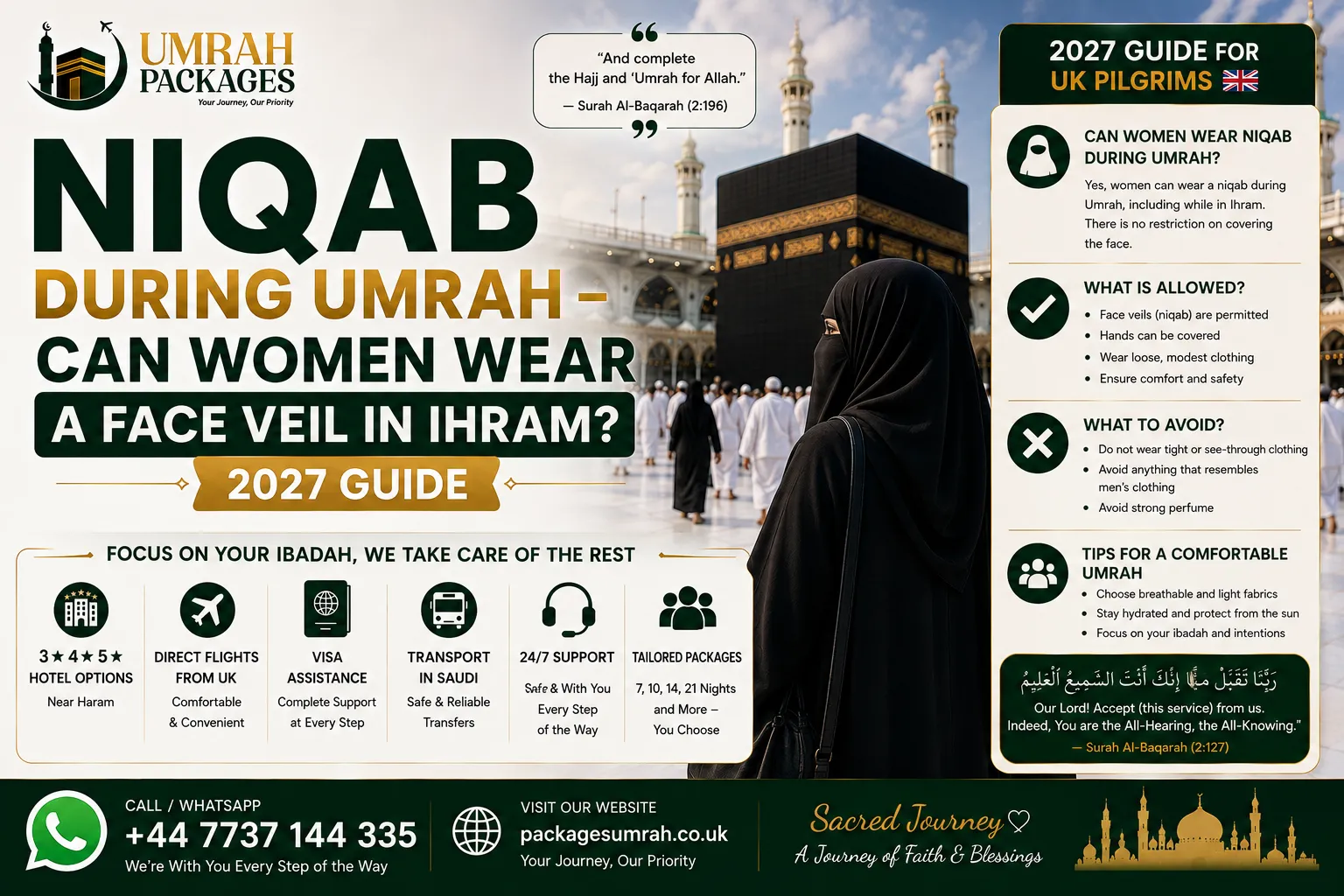
Women: Wear your normal Islamic dress — a long, loose garment that covers everything except face and hands. There is no special Ihram clothing for women. The colour can be any modest colour, though white or neutral colours are common. Women in Ihram do NOT wear niqab (face veil) or gloves, according to the majority of scholars.
Before making your intention, pray two rak’ahs of nafl (voluntary) prayer. Cover your head for this prayer (men). Recite Surah al-Kafirun in the first rak’ah and Surah al-Ikhlas in the second. This prayer is Sunnah — it is not obligatory for Ihram to be valid, but it is the established practice of the Prophet ﷺ.
If you are at an airport where there is a prayer facility, pray there. If you are entering Ihram on the plane, pray sitting if standing is not possible — the intention of Ihram and Talbiyah are what matter.
After your two rak’ahs, make your intention — niyyah — for the specific worship you are entering:
“Allahumma inni uridu al-Umrata fasahilha li wa taqabbalha minni.”
(O Allah, I intend to perform Umrah, so make it easy for me and accept it from me.)
The niyyah is primarily an act of the heart — you are declaring internally what you are about to begin. Saying it aloud in Arabic is not obligatory; making it clearly in your mind is sufficient.
After the niyyah, recite the Talbiyah aloud. This is the verbal signal that you have entered Ihram. From this moment, all Ihram restrictions apply.
The Talbiyah:
Labbayk Allahumma labbayk, labbayka la sharika laka labbayk,
Innal-hamda wan-ni’mata laka wal-mulk, la sharika lak.
Translation: Here I am, O Allah, here I am. Here I am — You have no partner — here I am. Truly all praise and favour belong to You, and all sovereignty — You have no partner.
Men recite the Talbiyah aloud. Women recite it quietly, audible only to themselves. Continue reciting the Talbiyah frequently throughout Ihram — especially when moving between different locations, climbing or descending, and when seeing other pilgrims.
Men’s Ihram consists of two pieces of cloth that are unstitched (uncut and unsewn):
Both pieces should be clean, white, and free of any stitching (sewn borders are fine — ‘unstitched’ means it is not shaped or tailored into a garment like a shirt or trousers). Pre-made Ihram sets are widely available in the UK from Islamic clothing shops and online, typically costing between £8 and £25 for a standard cotton set.
Direct Answer: White is strongly recommended and is the Sunnah — the Prophet ﷺ said: ‘Wear white garments, for they are the purest of your garments, and shroud your dead in them.’ (Abu Dawud, Tirmidhi). White is the near-unanimous choice of scholars and pilgrims. While some scholars permit other colours, the consensus and practice of the ummah is white, and there is no good reason for a UK pilgrim to choose otherwise.
Note: Wearing an umbrella strap across the shoulder, carrying a bag on the shoulder, or wearing eyeglasses is all permissible. These are not ‘stitched garments’ worn for coverage.
Men must wear sandals or footwear that leaves the heel and the top of the foot exposed, with the ankle bones visible. Flip-flops, open sandals, and Ihram-specific sandals all qualify. Some scholars of the Maliki school allow men to wear shoes that cover the ankle if sandals are genuinely unavailable, but this is the minority position — sandals are the established Sunnah.
Women’s Ihram is significantly different from men’s — not in the spirit or the intention, but in the physical garments and certain rules. A woman’s Ihram is her normal Islamic dress. There is no equivalent of the white two-piece for women.
Direct Answer: Women wear their regular, modest Islamic clothing — a long, loose dress or abaya that covers the entire body except face and hands. There is no prescribed colour, no prescribed style, and no requirement for it to be unstitched. The clothing must be clean, modest, and not tight-fitting or perfumed.
Direct Answer: The Prophet ﷺ prohibited women from wearing niqab (face veil) or gloves in Ihram: ‘A woman in Ihram should not wear a niqab or gloves.’ (Bukhari). This is the position of the majority of scholars — the Shafi’i, Maliki, and Hanbali schools. However, if a non-Mahram man is nearby, the majority also hold that a woman should cover her face with the edge of her khimar (headscarf) — this is not a niqab but a situational covering.
The Hanafi school holds that a woman must cover her face even in Ihram using a device that keeps the cloth away from touching her face (like a frame or loose draping). UK Hanafi pilgrims should follow their own scholarly guidance on this specific issue.
Yes. Women may wear any modest, non-perfumed colour. Black, white, grey, navy, dark green — all are permissible. Many UK women pilgrims choose black abayas. The key conditions are modesty, cleanliness, and absence of perfume — colour is not restricted.
Women have no special footwear restriction in Ihram. They may wear closed shoes, boots, or open sandals as they prefer. The sandal restriction applies to men only.
Yes, women may wear jewellery in Ihram — rings, bracelets, necklaces. However, they should not display it in a way that attracts non-Mahram attention. Perfumed jewellery or jewellery recently sprayed with perfume should be avoided.
The Talbiyah is the verbal declaration that marks a pilgrim’s entry into Ihram and their response to Allah’s call. It comes from the root labba — meaning ‘to respond’ or ‘to be present.’ When pilgrims recite ‘Labbayk Allahumma labbayk’ (Here I am, O Allah, here I am), they are answering the call of Ibrahim (AS) — who, when Allah commanded him to call people to Hajj, called out and Allah promised his call would reach every soul that would come to Hajj until the Day of Judgement.
Direct Answer: For Umrah: stop reciting the Talbiyah when you reach the Black Stone and begin your first circuit of Tawaf. For Hajj: stop the Talbiyah at the moment of the first stone-throwing at Jamarat al-Aqabah on the 10th of Dhul Hijjah (Yawm al-Nahr).
The restrictions of Ihram are called the Muharramat al-Ihram (محرمات الإحرام). Scholars count between 9 and 14 prohibitions depending on madhab and classification. Below is the complete list, separated clearly for men and women.
Any application of perfume, cologne, scented lotion, scented soap, scented shampoo, or fragrant oil is prohibited once Ihram is entered. Unscented products — unscented soap, unscented wet wipes, unscented deodorant — are permitted. This is one of the most commonly violated restrictions by first-time UK pilgrims.
No hair from any part of the body may be cut, shaved, plucked, or removed. Nails may not be trimmed. Even a single hair falling out due to intentional scratching or combing is technically a violation (though a minor one). This is why all grooming must be completed before entering Ihram.
Sexual intercourse in Ihram is one of the most serious violations. It invalidates the Umrah or Hajj entirely and requires a dam (sacrifice) as well as completing the rites and then repeating the entire Hajj or Umrah in the following year. Intimate touching, kissing, or foreplay with sexual intent is also prohibited.
Concluding a marriage contract in the state of Ihram is not valid. The Prophet ﷺ said: ‘A person in Ihram should not marry, nor facilitate the marriage of another, nor propose marriage.’ (Muslim). Existing marriages are not affected — this prohibition is about conducting a new Nikah.
Hunting wild land animals or assisting someone else in hunting — including pointing out prey — is prohibited in Ihram. Sea creatures (fish) are not included in this prohibition. Killing harmful animals such as rats, snakes, and scorpions is permitted.
This applies within the boundaries of the Haram area, not just during Ihram. However, it is a related and frequently asked about restriction for pilgrims.
Men may not wear shirts, trousers, underwear, vests, socks, gloves, or any garment that has been cut and sewn to fit the shape of a body part. The izar and rida are unstitched sheets — not tailored garments.
Men may not wear anything on their head that covers it — caps, hats, hoods, turbans, or wrapped cloths. If rain begins, an umbrella is permitted (held above the head), but a hat or cap worn on the head is not. Carrying a bag on the head briefly (e.g. while loading luggage) carries a scholarly difference of opinion; avoid it when possible.
Men must wear footwear that leaves the heel and the top of the foot exposed with the ankle bones visible. If sandals are not available, the Hanafi school permits wearing shoes with the back cut open.
Women in Ihram may not wear the niqab — a garment worn specifically as a face covering. The majority position is that the face remains uncovered in Ihram; the face may be covered with the edge of the khimar if non-Mahram men are nearby, as long as the cloth is not held against the face.
Women may not wear gloves in Ihram. Their hands remain uncovered. If it is cold, warming the hands within the loose sleeves of a garment is permissible.
Sunglasses: Permitted — they rest on the nose and ears, not on the head like a covering.
Mobile phones and earphones: Permitted — using technology carries no Ihram restriction.
Umbrellas (held in hand): Permitted for both men and women to shield from sun or rain.
Waist bags and body bags: Permitted — bags worn around the body are not ‘stitched garments’ in the prohibited sense.
Watches worn on the wrist: Permitted — this is not a garment prohibition.
When an Ihram restriction is violated, the consequence depends on the severity and type of the act. Scholars categorise violations into three levels of response.
A dam (slaughter of a sheep or goat in Makkah) is required for:
Fidyah is a lesser expiation — either fasting three days, or feeding six poor people, or slaughtering an animal — for lesser violations like:
Sexual intercourse before the completion of the main rites (before Tawaf al-Ifadah in Hajj, or before Tawaf in Umrah) invalidates the entire act of worship. In this case, the pilgrim must:
Forgiveness Principle: Acts done out of genuine forgetfulness, ignorance, or compulsion are treated with greater leniency. The Prophet ﷺ said: ‘Allah has forgiven my ummah for mistakes, forgetfulness, and what they are compelled to do.’ (Ibn Majah). Still seek scholarly advice if a violation occurs.
Direct Answer: Yes. Showering in Ihram is permitted. You may wash your body with unscented soap and unscented shampoo. You may wash your hair gently — but be careful not to pull or shed large amounts of hair. Bathing to maintain cleanliness and hygiene is not just allowed but encouraged — Ihram is a state of purity, and remaining clean supports that state.
What you may not do during a shower in Ihram: use scented soap, scented shampoo, scented body wash, or apply anything perfumed. Many UK pilgrims bring a travel-sized set of unscented products specifically for their Umrah — these are available from pharmacies and online UK retailers.
Packing Tip: Pack your ‘Ihram toiletry bag’ separately from your regular toiletries — label it clearly. Include: unscented soap, unscented shampoo, unscented roll-on deodorant, unscented wet wipes, and Vaseline for any skin chafing from the Ihram cloth.
Ihram garments can and do get dirty — from sweat, dust, food, and the sheer physical intensity of the pilgrimage. Changing or washing Ihram garments is completely permissible. You are not required to wear the same pieces of cloth from start to finish.
If your izar slips: quickly readjust it. There is no violation for brief accidental exposure as long as you cover yourself promptly. If the garment is lost or destroyed, replace it with new unstitched cloth — your Ihram remains valid.
Men: if the izar falls during Tawaf or Sa’i, quickly rewrap it. Other pilgrims and mosque staff are generally understanding. If the rida falls off one shoulder briefly, simply readjust it — this is not a violation.
Direct Answer: Yes — and this is exactly what the majority of UK scholars and Umrah operators recommend. Entering Ihram at your UK departure airport (Heathrow, Manchester, Birmingham, Glasgow, etc.) ensures you have crossed the Miqat correctly and removes any risk of missing it during the flight. You can use the airport toilets to change, pray two rak’ahs in the airport prayer room, make your niyyah, and begin the Talbiyah before boarding.
Most UK to Jeddah flights take approximately 6–7 hours. Sitting in two sheets of unstitched cloth for that duration is an experience that takes some getting used to. Practical advice from experienced UK pilgrims:
Your Ihram journey begins the moment you leave the UK. Our 3 star Umrah packages from UK airports are all-inclusive — return flights, hotel accommodation in Makkah and Madinah, Umrah visa, transfers, and full UK-based support throughout your trip. Departures from London Heathrow, Manchester, Birmingham, Glasgow, Leeds Bradford, and other UK airports.
📦 7 Nights 3 Star Umrah Package from UK — From £779 per person
A practical choice for UK pilgrims with limited leave. Typically 4 nights in Makkah, 3 nights in Madinah. You will enter Ihram at your UK airport, complete Tawaf and Sa’i on arrival in Makkah, and have sufficient time for worship and Ziyarah before returning home. Works well for organised, experienced pilgrims who know the rites.
Keywords: 7 nights umrah package | 7 night umrah from UK | short umrah 2026
📦 10 Nights 3 Star Umrah Package from UK — From £979 per person
The most popular duration for UK families and solo pilgrims. Ten nights gives you time to settle into the spiritual rhythm of Makkah, perform additional worship beyond the compulsory rites, and spend quality time in Madinah. First-time pilgrims frequently tell us they wish they’d had this duration rather than a 7 night option.
Keywords: 10 nights umrah package | 10 night umrah package UK | umrah packages 2026
📦 12 Nights 3 Star Umrah Package from UK — From £1,179 per person
Ideal for pilgrims who want more than just completing the rites — they want to inhabit the sacred city, pray in the Haram at every Salah time, and return home feeling transformed rather than rushed. Twelve nights allows deeper engagement with every aspect of the Umrah experience from Ihram to farewell Tawaf.
Keywords: 12 nights umrah package | 12 night umrah UK | extended umrah packages
📦 14 Nights 3 Star Umrah Package from UK — From £1,329 per person
Our most comprehensive Umrah package. Fourteen nights is the recommendation for first-time pilgrims who want time to learn rites properly on the ground, elderly pilgrims requiring a slower pace, families with young children, and women who need scheduling flexibility around the Ihram restrictions that apply to menstruation and Tawaf.
Keywords: 14 nights umrah package | 14 night umrah from UK | best value umrah 2026
Want a customised price for your group, family, or travel dates? Message our UK Umrah team on WhatsApp — free quote within the hour. All packages include flights, hotel, visa, and transfers.
Read these companion guides before you travel:
→ How to Perform Tawaf — The Complete UK Pilgrim’s Guide (/blog/how-to-perform-tawaf-complete-uk-pilgrim-guide)
→ How to Perform Sa’i — Safa and Marwah Explained Simply (/blog/how-to-perform-saee-safa-marwah-guide-uk-pilgrims)
→ Halq and Taqseer — Completing Umrah After Sa’i (/blog/halq-taqseer-umrah-guide)
→ 3 Star Umrah Packages from UK — 2026 Price Guide (/umrah-packages/3-star-umrah-packages)
→ Madinah Guide for UK Pilgrims — Ziyarah, Etiquette and What to Expect (/blog/madinah-guide-uk-pilgrims)
Every question below comes from real searches UK Muslims make when preparing for Umrah. Answers are written to qualify as Google featured snippets and to rank in AI Overview results.
Q1: What is Ihram in Islam?
A: Ihram is a sacred state of purity and intention that a Muslim enters before performing Hajj or Umrah. It involves two elements: wearing the Ihram garments (two white unstitched cloths for men; modest regular dress for women) and observing a set of spiritual prohibitions — including no perfume, no cutting of hair or nails, and no sexual relations — until the rites are complete.
Q2: What are the Ihram clothes called?
A: The two Ihram garments for men are called the izar (lower cloth, worn from navel to below the knee) and the rida (upper cloth, draped over both shoulders). Together they are referred to as the Ihram. Women have no specific Ihram garment — they wear their regular modest Islamic dress.
Q3: Can women wear any colour in Ihram?
A: Yes. Women may wear any modest, clean colour in Ihram — black, white, grey, or any other colour. The rules for women’s Ihram clothing are the same as their regular Islamic dress: full coverage except face and hands, non-tight-fitting, and free from perfume. There is no colour restriction.
Q4: Where do UK pilgrims enter Ihram?
A: UK pilgrims flying to Jeddah should enter Ihram at their UK departure airport before the flight — this ensures they do not miss the Miqat boundary (usually Qarn al-Manazil) mid-flight. UK pilgrims travelling to Madinah first enter Ihram at Dhul Hulayfah (Masjid al-Shajarah) when departing Madinah for Makkah.
Q5: What is the Miqat for UK pilgrims?
A: The relevant Miqat points for UK pilgrims are: Qarn al-Manazil (for those flying directly to Jeddah — the plane crosses this boundary approximately 90 minutes before landing) and Dhul Hulayfah/Abyar Ali (for those visiting Madinah first — approximately 9 km from Madinah city centre, where Masjid al-Shajarah is located).
Q6: What is not allowed in Ihram?
A: Ihram prohibits: using perfume, cutting hair or nails, sexual intercourse, marriage contracts, and hunting. Men additionally cannot wear stitched garments or cover their heads. Women additionally cannot wear niqab or gloves. These restrictions apply from the moment of niyyah until the rites of Umrah are complete and Ihram is exited.
Q7: Can you use deodorant in Ihram?
A: Unscented deodorant is permitted in Ihram. You may use an unscented roll-on or stick deodorant to maintain hygiene. Scented deodorant, antiperspirant spray, or any perfumed product is not permitted. Pack an unscented deodorant specifically for Ihram — this is one of the most frequently needed items UK pilgrims forget.
Q8: Can you brush your teeth in Ihram?
A: Yes. Brushing teeth with toothpaste is permitted in Ihram. Using a miswak (natural tooth-cleaning stick) is also permitted and is Sunnah. Avoid strongly perfumed or flavoured toothpaste where possible, though most scholars consider standard toothpaste permissible as it is rinsed out and not worn on the body.
Q9: What happens if you accidentally break Ihram?
A: If you break an Ihram restriction accidentally — through genuine forgetfulness or ignorance — most violations incur a fidyah (minor expiation) rather than a dam. The Prophet ﷺ said Allah forgives his ummah for mistakes and forgetfulness. If a serious violation occurs, seek advice from a qualified scholar as soon as possible — the consequence depends on the type and circumstances of the violation.
Q10: How long do you stay in Ihram for Umrah?
A: For Umrah, you remain in Ihram from the moment of niyyah at the Miqat until you complete Tawaf, Sa’i, and Halq/Taqseer (cutting hair). This typically takes between 3 and 6 hours for the rites themselves, though many UK pilgrims performing Umrah on arrival find the process takes a full day including travel and queueing.
Q11: Can you sleep in Ihram?
A: Yes. Sleeping in Ihram is completely permissible. The Ihram state continues while you sleep — your niyyah and Talbiyah remain in effect. Ensure your izar is securely fastened before sleeping to avoid accidental uncovering. Many pilgrims on 10 night and 14 night packages complete Umrah rites across two separate sessions if they need rest in between.
Q12: Does Ihram have to be white for men?
A: White is strongly recommended and is the Sunnah, based on the Prophet ﷺ’s guidance to wear white garments. All four schools of Islamic law consider white the preferred — and in practice, near-universal — colour for men’s Ihram. While some scholars permit other colours, white is what every experienced scholar and Umrah operator will advise.
Q13: Can men wear a money belt in Ihram?
A: Yes. A money belt worn around the waist or across the shoulder is not a ‘stitched garment’ in the prohibited sense. It is an accessory for carrying belongings, not a sewn garment worn as clothing. Similarly, a waist bag, neck wallet, or body belt is permitted in Ihram for men.
Q14: What is the Talbiyah and when do you say it?
A: The Talbiyah is the declaration made upon entering Ihram: ‘Labbayk Allahumma labbayk…’ (Here I am, O Allah, here I am). It is the verbal signal that Ihram has been entered and that the pilgrim is responding to Allah’s call. Men recite it aloud; women recite it quietly. For Umrah, stop saying Talbiyah when you begin Tawaf at the Black Stone.
Q15: Can I enter Ihram at the UK airport?
A: Yes — and this is recommended by the majority of UK Islamic scholars for pilgrims flying directly to Jeddah. Enter Ihram at your UK departure airport: use the airport bathroom to change, pray two rak’ahs in the airport prayer room, make your niyyah, and begin the Talbiyah before boarding. This eliminates any risk of missing the Miqat during the flight.
Q16: What is fidyah in Ihram?
A: Fidyah is the expiation required for minor Ihram violations. It gives the pilgrim three options: fast for three days, feed six poor people (approximately 0.5 kg of food per person, valued at the local rate in Makkah or the UK), or sacrifice one sheep. The choice between these three is the pilgrim’s to make. Fidyah applies to violations like cutting a single hair, accidentally using perfume, or briefly wearing prohibited clothing.
Q17: Is Ihram required for Madinah?
A: No. Madinah is outside the Miqat boundary. No Ihram is required to visit Madinah — you may wear regular clothing throughout your stay there. Ihram is only required when you intend to perform Umrah or Hajj and are approaching the Miqat boundary on your way to Makkah.
Q18: Which Umrah package is best for first-time UK pilgrims entering Ihram for the first time?
A: A 10 nights or 14 nights 3 star Umrah package gives first-time pilgrims the most confidence — extra time means you can ask questions, learn the rites on arrival, and perform Umrah without the pressure of a tight schedule. A 10 nights package from £979 is the most popular first-time choice. A 14 nights package from £1,329 is ideal for anyone who wants a deep, unhurried experience from Ihram to farewell Tawaf.
There is a reason Ihram comes first. Before Tawaf. Before Sa’i. Before any of the rites that follow. Allah does not call you to His House without first asking you to leave the world at the door. The two sheets of cloth, the bare head, the absence of perfume — these are not hardships. They are a stripping away of everything that separates you from sincerity.
Enter Ihram correctly. Know the rules before you travel. Prepare your garments, your niyyah, and your heart — and let the Talbiyah carry you all the way to the House of Allah.
Whether you choose a 7 nights 3 star package from £779, a 10 nights from £979, a 12 nights from £1,179, or a 14 nights from £1,329 — our UK team will ensure your journey is handled with care from the moment you leave home to the moment you return.
Speak to our UK Umrah team on WhatsApp — get your package quote today →

Verified Umrah Travel Specialist
Written By: Azeem Ali
A seasoned Umrah travel specialist with more than 10 years of experience in planning and managing Umrah journeys. Every article is carefully prepared by Azeem Ali, drawing on years of expertise in assisting thousands of pilgrims from the UK. Our goal is to provide reliable, up-to-date, and practical guidance to help you confidently prepare for your sacred journey.
PACKAGES UMRAH
SERVICES FROM UK

Latest Articles