

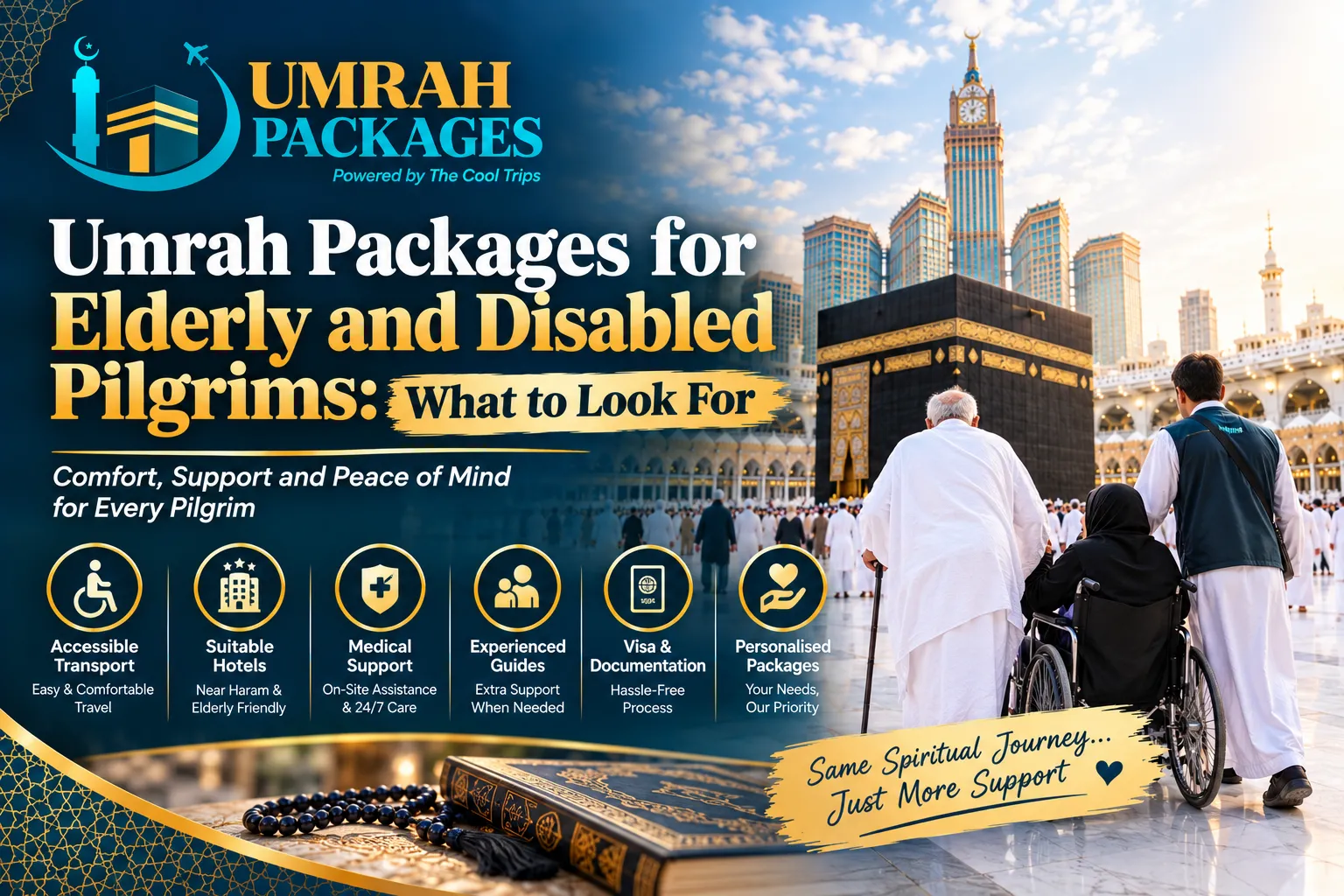
Families worry about Tawaf. It is Sa’i that is hard.
Seven circuits of Tawaf at ground level is under a kilometre. Sa’i, which is seven lengths between Safa and Marwah at roughly 450 metres each, is around three kilometres.
Three to four times the walking, immediately after Tawaf, when somebody of eighty is already tired.
The hotel. On a seven night trip a pilgrim at 200 metres walks around 8 kilometres. At 1.2 kilometres they walk 48.
That forty kilometre gap is the entire argument for paying for proximity, and it matters more here than for anybody else.
The rites and what help is available, wheelchairs at both mosques, the hotel, the flight, and an honest section on whether the trip is advisable at all.
The short version Sa’i is around three kilometres. Tawaf on the ground is under one. Prepare for Sa’i. Wheelchairs are available at both mosques, to rent, with pushers for hire. The upper level Tawaf is longer and easier, because it is designed for wheelchairs and far less dense. Book under 400 metres, or Haram facing at £879 if you can. It is worth more than any other decision. Special assistance on the flight is free and it is booked with the airline, not us. |
Tell us the mobility needs and we will build around them
Rite | What it involves | Approximate distance |
|---|---|---|
Tawaf, ground level | Seven circuits of the Kaaba | Under a kilometre |
Tawaf, first floor | Same seven, bigger radius | Around one and a half kilometres |
Tawaf, roof level | Same seven, larger again | Longer still |
Sa’i | Seven lengths, Safa to Marwah | Around three kilometres |
Because it is three times the distance, it comes immediately after Tawaf, and it is indoors and visually repetitive so it feels longer than it is.
Families prepare somebody for the crowd around the Kaaba and then run out of pilgrim somewhere around the fourth length.
The upper levels of the Mataf are longer in distance and considerably easier.
Because they are far less densely crowded, they are designed for wheelchair access, and if somebody is being pushed the distance matters far less than the crowd does.
For an elderly or disabled pilgrim, the longer route is frequently the better one. That is the opposite of what most people assume and it is worth knowing before you arrive.
The Sa’i course has designated lanes for wheelchairs, which keeps you clear of the walking crowd for the whole three kilometres.
Decide before you start who is pushing and for how long. Working it out at Marwah with a tired parent is a worse conversation than having it in the hotel.
Both mosques provide for wheelchair users extensively. Manual wheelchairs are available to rent, and paid pushers can be hired if nobody in your party can manage it.
At Masjid al-Haram, electric mobility scooters are available for hire on the upper levels for Tawaf. They are popular and they can be busy in peak periods.
Arrive with time in hand rather than expecting to hire something five minutes before you want to start. In busy periods there is a queue.
Provision, pricing and availability change. Ask us for the current position before you travel, and confirm again on arrival rather than assuming.
Possible, and airlines carry mobility equipment free of charge under UK rules. A folding chair is easier to manage than a rigid one across airports and coaches.
If you bring your own, label it clearly and photograph it before you fly. Damage in transit does happen and a photograph makes a claim straightforward.
Both mosques have extensive lift and ramp provision to reach the upper levels, and the upper Tawaf areas are the intended route for wheelchair users.
Ask specifically about lifts, the number of them, and whether the room can be on a low floor. A tall property with a long lift wait at prayer times is a genuine problem for somebody who cannot stand comfortably.
Full detail on the lift question in our five star post.
Tell us the mobility needs at the enquiry rather than after booking. It changes the hotel we recommend, the floor we request and the transfer we arrange.
On a seven night trip with four Makkah nights, attending most prayers means around forty one-way walks.
Hotel distance | Total walking across the trip |
|---|---|
200 metres | Around 8 km |
400 metres | Around 16 km |
700 metres | Around 28 km |
1.2 kilometres | Around 48 km |
The difference between the closest and furthest band is forty kilometres across a single week, for somebody who may struggle with one.
Under 400 metres for anybody over seventy or with mobility difficulties. Haram facing, under 200 metres, at £879, if the budget reaches.
Because several properties in that band connect through covered walkways, so a large part of the journey is indoors and level.
Number three. A route with a flight of steps is not a route for a wheelchair or a walking frame, and it appears on no listing anywhere.
The property name, the distance in metres and the nearest gate. Tell us there are mobility needs and we will add the terrain and whether the route is covered.
Misfalah is worth knowing about. Slightly further than Ajyad and the walk is flat and largely covered, reaching quieter back gates.
For an older traveller, the further district is frequently the better one. Detail in our Makkah areas guide.
Special assistance at UK airports is provided free of charge and it is a legal requirement rather than a favour. It covers help from arrival at the airport through to the aircraft seat.
Through the airline, at least 48 hours before departure and ideally at the point of booking. It is arranged with the carrier rather than with us.
Tell us the needs anyway, because we can make sure the booking reflects them and remind you to do it.
The level of assistance needed, whether the person can walk short distances or manage steps, and whether they are bringing their own equipment.
Airports categorise assistance levels and the right category gets the right help. Vague requests get the default, which may not be enough.
Ask for an aisle seat with a movable armrest, which makes transferring considerably easier. Request it at booking rather than at the gate.
Cabin crew can help with moving around the cabin but are not permitted to lift passengers. If somebody needs lifting, a travelling companion must be able to provide it.
Assistance is available and the airport is used to large numbers of pilgrims with mobility needs. Our transfers include help with luggage, and tell us in advance if a vehicle with easier access is needed.
All medication in hand luggage with the pharmacy label attached, and enough for the trip plus several extra days in case of delay.
For anything unusual, injectable, or controlled, ask your GP for a letter listing the medication and the condition. It costs a small fee and it removes any question at a border.
Saudi Arabia is ahead of the UK, and for medication taken at fixed hours that needs planning rather than improvising on arrival.
Ask your GP or pharmacist how to manage the shift before you travel. It is a common question and they will have an answer.
If anything needs it, ask us to confirm a fridge in the room for your specific hotel. It is not standard at every three star property and it is not something to discover at check-in.
A folding walking frame or stick is easier across airports than anything rigid. And take a spare of anything critical that would be difficult to replace.
Essential rather than optional, and declare all pre-existing conditions. An undeclared condition is the commonest reason a claim fails, and medical treatment abroad is expensive.
Policies for older travellers and those with conditions cost more and are widely available. Shop for one that covers the conditions rather than the cheapest one.
The ACWY certificate is a visa requirement for every traveller regardless of age, and it must be dated at least ten days before arrival.
Whether the vaccine is suitable given any conditions or medication. That is a medical question and it belongs with them.
Everything on this page about health is a description of provision rather than advice. Speak to a GP before booking, not after.
The section that costs us bookings, and a page that will not have it is not worth reading.
Not this year, or not without more support than the family has considered, or not at all. That is a real thing and pretending otherwise helps nobody.
Families sometimes take an elderly parent because they feel they should, and the parent goes because they do not want to disappoint anybody.
It is worth asking directly and accepting the answer.
Airlines can require medical clearance in some circumstances and there are conditions where flying is inadvisable. That is a question for a GP and for the airline, and it wants asking before a deposit rather than afterwards.
July and August at 38 to 45 degrees, and the last ten nights of Ramadan at the densest crowds of the year.
For a frail traveller, either of those is a materially different risk to November or January and we would say so.
Somebody has a good trip next year, properly planned, than a difficult one now because nobody wanted to raise it.
If you tell us the situation honestly we will tell you honestly what we think, including if we think it should wait.
Plenty of people in their eighties do this comfortably every year, with a close hotel, a wheelchair, the right month and a family who planned it.
Age alone is not the question. Planning is.
November and January, both at £499, and for a frail or elderly traveller the gap between them and the alternatives is enormous.
November or January | July or August | |
|---|---|---|
Makkah temperature | 20 to 32 | 38 to 45 |
Walking at midday | Comfortable | Not advisable |
Isha to Fajr | Over ten hours | Around eight |
Crowds | The quietest of the year | The busiest outside Ramadan |
Ziyarat | Pleasant | An endurance exercise |
7 nights, 3 star | From £499 | From £699 |
The winter night is over ten hours between Isha and Fajr against around eight in summer. For an older traveller that is the difference between attending five prayers sustainably and stopping by day four.
Madinah nights are genuinely cold in December and January, dropping toward ten degrees. Older travellers feel it more and almost nobody packs for it.
A proper fleece, socks and a large shawl. Detail in our winter packing guide.
July and August, and the last ten nights of Ramadan. Both are genuinely demanding for a fit adult.
The first ten nights at £749 rather than the last ten at £1,199. Manageable crowds, a hotel you can use, and the reward is widely understood to apply across the whole month.
Ten nights rather than seven. More time means a slower pace, rest days, and no need to fit everything into four Makkah nights.
A short section for whoever is taking the parent, because the trip is different for you.
Said plainly. If you are the person pushing the wheelchair, managing the medication and getting somebody to Fajr, your own worship happens around that.
Most people find that acceptable and worth it. It helps to expect it rather than discover it.
Considerably. Three kilometres of Sa’i pushing a wheelchair is hard work, and being able to take turns changes the whole week.
A parent and two adult children is three people, which is a triple from £579 each. Four is a quad at £499 each, which is cheaper per person and gives you a fourth pair of hands.
A parent may want their own room, particularly for continence or medication reasons. A quad plus a single works and the single carries the largest supplement.
Full configuration detail in a separate post.
Worth building in deliberately. An hour at the Haram alone, while somebody else sits with your parent, is the thing carers most often say they wished they had arranged.
That you are travelling with somebody who needs help. It changes how the group moves and how much support you get, and most leaders are glad to know.
Under 400 metres, or Haram facing at £879 if you can. It is worth more than any other decision on the booking.
Four star as a minimum, at £629, which is typically what gets you inside 400 metres. Five star at £690 or Haram facing at £879 if the budget allows.
November or mid to late January.
Ten nights at £545 rather than seven. Slower pace, room for rest days, and no need to compress everything.
Consider more Madinah nights than standard. The ground is flat, the walks are shorter and the whole city is easier for somebody with mobility difficulties.
Detail in our Madinah guide.
Whatever suits. A quad with the family, a triple, or a room of their own if there is a reason. Tell us and we price the options.
If you are | Book | From |
|---|---|---|
Taking a parent, mobile but slow | 10 nights, 4 star under 400 m | £679 |
Taking a wheelchair user | 10 nights, Haram facing | £975 |
A parent who wants their own room | Quad plus single | On request |
Two carers and a parent | 10 nights, triple, 4 star | On request |
On a tighter budget | 7 nights, 4 star under 500 m | £629 |
The mobility needs, the medication needs, whether a wheelchair is needed and whether it is being brought or hired. All four change what we build.
Tier | 7 nights | 10 nights | 14 nights |
|---|---|---|---|
4 Star | From £629 | From £679 | From £769 |
5 Star | From £690 | From £745 | From £825 |
Haram facing, under 200 m | From £879 | From £975 | From £1,129 |
Per person, quad sharing, off-peak. Includes return flights, both hotels named in writing with the distance in metres and the nearest gate, the Saudi Umrah visa, all three transfers and guided Ziyarat in both cities. Held with a £99 deposit.
Because it is typically further out, and for a pilgrim with mobility difficulties the distance is the whole trip.
We will quote it if you ask, and we will tell you what the walk is.
Five star to Haram facing at £189. It is the largest single step in our range and it is the one that takes you under 200 metres with covered access.
For somebody who struggles to walk, it is the best money on the booking by a distance.
Ten nights at four star under 400 metres, £679. Or Haram facing at £975 if the mobility needs are significant.
£99 per person, and it fixes your price in writing.
Interest free across the months to eight weeks before departure, when you book four or more months ahead.
The fourth. Everything else is preparation. The hotel distance is the decision.
The fifth. Special assistance is a free legal entitlement at UK airports and a large share of families who would benefit from it never ask.
Around three kilometres against under one, immediately after, and it is the one families do not prepare for.
Less dense, designed for wheelchairs, and if somebody is pushing the crowd matters more than the distance. The longer route is frequently the better one.
Forty kilometres of walking between 200 metres and 1.2 kilometres across a single week. Under 400 metres, or Haram facing if you can.
A legal entitlement at UK airports, arranged with the airline at least 48 hours ahead.
We would rather somebody had a good trip next year, properly planned, than a difficult one now because nobody wanted to raise it.
Tell us the needs and we will build around them
Not just the ages. What they can and cannot manage, what medication needs planning, whether a wheelchair is needed, and who is travelling to help.
We will build the trip around that, and if we think it would be better next year with more planning, we will say so rather than take the booking.
Packages Umrah WhatsApp or call: +44 7737 144 335 Office: 7 Huxley Avenue, Manchester, M8 0SJ English and Urdu. Same-day quotes. Four star from £629pp, Haram facing from £879pp. £99 deposit fixes your price. Trading name of Uraan Travel Ltd. |
Grouped by topic. Direct answer first. Everything health related is a question for a GP rather than for us.
Sa’i. Around three kilometres against under one for Tawaf on the ground floor.
Safa to Marwah is roughly 450 metres and there are seven lengths, so about three kilometres.
It is indoors, air conditioned and visually repetitive, and it comes immediately after Tawaf.
Frequently yes. Longer in distance and considerably less dense, and designed for wheelchair access.
If somebody is pushing, the crowd matters far more than the distance. That is the opposite of what most people assume.
The course has designated lanes, which keeps you clear of the walking crowd for the whole three kilometres.
At Safa or Marwah, and it is entirely normal. Nobody minds.
Rent a wheelchair for Sa’i even when the pilgrim walks Tawaf, and take turns pushing.
Who pushes and for how long. Working it out at Marwah with a tired parent is a worse conversation.
Both provide extensively. Manual chairs to rent, and paid pushers if nobody in your party can manage it.
Mobility scooters are available for hire on the upper levels at Masjid al-Haram. They are popular and can be busy.
Yes. In busy periods there is a queue and turning up five minutes before you want to start does not work.
Availability and pricing do. Ask us for the current position before travelling and confirm on arrival.
Airlines carry mobility equipment free of charge under UK rules. A folding chair is easier than a rigid one.
Before you fly, and label it clearly. Damage in transit happens and a photograph makes a claim straightforward.
Extensive provision at both mosques, and the upper Tawaf areas are the intended route for wheelchair users.
Ask how many there are and whether you can have a low floor. A tall property with long lift waits at prayer times is a real problem.
From 200 metres, around 8 kilometres. From 1.2 kilometres, around 48.
Forty kilometres across a single week, for somebody who may struggle with one.
Under 400 metres for anybody over seventy or with mobility difficulties. Haram facing under 200 metres if the budget reaches.
Several properties in that band connect through covered walkways, so much of the journey is indoors and level.
Metres to a named gate, whether it is flat or has a gradient, whether there are steps or road crossings, and whether it is covered.
The steps. A flight of steps is not a route for a wheelchair or a frame, and it appears on no listing anywhere.
Misfalah is worth knowing about. Slightly further than Ajyad, flat, largely covered, and reaching quieter back gates.
For an older traveller, frequently. Flat and covered beats short and steep.
Whether it opens at ground level or above changes the walk once you are inside, which can exceed the walk outside.
Free help at UK airports from the terminal through to the aircraft seat. A legal requirement rather than a favour.
Assistance to check-in, through security and passport control, a wheelchair to the gate and to the seat, help on arrival, and free carriage of mobility equipment.
Through the airline, at least 48 hours before departure and ideally at booking.
It is arranged with the carrier. Tell us the needs anyway so the booking reflects them and we can remind you.
The level of assistance, whether they can walk short distances or manage steps, and whether they are bringing equipment.
Airports categorise assistance levels. Vague requests get the default, which may not be enough.
Ask for an aisle seat with a movable armrest, at booking rather than at the gate.
They can help with moving around the cabin but are not permitted to lift. A travelling companion must be able to.
Assistance is available and the airport is used to pilgrims with mobility needs. Tell us if a vehicle with easier access is needed.
Hand luggage, with the pharmacy label attached, and enough for the trip plus several extra days.
For anything unusual, injectable or controlled, yes. It costs a small fee and removes any question at a border.
Saudi Arabia is ahead of the UK. For medication at fixed hours, ask your GP or pharmacist how to manage the shift before you travel.
Ask us to confirm it for your specific hotel. It is not standard at every three star property.
One that covers all pre-existing conditions, declared in full. An undeclared condition is the commonest reason a claim fails.
No. Shop for one that covers the conditions rather than the lowest premium.
For every traveller regardless of age, dated at least ten days before arrival.
Ask the GP, given any conditions or medication. That is a medical question.
Folding rather than rigid, and a spare of anything critical that would be difficult to replace.
No. Some people should wait, or need more support than the family has considered, and a page that will not say so is not worth reading.
The flight, three kilometres of Sa’i, whether somebody can physically assist including lifting, whether the condition is stable, and whether they want to go.
Because families sometimes take a parent out of duty and the parent goes so as not to disappoint anybody. Ask directly.
Airlines can require medical clearance in some circumstances. That is a question for a GP and the airline, before a deposit.
July and August at 38 to 45 degrees, and the last ten nights of Ramadan at the densest crowds of the year.
Somebody has a good trip next year, properly planned, than a difficult one now because nobody wanted to raise it.
No. Plenty of people in their eighties do this comfortably with a close hotel, a wheelchair, the right month and a family who planned it.
November and January, both at £499.
Comfortable walking at every hour, over ten hours between Isha and Fajr, and the quietest Haram in the calendar.
The difference between attending five prayers sustainably and stopping by day four.
Madinah nights drop toward ten degrees in December and January. Older travellers feel it more and almost nobody packs for it.
A proper fleece, socks and a large shawl. Not a token layer.
The first ten nights at £749 rather than the last ten at £1,199.
Ten nights rather than seven. Slower pace, room for rest days, and no need to compress everything.
Not really. If you are pushing the wheelchair and managing medication, your own worship happens around that.
Considerably better. Three kilometres of Sa’i pushing a chair is hard work and taking turns changes the week.
A quad at £499 each is cheaper per person than a triple at £579, and it gives you another pair of hands.
If there is a reason, and one line at the enquiry is enough. A quad plus a single works.
Who pushes, who holds medication, the plan if somebody is unwell, how many prayers you realistically attend, and whether anybody gets time alone.
An hour at the Haram alone is the thing carers most often say they wished they had arranged.
Yes. It changes how the group moves and how much support you get.
Four star minimum at £629, which typically gets you inside 400 metres. Haram facing at £879 if the needs are significant.
Because it is typically further out and the distance is the whole trip. We will quote it and we will tell you what the walk is.
Five star to Haram facing at £189. The largest step in our range and the one that takes you under 200 metres with covered access.
Worth considering. Flat ground, shorter walks and an easier city for somebody with mobility difficulties.
£99 per person, and it fixes your price in writing.
The mobility needs, the medication needs, whether a wheelchair is needed and whether it is brought or hired.
Not just the ages. What they can and cannot manage, what medication needs planning, whether a wheelchair is needed, and who is travelling to help.
We will build the trip around that, and if we think it would be better next year with more planning, we will say so rather than take the booking.
Packages Umrah WhatsApp or call: +44 7737 144 335 Office: 7 Huxley Avenue, Manchester, M8 0SJ English and Urdu. Same-day quotes. Four star from £629pp, Haram facing from £879pp. £99 deposit fixes your price. |
Verified Umrah Travel Specialist
Written By: Azeem Ali
A seasoned Umrah travel specialist with more than 10 years of experience in planning and managing Umrah journeys. Every article is carefully prepared by Azeem Ali, drawing on years of expertise in assisting thousands of pilgrims from the UK. Our goal is to provide reliable, up-to-date, and practical guidance to help you confidently prepare for your sacred journey.
PACKAGES UMRAH
SERVICES FROM UK
Latest Articles