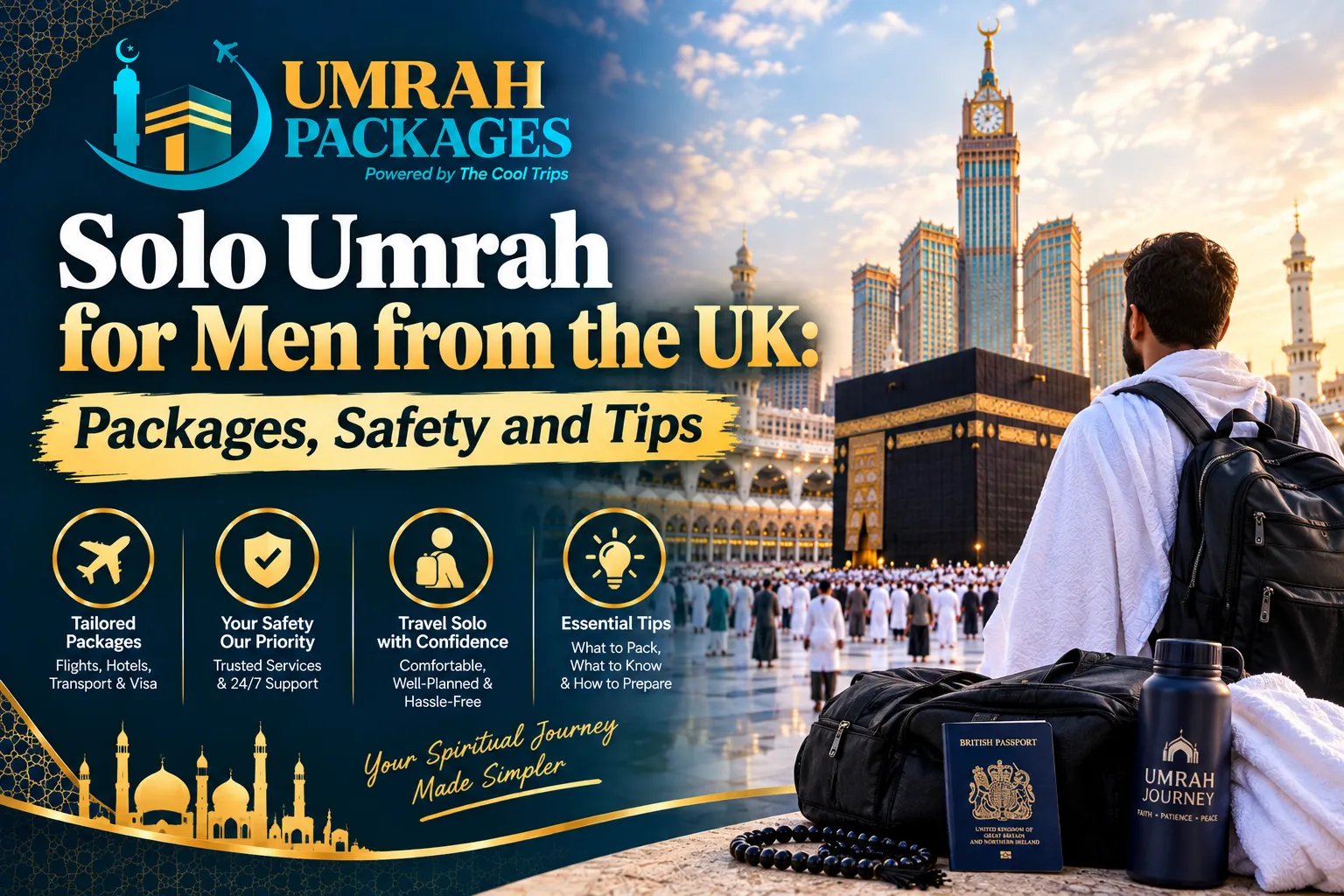
Solo Umrah for men from the UK is safe, simple to arrange and often cheaper than people expect. Sharing a quad room with other male pilgrims keeps a 7-night 4-star trip at around £780 to £950, while a private single room usually costs £1,080 to £1,610. Use licensed taxis, book your free Umrah permit only through the official Nusuk app, keep your passport secure and check the UK government’s travel advice before you fly.
Going for Umrah on your own is different from going with family. Nobody to wait for, nobody to keep up with. You pray when you want, sit in the Haram as long as you like and perform Tawaf at two in the morning if that’s when the mataf is quietest. Many brothers tell us their solo trip was the most focused worship of their lives.
It also raises its own questions. Do I have to pay for a whole room? Is it safe? Can I do it all myself? What if I lose my passport? We arrange solo trips for men from our office in Manchester, from students on a budget to retired brothers travelling after losing a wife, and this guide covers what they ask us most.
A solo male pilgrim from the UK can travel on a package with a shared or private room, or book independently, with the Umrah permit itself issued free through the Nusuk app.
Solo Umrah for men from the UK | |
|---|---|
Shared room with other men, 7 nights 4-star | £780–£950 per person |
Private single room, 7 nights 4-star | £1,080–£1,610 |
Umrah permit | Free in the official Nusuk app |
Visa options | Umrah visa through an agent, or Saudi tourist eVisa or ETA |
Emergency number | 911 (112 without a Saudi SIM) |
Main risks | Crowds, heat, petty theft, unlicensed taxis |
Men’s rites | Two-sheet ihram, idtiba’ and raml in Tawaf, shave or trim |
Best-value months | January and November |
Deposit | Most of our packages secured with £99 |
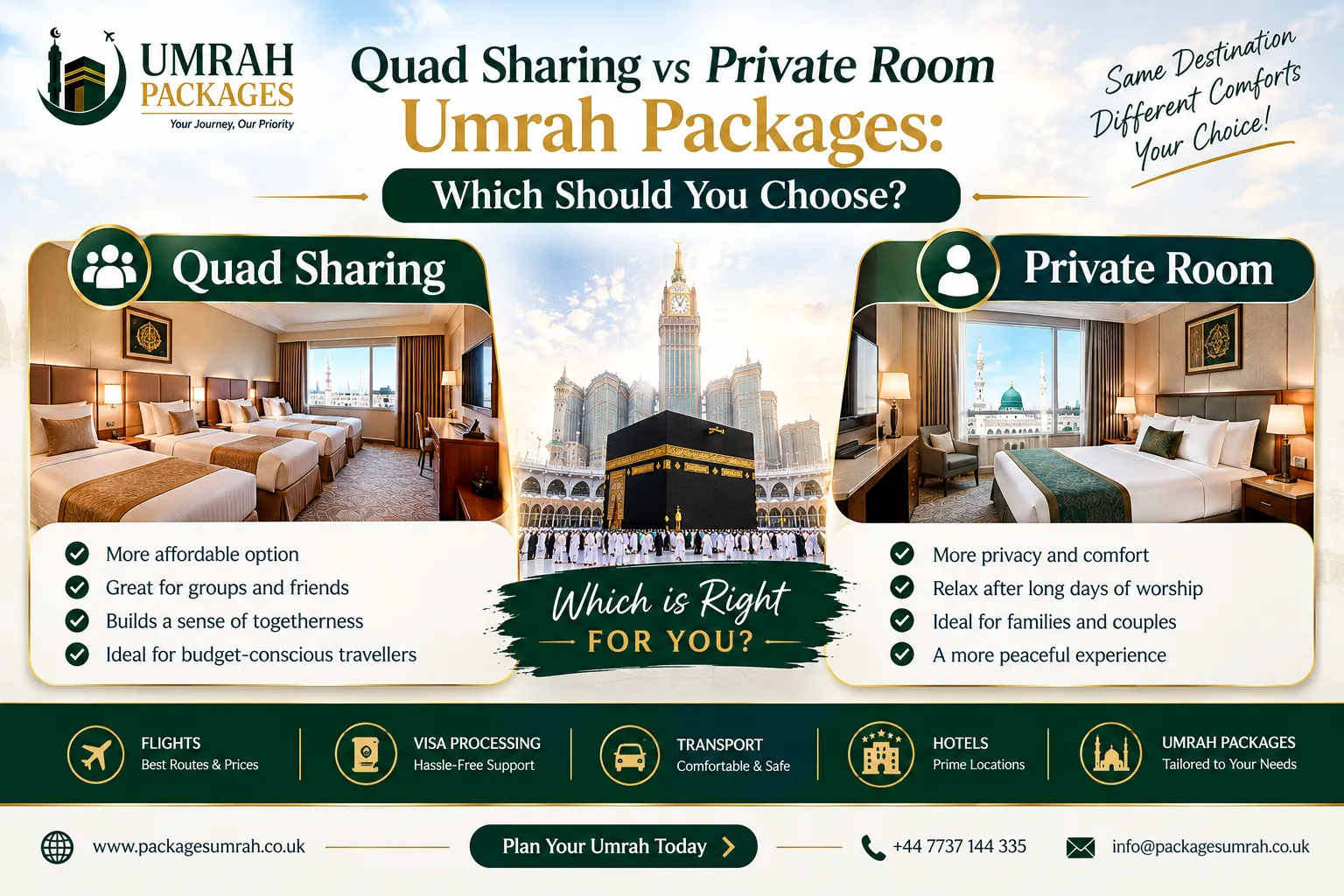
The biggest cost decision for a solo man is whether to share a room with other male pilgrims, which gives you the lowest quad price, or pay for a private single room, which typically adds £300 to £800 per person on a 7 to 10-night 4-star trip.
Hotel standard | 7 nights, shared room | 7 nights, single room | 10 nights, shared room | 10 nights, single room |
|---|---|---|---|---|
3-star | £645–£800 | £885–£1,340 | £750–£920 | £1,110–£1,520 |
4-star | £780–£950 | £1,080–£1,610 | £900–£1,150 | £1,380–£1,960 |
5-star | £900–£1,250 | £1,350–£2,150 | £1,100–£1,550 | £1,850–£3,050 |
Per person, economy flights from the UK, outside peak dates. Shared room means four men sharing. Indicative UK market ranges, October 2026.
Most UK agencies, ours included, can place solo men in a shared room with other male pilgrims. You each have your own bed and share the bathroom, and you pay the four-sharing price. It’s how most students and many first-timers travel. Done well, it’s also how lifelong friendships start: you’ll walk to Fajr together, compare notes on the rites and look out for each other.
Ask your agent how they match roommates. Age and travel dates are usually the main factors, and it’s fair to ask for someone with a similar routine if you’re an early riser or a night owl.
A single room gives you privacy, your own schedule and a quiet space to rest. Because you pay the whole room rate, it costs a lot more, and the gap is widest at 5-star hotels and in Ramadan. Older brothers, light sleepers and anyone who needs a CPAP machine or has health needs often find it worth the money.
Many hotels near the Haram don’t have true single rooms, so a “single” is often a double or twin room let to one person. The price is broadly the same as a single supplement. Check whether you’ll have one bed or two, especially if you want space to spread out.
For a first solo Umrah of seven to ten nights, share. You’ll save hundreds of pounds and you’ll rarely be in the room anyway. For longer stays, or if you’re older and value your rest, the single room earns its price.
A package is simpler and comes with financial protection, while a DIY trip on a Saudi tourist visa or ETA gives you flexibility but leaves you responsible for every booking; for most first-time solo pilgrims, a package is the safer choice.
Package | DIY | |
|---|---|---|
Visa | Arranged for you | Tourist eVisa or ETA, applied for yourself |
Umrah permit | Arranged or guided | Free in Nusuk, booked yourself |
Hotels and transfers | Named and booked | Booked separately |
Financial protection | ATOL when flights are included | No package protection |
Flexibility | Fixed dates and hotels | Change plans as you go |
Support if things go wrong | Agent on hand | You sort it yourself |
Best for | First-timers and most solo men | Experienced, confident travellers |
A package bundles your flights, visa, hotels and transfers, and when it includes flights it should come with ATOL protection, so you can get home or get your money back if the company fails. The UK government warns that organised crime groups target people planning Hajj and Umrah, so choose a company you can verify and get everything in writing.
British nationals can also travel on a Saudi tourist eVisa or the newer ETA, which the UK government lists as covering Umrah outside the Hajj season. You then book your own flights and hotels, and request a free Umrah permit in the Nusuk app. It suits confident travellers who’ve done Umrah before. If you go this route, remember that separately booked flights and hotels don’t have package protection.
The permit is free. Anyone offering to sell you an Umrah or Rawdah permit is a red flag.
Men and women visit the Rawdah at separate times, booked in Nusuk. Rules on how often you can book have changed several times since 2024, so book as soon as your Madinah dates are fixed and check for extra slots once you’re near the mosque.
Solo Umrah is generally safe: the UK government describes crime in Saudi Arabia as low, though petty theft happens, and the bigger risks for solo pilgrims are crowds, heat and losing documents.
Violent crime against pilgrims is rare. Pickpocketing in packed areas, around the mataf at busy times, on crowded buses and in markets, is the main thing to guard against. Keep your phone and wallet in a zipped pocket or ihram belt, not in a loose bag.
The mataf and the Sa’i area can become very crowded, especially on Fridays, in Ramadan and between Maghrib and Isha. Go at quieter times, such as after Fajr or late at night, follow the directions of the security staff and never push against the flow.
Makkah’s average daytime highs run from around 31°C in January to the mid-40s in summer, and the UK government notes summer can pass 50°C. Carry water, use an umbrella, which is allowed in ihram, and save walking for early morning and evening.
The UK government’s travel advice for Saudi Arabia currently includes a security warning, and advises travellers to be ready for flight cancellations and changes at short notice. Read it before you book and again before you fly, and make sure your travel insurance covers your trip.
Service | Number |
|---|---|
Police, ambulance, fire (unified) | 911 |
From a phone without a Saudi SIM | 112 |
Ministry of Health advice line | 937 |
British Consulate-General, Jeddah | Find current contact details on the UK government website |
Save these in your phone before you land, along with your hotel’s number and your agent’s WhatsApp.
The most common problems for solo men are unlicensed airport taxis, people selling permits that are actually free, fake travel agents in the UK and overpriced informal services near the Haram.
Not sure whether an offer you’ve seen is genuine? Send it to us on WhatsApp and we’ll tell you honestly what we think, even if you don’t book with us.
Men wear two unstitched white sheets in ihram, keep the head uncovered, uncover the right shoulder during Tawaf, walk briskly in the first three circuits and finish by shaving or trimming the whole head.
A man’s ihram is two pieces of cloth: one wrapped around the waist (the izar) and one over the shoulders (the rida’). The Prophet ﷺ said a man in ihram should not wear shirts, turbans, trousers, hooded cloaks or leather socks (Sahih al-Bukhari 1542). White is preferred. Underwear isn’t worn, according to the majority of scholars.
Wear sandals or slippers that leave the ankle bones uncovered. In the Hanafi school, the raised bone in the middle of the top of the foot should also be uncovered, so open sandals are the safest choice.
You can wear a belt or money belt, even if it’s stitched, carry an umbrella, wear a watch and glasses, and use unscented soap. Perfume is sunnah before you enter ihram, but not after.
During the Tawaf of Umrah only, men uncover the right shoulder by passing the upper sheet under the right arm, known as idtiba’. In the first three circuits, men also walk briskly with short steps, known as raml, if the crowd allows. Neither applies to women, and neither is needed in other Tawafs.
Men complete Umrah by shaving or shortening the hair from the whole head. Shaving is better: the Prophet ﷺ prayed three times for those who shave before praying for those who trim (Sahih al-Bukhari 1727; Sahih Muslim 1301). If you’re planning a second Umrah within days, some scholars suggest trimming the first time so there’s hair left to shave later.
There are licensed barbers’ shops close to the Marwah end of the Sa’i area and around the Haram. They’re quick and cheap. Bring your own razor if you prefer, which also follows health advice to avoid shared blades.
A solo Umrah follows the same rites as any other, but planning each step in advance means you’ll never feel lost.
Our Umrah duas in Arabic, transliteration and English cover every step, and our month-by-month Umrah packing list helps you pack light.
On your own, you control your schedule, so build it around the prayers, rest in the hottest hours and make the most of quiet times in the Haram.
On Fridays, the Haram fills hours before the prayer. Arrive by mid-morning if you want a place inside, as some gates and the mataf area close early. Bring water and the Qur’an.
Eating alone is easy near both mosques. Food courts, small restaurants and bakeries are open late, and many solo pilgrims eat after Isha. Don’t skip meals to save time; you’ll feel it by day three.
Join a group ziyarat tour if your package offers one, chat to your roommates or sit in on a Qur’an circle. Most brothers find they’re never short of company unless they want to be.
Some men, especially those travelling after a bereavement, find the evenings hard. Call home, keep a journal and remember that the Haram never really empties. Many find their loneliest moments turn into their deepest duas.
Every Saudi SIM is registered to a passport at purchase. A travel eSIM set up before you leave avoids the queue at the airport and keeps you connected the moment you land.
Travelling alone and want a hand planning? Message us on WhatsApp and tell us whether you’d prefer a shared or single room.
Use the room safe, carry a copy of your passport, keep cash to a minimum and know where the lost property offices are.
Keep your passport, cash and valuables in the room safe or a locked bag. Most roommates are honest, but it’s sensible not to tempt anyone. Agree on simple things early, such as lights and alarms.
Carry only what you need: your phone, a little cash, your hotel card and a copy of your passport. Leave shoes in a numbered rack or carry them in a small bag, and note the gate you used.
Masjid al-Haram has a lost property office in the eastern courtyard, and Masjid an-Nabawi has its own office; any of the staff at the gates can point you to it. If you lose your passport, report it to the police and contact the British Consulate-General in Jeddah, which can issue an emergency travel document for a fee.
You’ll need to declare large amounts of cash, currently SAR 60,000 or more, when entering or leaving Saudi Arabia. Most solo pilgrims carry a few hundred riyals and use cards for everything else.
Solo men can travel whenever suits them, so they can take full advantage of the cheapest months, January and November, and avoid the school-holiday rush.
Without children’s term dates to worry about, you can travel in quieter months, when prices and crowds are lower. Shared rooms are easiest to arrange in busy periods, including Ramadan, when single rooms near the Haram become very expensive. Remember that the last date to enter on an Umrah visa this season is 23 March 2027, so Easter isn’t possible on an Umrah visa.
Solo men range from students on a tight budget to retired brothers, and each needs something slightly different from the trip.
A shared quad at a walkable 3-star hotel is the classic student Umrah. See our Umrah packages for students for budget options.
If leave is tight, seven nights with a direct flight works well. A 4-star hotel close to the Haram, like those in our 4 star Umrah packages, saves time every day.
A single room, a hotel a few minutes from the mosque and a direct flight make the trip far more comfortable. Our business class Umrah packages suit those who’d like a flatbed seat for the journey, and our 5-star luxury Umrah packages put you right by the Haram.
Many brothers travel solo to perform Umrah on behalf of a parent who has passed away or can’t travel. Perform your own Umrah first, then enter ihram again from a miqat, often Masjid Aisha in Tan’eem, for your parent’s Umrah.
To book, tell us your dates, departure airport, whether you’d like a shared or single room and your preferred hotel standard, and we’ll send named hotels and a clear price.
You can secure most of our packages with a £99 deposit. We fly from every major UK airport, with direct flights from Heathrow and our home airport of Manchester. See our Umrah packages from Manchester, our Umrah packages from Derby or all our Umrah packages from the UK. For hotels by the mosque, our comparison of the Swissotel, Anjum and Pullman ZamZam is worth a look.
We arrange solo trips for men throughout the season, and we checked the safety, legal and religious details again for this guide.
Safety information, emergency numbers and fraud warnings come from the UK government’s travel advice for Saudi Arabia and its guidance for Hajj and Umrah pilgrims. Taxi rules come from Saudi transport authority announcements. Nusuk steps reflect the app’s visitor process as of 2026.
Rulings on men’s ihram, idtiba’, raml and shaving come from hadith in Sahih al-Bukhari and Sahih Muslim and established fatwa sources, with differences between schools noted.
Prices are typical UK market ranges as of October 2026, based on the flights and hotels we book. Single-room figures are indicative and vary most in Ramadan and at 5-star hotels.
Sharing a room with other male pilgrims, a 7-night 4-star trip typically costs £780 to £950. A private single room usually costs £1,080 to £1,610 for the same trip. Three-star is cheaper and 5-star more, and Ramadan and Christmas cost the most.
On a 7 to 10-night 4-star trip, a single room usually adds around £300 to £800 per person compared with sharing a quad. The supplement is highest at 5-star hotels near the Haram and during Ramadan, when a whole room rate is very expensive.
Yes. Most UK agencies can place solo men in a shared room with other male pilgrims, each with their own bed and a shared bathroom. You pay the four-sharing price, which is the cheapest rate. Ask how roommates are matched, usually by age and travel dates.
Generally, yes. Your roommates are fellow pilgrims, and most shared rooms work well. Keep your passport, cash and valuables in the room safe or a locked bag, agree on lights and alarms early and tell your agent if there’s a problem so they can help.
The cheapest option is usually a shared quad at a walkable 3-star hotel, with a one-stop flight, in January or November. A 7-night trip like this can cost around £645 to £800. Avoid very cheap packages that use shuttle hotels far from the Haram.
Often, yes. If you’re travelling with a friend or brother but want to share a quad to save money, tell your agent and they’ll put you together, filling the other beds with fellow pilgrims. Otherwise, roommates are matched by dates and, where possible, age and routine.
It depends on your age, health and trip length. For a first trip of seven to ten nights, sharing saves hundreds of pounds and you’ll rarely be in the room. For longer stays, older pilgrims, light sleepers or anyone with medical equipment, the privacy of a single room is often worth it.
Yes, for most pilgrims. The UK government describes crime in Saudi Arabia as low, though petty theft happens in crowds. The main risks are heat, crowds and losing documents. Check the current travel advice before you go and keep your passport and phone secure.
The UK government’s travel advice for Saudi Arabia currently includes a security warning and advises being ready for flight disruption, but Makkah, Madinah and Jeddah aren’t in areas where it advises against travel. Read the latest advice before booking and again before you fly.
The UK government lists 911 for police, ambulance and fire in Saudi Arabia, or 112 if you don’t have a Saudi SIM. The Ministry of Health’s 937 line offers medical advice around the clock. Save these numbers before you land, along with your hotel’s.
Use the official taxi rank, a licensed ride-hailing app, a pre-booked transfer or the Haramain train. Don’t accept rides from people approaching you in the arrivals hall, as unlicensed airport taxis are illegal and drivers face heavy fines. Agree the price before you set off.
No. Rawdah and Umrah permits are issued free through the official Nusuk app, and anyone selling one is a warning sign. Book your Rawdah slot in Nusuk as soon as your dates are fixed, and check for extra slots once you’re near Masjid an-Nabawi.
Report it to the police and contact the British Consulate-General in Jeddah, which can issue an emergency travel document for a fee. Keep photos and photocopies of your passport and visa on your phone and in your bag, and tell your agent straight away.
Personal photos are generally tolerated, but filming other worshippers without their consent isn’t allowed, tripods may be stopped at the entrance and drones are banned. Keep photos brief and respectful, avoid blocking walkways while you take them, and don’t let your phone distract you from worship.
Two unstitched pieces of cloth: one around the waist and one over the shoulders, usually white. Men don’t wear shirts, trousers, head coverings or underwear in ihram, according to the majority of scholars. Wear sandals that leave the ankle bones uncovered.
Yes. Men can wear a belt or money belt in ihram, even if it’s stitched, to hold the lower sheet and keep money and documents safe. A watch, glasses and an umbrella are also allowed. Perfume isn’t allowed once you’ve entered ihram.
Idtiba’ means uncovering the right shoulder by passing the upper sheet under the right arm and over the left shoulder. Men do it only during the Tawaf of Umrah, then cover the shoulder again afterwards, including for the two rak’ahs of prayer.
Raml is walking briskly with short steps during the first three circuits of the Tawaf of Umrah. It applies only to men, and only if the crowd allows it safely. The remaining four circuits are walked at a normal pace.
Shaving the whole head is better. The Prophet ﷺ prayed three times for those who shave before praying for those who trim (Sahih al-Bukhari 1727). Trimming from the whole head is also valid, and some men trim first if they plan another Umrah within a few days.
Men shouldn’t wear socks or shoes that cover the ankle bones in ihram. Open sandals or slippers are the safest choice. In the Hanafi school, the raised bone on the top of the foot should also be left uncovered. If you need medical footwear, ask a scholar about the expiation that may apply.
No. Men shouldn’t cover their head with anything that touches it, including a cap or the ihram sheet, even while sleeping. Covering the face is a point scholars differ on. A pillow under the head is fine, and an umbrella or tent shade is allowed because it doesn’t touch the head.
Yes. An umbrella provides shade without touching the head, so it’s allowed for men in ihram. In Makkah’s heat it’s one of the most useful things you can carry, especially for the walk to and from the Haram in the middle of the day.
Yes. Men can perform Umrah alone, either on a package without a group or independently. You’ll need a visa, a Nusuk permit and accommodation. Many agencies, ours included, book individual travellers without a fixed group schedule, with transfers and support if you need them.
Yes. British nationals can travel on a Saudi tourist visa or the ETA, book their own flights and hotels and get a free Umrah permit in the Nusuk app. It suits experienced travellers, but separately booked trips don’t have the financial protection of an ATOL package.
Yes. The Umrah permit issued in the Nusuk app is free. If you travel on an Umrah visa, the visa and the required hotel and transport bookings cost money, but the permit itself doesn’t. Anyone charging for a permit alone should be avoided.
Seven to ten nights suits most solo men. Seven nights covers Umrah, both holy cities and a ziyarat; ten gives you rest days and more time in Madinah. Retired brothers often stay 14 nights or more to enjoy a slower pace.
January, after the New Year rush, and November are usually the cheapest months. Solo men can travel in term time, so they avoid school-holiday prices. Ramadan and Christmas are the most expensive, and single rooms cost the most then, so sharing makes the biggest difference in those periods.
Often, yes. Solo men are easier to fit into shared rooms and available flights than families. You still need the meningitis vaccine at least 10 days before arrival, a valid passport and a visa or ETA, so allow at least two weeks if you can.
Yes. You can perform Umrah for a parent who has died or can’t travel. Perform your own Umrah first, then enter ihram again from a miqat, usually Masjid Aisha in Tan’eem, with the intention for your parent, and complete the rites as normal.
Take the Haramain train from the airport station, a licensed taxi from the official rank, a licensed ride-hailing app or a pre-booked transfer. The journey takes about an hour to an hour and a half by road. If you arrive in ihram, a direct transfer is easiest.
Not necessarily. A travel eSIM set up before you leave works from the moment you land. Saudi SIM cards are sold at the airport but must be registered to your passport. Either way, mobile data helps with maps, Nusuk and staying in touch with home.
Arrive by mid-morning if you want a place inside, as the Haram fills hours before the prayer and some gates and the mataf area close early. Bring water and the Qur’an, and plan your Tawaf for another day, when it’s quieter.
A few hundred riyals is enough for most solo pilgrims, as cards are widely accepted near both mosques. Keep cash in a money belt or zipped pocket. Large amounts, currently SAR 60,000 or more, must be declared when entering or leaving Saudi Arabia.
Call the Ministry of Health’s 937 line for advice, or 911 in an emergency. Hospitals and clinics are close to both mosques. Tell your roommates or hotel reception, keep your insurance details with you and let your agent know so they can help.
Choose a hotel you can walk from to every prayer, ideally within about ten minutes of the Haram. A walkable 3 or 4-star hotel suits most solo men, especially when sharing a room. Avoid shuttle hotels if you’re alone, as you’ll depend on buses at the busiest times.
Yes. The cover bundled with the Umrah visa only pays for emergency treatment inside Saudi Arabia. A UK policy is what helps if you fall ill before departure, a flight is cancelled or your bag goes missing, and when you’re travelling alone there’s nobody else to absorb those costs. Declare any medical conditions.
Yes. Many packages include group ziyarat tours in Makkah and Madinah, and solo travellers are welcome. It’s a good way to see the historic sites and meet other pilgrims. You can also book a private tour if you’d prefer your own pace.
A solo Umrah is one of the most personal journeys a Muslim man can make. Decide between a shared or single room, choose a hotel close enough to walk to every prayer, keep your documents safe and give yourself the time to simply be there.
WhatsApp us for a solo Umrah quote. Tell us your dates, your airport and your room preference, and we’ll send named hotels and a clear price.
Packages Umrah is an Umrah travel company based at 7 Huxley Avenue, Manchester M8 0SJ. We arrange Umrah for British Muslims from every major UK airport, including shared and single rooms for solo travellers, and speak English and Urdu.
You can reach us on +44 7737 144335 by phone or WhatsApp.
Prices, travel advice and Saudi regulations change. This guide reflects published information as of October 2026. Always check the latest UK government travel advice before you travel.
Verified Umrah Travel Specialist
Written By: Azeem Ali
A seasoned Umrah travel specialist with more than 10 years of experience in planning and managing Umrah journeys. Every article is carefully prepared by Azeem Ali, drawing on years of expertise in assisting thousands of pilgrims from the UK. Our goal is to provide reliable, up-to-date, and practical guidance to help you confidently prepare for your sacred journey.
PACKAGES UMRAH
SERVICES FROM UK
Latest Articles