

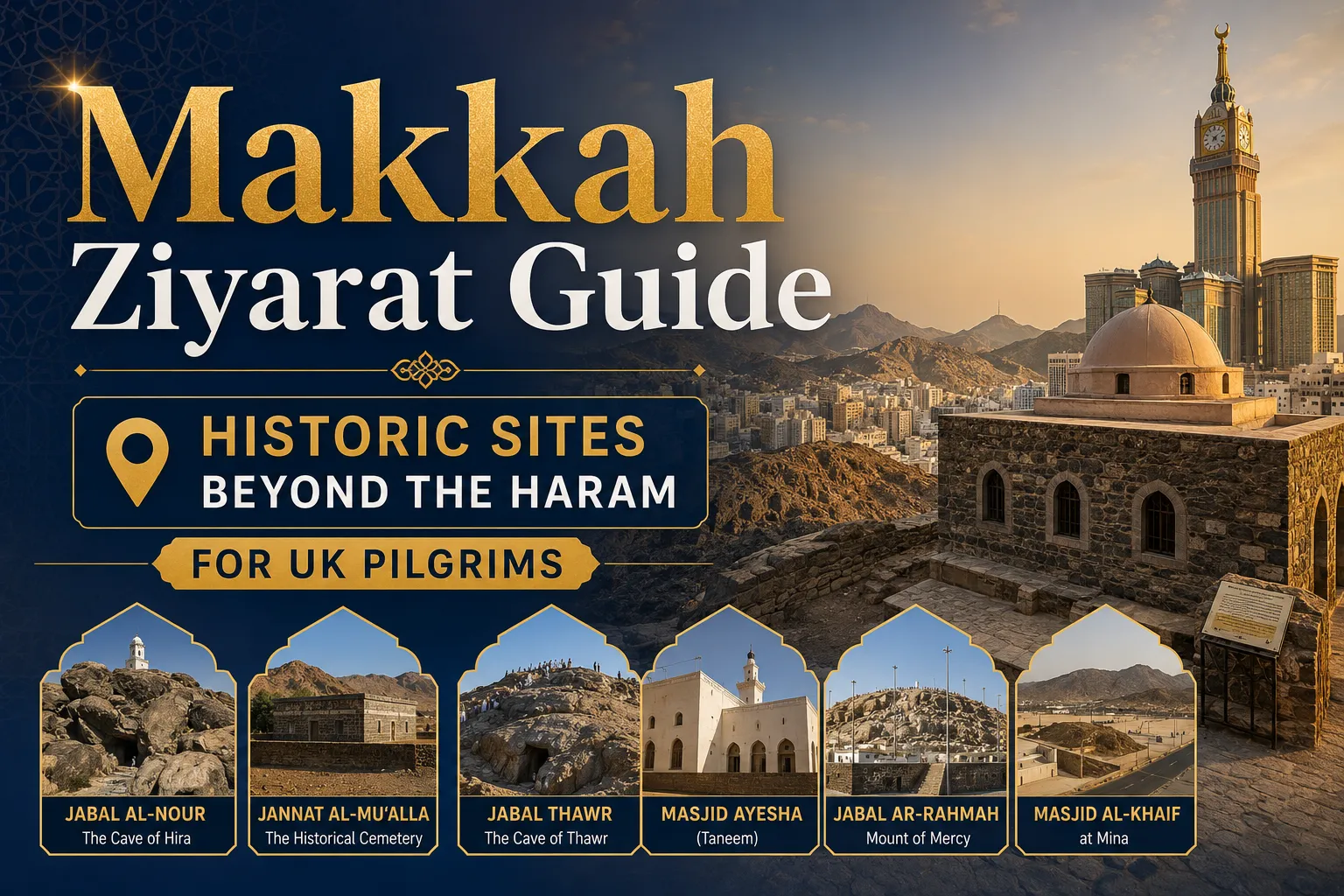
The Haram is why you are in Makkah. The Kaaba, Tawaf, Sa’i, the Multazam, the Zamzam well — all of this is the centre of the Makkah experience, and no UK pilgrim who spends every moment of their Makkah stay in the Haram has missed anything essential. The Ziyarat sites described in this guide are additions to that centre — places that give the Seerah a physical form, places that transform the narrative of early Islam from something you know intellectually into something you stand inside.
Standing in the Cave of Hira — the narrow crack of rock on the summit of Jabal al-Nour where Jibril (AS) appeared to the Prophet ﷺ and the word ‘Iqra’ was first spoken — changes your relationship with the Quran in a way that no tafsir class ever fully achieves. Standing at the entrance to the Cave of Thawr — where the Prophet ﷺ and Abu Bakr (RA) hid for three days while the entire Quraysh army searched for them — makes the verse ‘la tahzan, innAllaha ma’ana’ (do not grieve, indeed Allah is with us) a lived experience rather than a memorised text.
Packages Umrah (7 Huxley Avenue, Manchester M8 0SJ). UK Umrah packages from £645/pp all-inclusive. WhatsApp +44 7737 144335 — same-day quote.
# | Site | Distance from Haram | Mountain Climb? | Time to Allow | Seerah Connection |
1 | Jabal al-Nour (Cave of Hira) | ~4km north | Yes — 1–1.5 hrs return | 2–3 hours total | First revelation: ‘Iqra’ — the beginning of Islam |
2 | Jabal Thawr (Cave of Thawr) | ~5km south | Yes — 1.5–2 hrs return | 2.5–3.5 hours total | Hijra: Prophet ﷺ and Abu Bakr (RA) hid for 3 days |
3 | Jannat al-Mu’alla | ~1km north of Haram (walk) | No | 30–45 mins | Grave of Khadijah (RA), ancestors of Prophet ﷺ |
4 | Masjid Aisha (Tan’im) | ~6km north of Haram | No | 30–45 mins | Miqat for Makkah residents; second Umrah starting point |
5 | Masjid al-Jinn | ~1km from Haram (walk) | No | 20–30 mins | Site where Jinn accepted Islam — Surah al-Jinn |
6 | Masjid al-Rayah | ~2km from Haram | No | 20–30 mins | Where Prophet ﷺ placed flag at Conquest of Makkah |
7 | Mina | ~5km east of Haram | No | 30–60 mins drive-through | Hajj site; also connects to Seerah and Ibrahim (AS) |
8 | Plain of Arafat | ~25km from Haram | No | 30–60 mins drive-through (Hajj) or reflection only | Day of Arafah; Adam and Hawwa’s reunion; Day of Judgement echoes |
The Prophet ﷺ was in the Cave of Hira when Jibril (AS) came and said: ‘Iqra’ (Read/Recite). The Prophet ﷺ said: ‘I am not of those who read.’ Jibril embraced him tightly, then released him and said again: ‘Iqra.’ After the third time, he recited the first five verses of Surah al-Alaq. — Sahih Bukhari 3
The Cave of Hira sits near the summit of Jabal al-Nour — the Mountain of Light — approximately 640 metres above Makkah, 4km north of the Haram. The cave itself is a narrow fissure in the rock, approximately 3.7 metres long and 1.6 metres wide — barely large enough for two people to sit in. The Prophet ﷺ used to retreat to this cave, sometimes for days, in a practice of tahannuth — spiritual seclusion and devotion — before his prophethood began.
In the cave on the night of 27 Rajab (approximately 610 CE), when the Prophet ﷺ was 40 years old, Jibril (AS) appeared. What followed — the command ‘Iqra,’ the embrace, the Prophet’s ﷺ terror, his flight home to Khadijah (RA), her words of comfort (‘By Allah, Allah will never disgrace you…’), the visit to Waraqah ibn Nawfal — is the beginning of the Islamic revelation that UK Muslims recite in their prayers every day.
The first words ever revealed of the Quran were here, in this cave, to this man:
اقْرَأْ بِاسْمِ رَبِّكَ الَّذِي خَلَقَ
“Recite in the name of your Lord who created” — Al-Alaq 96:1 — the first verse of the Quran ever revealed
For a UK Muslim who has recited Surah al-Alaq since childhood without knowing what they were connected to — the cave where those words first descended is a physical encounter with the origin of everything they have believed.
The climb to Jabal al-Nour is one of the most physically demanding aspects of Makkah Ziyarat. UK pilgrims should understand what they are committing to before deciding whether to attempt it:
UK pilgrim fitness note: The Jabal al-Nour climb requires genuine physical fitness. UK adults who walk regularly will manage it comfortably in cool months. Elderly pilgrims, those with cardiac or respiratory conditions, pregnant women, and anyone with significant joint problems should not attempt the climb. The spiritual connection with Hira can be made from the mountain’s lower areas or from the Haram in dua — the cave itself is not visited for an obligatory purpose.
‘If you do not aid him (Muhammad ﷺ), Allah has already aided him when those who disbelieved had driven him out and he was but one of two, when they were in the cave — he said to his companion: Do not grieve; indeed Allah is with us.’ — Al-Tawbah 9:40
The Cave of Thawr is the site of one of the most dramatic moments in the entire Seerah. The year is 622 CE. The Quraysh of Makkah have decided to assassinate the Prophet ﷺ — a plan to send men from every tribe simultaneously so that no single tribe could be blamed by Banu Hashim for the killing. The Prophet ﷺ is warned by divine revelation of the plan, instructs Ali (RA) to sleep in his bed to delay the discovery of his departure, and leaves Makkah at night with Abu Bakr al-Siddiq (RA).
They travel south — in the opposite direction from Madinah, which is to the north — specifically to avoid the immediate Quraysh pursuit that would naturally chase northward. They hide in the Cave of Thawr on Jabal Thawr, approximately 760 metres above sea level, 5km south of Makkah. They stay for three days while the Quraysh search every approach out of Makkah. The Quraysh search party reaches the very entrance to the cave. Abu Bakr (RA) whispers to the Prophet ﷺ: ‘If any of them were to look down at their feet they would see us.’ The Prophet ﷺ replies: ‘What do you think, O Abu Bakr, of two whose third is Allah?’
The Quraysh search party does not enter the cave. Traditions narrate various explanations — a spider that wove a web across the entrance, a dove that had nested there with eggs. Whatever the means, the fact is the same: the most wanted man in Arabia was three days’ walk from his enemies, and the verse of Tawbah 9:40 was revealed about this specific moment. ‘Do not grieve; indeed Allah is with us.’
Jabal Thawr is 760 metres above sea level — taller than Jabal al-Nour. The climb is steeper and more demanding, with fewer constructed steps and more natural rock-face sections. UK pilgrims who found Hira challenging should understand that Thawr requires significantly more physical exertion:
At the cave entrance, recite the verse that was revealed here — Al-Tawbah 9:40. Allow yourself to understand the specific geography: the Quraysh search party was HERE, at this cave entrance, in this specific location. The Prophet ﷺ was inside. This is not a metaphorical closeness. It is a physical one. The spiritual weight of ‘Allah is with us’ carries its full meaning in the place where it was first made real.
The Prophet ﷺ is narrated to have visited Jannat al-Mu’alla and to have prayed for its occupants. Among those buried here is Khadijah bint Khuwaylid (RA) — his first wife, the first person to believe in him, the woman whose wealth funded the early Muslim community, and whose death he ﷺ mourned so deeply that he ﷺ called the year of her death the Year of Grief.
Jannat al-Mu’alla is the main Makkah cemetery, located approximately 1km north of the Haram — accessible on foot. It is one of the oldest cemeteries in Islamic history, predating the Prophet’s ﷺ prophethood. Among those buried here: Khadijah bint Khuwaylid (RA) — the Prophet’s ﷺ first and most beloved wife. Abd al-Muttalib — the Prophet’s ﷺ paternal grandfather. Aminah bint Wahb — the Prophet’s ﷺ mother, though she passed in al-Abwa and is buried there. The Prophet’s ﷺ son Qasim (RA), who died in infancy. Several other early Muslims of the Hashimi family.
Khadijah’s grave is particularly significant for UK Muslim pilgrims. The Prophet ﷺ did not remarry while Khadijah (RA) was alive — their marriage was the context for the entire first thirteen years of Islamic revelation in Makkah. When he ﷺ returned from Hira trembling and terrified, it was her lap he sought. When he ﷺ described to her what had happened, it was her words — ‘By Allah, Allah will never disgrace you; you keep good relations with your kith and kin, help the poor and the destitute, serve your guests generously and assist the deserving calamity-afflicted ones’ (Sahih Bukhari 3) — that first reassured him that he had not gone mad.
Jannat al-Mu’alla is approximately 1km north of the Haram and can be reached on foot. Specific visiting hours apply — typically open in the morning (approximately 8:00–11:00am) and for a period in the evening. The appropriate etiquette is the same as for any Muslim cemetery: offer the Salam dua for the deceased, make dua for yourself and your family, and do not touch graves or pray toward them. Allow 30–45 minutes for a respectful visit.
Masjid Aisha — also called Masjid Tan’im — is located approximately 6km north of Masjid al-Haram, at the boundary of the Haram zone (the sacred area surrounding Makkah). Its specific significance for UK Umrah pilgrims is practical as much as historical: this is the nearest Miqat point accessible from within Makkah for pilgrims who want to perform additional Umrahs. After completing their first Umrah and exiting Ihram in their hotel, pilgrims who want to perform a second Umrah travel to Masjid Aisha, enter Ihram, make the intention for a new Umrah, begin the Talbiyah, and return to the Haram to complete the four rituals again.
The mosque is named for Aisha bint Abi Bakr (RA) — the Prophet’s ﷺ wife and one of the most significant narrators of hadith in Islamic history. The narration that gives this mosque its name: during the Prophet’s ﷺ Farewell Pilgrimage, Aisha (RA) was unable to perform Umrah because she was in a state of menstruation. The Prophet ﷺ instructed her to complete Hajj and then perform Umrah from this location — entering Ihram at Tan’im. Her brother Abd al-Rahman ibn Abi Bakr (RA) accompanied her. (Sahih Bukhari 1560). The mosque marks the location where she entered Ihram.
Masjid Aisha is approximately 6km from the Haram. Taxi: 10–15 minutes, SAR 15–25 (£3–£5) each way. The mosque is a functional, modern mosque — accessible and open throughout the day. For UK pilgrims planning additional Umrahs:
‘Say, it has been revealed to me that a group of the Jinn listened and said: We have heard an amazing Quran — it guides to the right course, and we have believed in it.’ — Al-Jinn 72:1–2
Masjid al-Jinn is located approximately 1km northeast of the Haram — reachable on foot from the Haram area. It is built on the site where a group of Jinn are said to have gathered and listened to the Prophet ﷺ reciting the Quran, subsequently accepting Islam and returning to their communities to spread the message. This event is the subject of Surah al-Jinn (Chapter 72) — one of the few places in the Quran where non-human beings explicitly testify to the truth of the revelation.
For UK pilgrims who have grown up with the concept of Jinn as a theological fact of Islamic belief but without the specific geographical context, Masjid al-Jinn gives that belief a physical anchoring point. The Quran says it happened here. A mosque has stood on this site for centuries to mark that it happened here. The mosque is small and simple — not architecturally remarkable — but its significance is the event it marks.
Masjid al-Rayah — ‘the Mosque of the Flag’ — is located approximately 2km from the Haram and marks the site where the Prophet ﷺ planted his flag during the Conquest of Makkah in 8 AH (January 630 CE). The Conquest of Makkah is one of the most remarkable events in the Seerah — the city that had expelled the Prophet ﷺ eight years earlier, that had sent armies against the Muslim community at Badr, Uhud, and the Trench, was entered peacefully. The Prophet ﷺ entered at the head of an army of 10,000 but gave a general amnesty: ‘Go, for you are free.’
This site — where the flag was planted to mark the Muslim entry into Makkah — is a reminder of what happened to the city that the Prophet ﷺ and his companions had left in fear of their lives eight years before. The same city. A different relationship with it. For UK pilgrims who visit the Haram and perform Tawaf, the Conquest of Makkah is the event that made that Tawaf available to them. The flag planted at Masjid al-Rayah is part of that story.
Mina is a valley approximately 5km east of the Haram — the site of the Hajj ritual stoning of the Jamarat (symbolic stoning of the devil at three pillars). For Umrah pilgrims who are not performing Hajj, Mina is typically included in a Ziyarat drive-through rather than an extensive visit — the tented city of Mina (which houses 2.5 million Hajj pilgrims during the Hajj days) is largely empty during non-Hajj periods. The valley is visible from the road, and some pilgrims stop briefly at the Jamarat area to see the three pillars that mark the sites of Shaytan’s appearance to Ibrahim (AS).
The Ibrahim (AS) connection at Mina is profound: it is here that Shaytan appeared three times to Ibrahim (AS) as he was taking his son Ismail (AS) to be sacrificed in obedience to Allah’s command. Ibrahim (AS) stoned the devil at three locations. The Hajj ritual of Ramy al-Jamarat — the stoning — commemorates Ibrahim’s (AS) rejection of Shaytan’s whispers. The Eid al-Adha sacrifice, which UK Muslims perform globally every year, commemorates the same event. Mina is the physical location of that story.
The Prophet ﷺ said: ‘Hajj is Arafat.’ — Tirmidhi 889, Abu Dawud 1949
The Plain of Arafat — where pilgrims must stand on the Day of Arafah (9th Dhul Hijjah) for Hajj to be valid — is approximately 25km southeast of Makkah. For Umrah pilgrims, Arafat is not a ritually required stop. It is included in extended Ziyarat tours (typically on the same journey as Mina and Muzdalifah) as a reflective visit to one of the most significant physical locations in Islamic history.
Jabal al-Rahmah — the Mount of Mercy — rises from the plain of Arafat. It is on this mountain that Adam (AS) and Hawwa are said to have been reunited after their descent from Paradise to separate locations on earth. It is at this plain that the Prophet ﷺ delivered his Farewell Sermon (Khutbat al-Wada’) on 9 Dhul Hijjah 10 AH — the comprehensive statement of Islamic principles that remains one of the most significant speeches in world history. And it is here that, on the Day of Judgement, mankind will stand for the accounting.
Standing on the plain of Arafat as an Umrah pilgrim — knowing the Hajj pilgrims who fill this plain on the Day of Arafah, knowing the Farewell Sermon was delivered here, knowing this is the place the Prophet ﷺ said ‘Hajj is Arafat’ — connects you to a future obligation and a vast Islamic tradition in a way that is only possible through physical presence.
Before any UK pilgrim plans their Makkah Ziyarat schedule, it is important to understand the appropriate place of Ziyarat within the Makkah visit. Ziyarat in Makkah is voluntary worship — it is not obligatory, not recommended by any madhab to the extent that it takes precedence over Haram worship, and not a religious requirement that would leave a deficiency if skipped.
The priority order for a Makkah stay: (1) Complete Umrah rituals correctly — Ihram, Tawaf, Sa’i, Halq/Taqsir. (2) Maximise Haram worship — voluntary Tawaf, prayer in congregation, dua, Quran recitation. (3) Rest and physical maintenance — the Haram is demanding, and exhausted worship is less spiritually present than rested worship. (4) Ziyarat — if time, energy, and health permit, as an enrichment of the experience, not as an obligation.
Do not sacrifice Haram worship for Ziyarat. A UK pilgrim who performs every Haram prayer, makes extensive personal dua, performs multiple voluntary Tawaf circuits, and leaves Makkah without visiting a single Ziyarat site has used their Makkah time far better than a pilgrim who does one Tawaf and spends the rest of the time climbing mountains. The Haram is the reason for the trip. The Ziyarat sites are the context.
Option | Cost (approx.) | Best For | Practical Notes |
Shared Ziyarat tour bus | SAR 40–80/person (£8–16) | Most pilgrims; first-time Ziyarat | Ask at your hotel reception. Daily tours from Zone 1 and Zone 2 hotel areas. Fixed route, multiple stops. |
Private taxi (group 4+) | SAR 100–200 total (£20–40) | Families; elderly; flexible timing | Negotiate total fare before entering. Covers most major sites in 3–4 hours. |
Walking (select sites) | Free | Jannat al-Mu’alla; Masjid al-Jinn; Masjid al-Rayah | Within ~2km of Haram. In cool months only. |
Uber/Careem app | SAR 15–40 each way (£3–8) | Solo pilgrims; flexible timing | Available in Makkah. Good for individual site visits. |
Month | Mountain Climbs (Hira/Thawr) | Non-Climb Sites | General Note |
October/November | 7:00–9:30am. Comfortable. | Any morning or evening | Best Ziyarat conditions of the year. Recommend both mountains. |
December/January | 8:00–10:30am. Comfortable. | Any time | Good conditions. January slightly cooler at higher altitude — bring a light layer. |
April (Easter) | 6:30–9:00am. Warm building. | Morning preferred | Manageable but climbing in the afternoon heat not advised. |
July/August | Pre-dawn ONLY (3:30–5:30am). Extreme heat risk. | Morning only, before 10am | Mountain climbs in summer require pre-dawn timing or should be skipped. |
March (Ramadan) | Pre-Suhoor timing OR skip | Early morning or after Iftar | Fasting adds dehydration risk to mountain climbs. Consider skipping Hira/Thawr. |
With 4 Makkah nights and the Umrah to complete, Ziyarat must be selective. Priority recommendation:
Six Makkah nights allow for both thorough Ziyarat and substantial Haram worship time:
Eight Makkah nights give time for all Ziyarat sites, multiple Umrahs, and sustained Haram worship without compromise:
Package | Duration | Makkah Nights | Madinah Nights | Price Per Person |
3★ — 7 Nights | 7N (4 Makkah + 3 Madinah) | 4 | 3 | From £645/pp |
3★ — 10 Nights | 10N (6 Makkah + 4 Madinah) | 6 | 4 | From £695/pp |
3★ — 12 Nights | 12N (7 Makkah + 5 Madinah) | 7 | 5 | From £735/pp |
3★ — 14 Nights | 14N (8 Makkah + 6 Madinah) | 8 | 6 | From £775/pp |
4★ — 10 Nights | 10N (6 Makkah + 4 Madinah) | 6 | 4 | From £845/pp |
Off-peak months. All-inclusive: flights, visa, named hotels both cities, Rawdah booking, all transport. ATOL protected.
How hard is the climb to the Cave of Hira?
Moderately hard — approximately 1,200 steps, 640m altitude, 45–75 minutes ascent. Suitable for fit adults in good health. Not suitable for elderly pilgrims with mobility issues, cardiac conditions, or anyone with joint problems. In cool months (October–January), morning climbs are very manageable for fit UK adults.
What time should I start the Jabal al-Nour climb?
Pre-dawn (3:00–4:00am) is the best time — reaching the summit for Fajr. In cool months (October–January), 7:00–9:00am is also comfortable. In summer (June–August), only pre-dawn climbs are safe — never after 6:00am due to heat.
What was the first verse of the Quran revealed in the Cave of Hira?
The first five verses of Surah al-Alaq (96:1–5): ‘Iqra bismi rabbika alladhi khalaq… Read in the name of your Lord who created…’ These were revealed on the Night of Power (Laylatul Qadr) in Ramadan 610 CE.
Is it Sunnah to visit the Cave of Hira?
The Prophet ﷺ himself retreated to Hira before prophethood, but there is no established Sunnah to visit it after prophethood as a specific act of worship. Visiting Hira is a Ziyarat — a voluntary visit to a historical Islamic site for reflection and historical connection. The scholars differ on its recommended status; many permit it as a form of seeking historical connection to the Seerah.
Is the Cave of Thawr harder to climb than Hira?
Yes — Jabal Thawr is 760m above sea level (higher than Hira’s 640m) and has fewer constructed steps, with more natural rock sections. Most UK pilgrims who have done both describe Thawr as significantly more demanding. Allow 2–2.5 hours minimum.
Which Quran verse refers to the Cave of Thawr?
Al-Tawbah 9:40: ‘If you do not aid him, Allah has already aided him when those who disbelieved had driven him out — he was but one of two, when they were in the cave — he said to his companion: Do not grieve, indeed Allah is with us.’ The companion in the cave is Abu Bakr al-Siddiq (RA).
Who is buried at Jannat al-Mu’alla?
Among others: Khadijah bint Khuwaylid (RA) — the Prophet’s ﷺ first wife; Abd al-Muttalib — his grandfather; and other members of the Hashimi family and early Muslims. Khadijah’s grave is the most visited by pilgrims.
Can women visit Jannat al-Mu’alla?
The visiting hours for women at Makkah cemeteries are typically more restricted than for men. Confirm current visiting hours with your Packages Umrah agent before departure, as these can vary by season and Saudi authority policy.
Why is Masjid Aisha important for UK pilgrims performing multiple Umrahs?
Masjid Aisha at Tan’im is the nearest Miqat point accessible from within Makkah. After completing your first Umrah and exiting Ihram, you travel to Masjid Aisha to re-enter Ihram for a second Umrah. This is the established practice for additional Umrahs performed during a single stay in Makkah.
How far is Masjid Aisha from the Haram?
Approximately 6km north of the Haram. Taxi: 10–15 minutes. Approximately SAR 15–25 (£3–£5) each way.
Is Ziyarat in Makkah obligatory?
No — Ziyarat in Makkah is voluntary. The obligatory elements of Umrah (Ihram, Tawaf, Sa’i, Halq/Taqsir) are all performed within or immediately outside the Haram. Ziyarat of historical sites is voluntary worship for reflection and historical connection.
How much does a Makkah Ziyarat tour cost?
Shared Ziyarat tour: SAR 40–80 per person (£8–16). Private group taxi: SAR 100–200 total (£20–40) for a 3–4 hour circuit of major sites. Walking distance sites (Jannat al-Mu’alla, Masjid al-Jinn) are free.
Can elderly pilgrims do Makkah Ziyarat?
Most sites except the mountain climbs are accessible for elderly pilgrims. Jannat al-Mu’alla, Masjid Aisha, Masjid al-Jinn, Masjid al-Rayah, and the Mina/Arafat drive-through are all suitable. Jabal al-Nour and Jabal Thawr mountain climbs are not recommended for elderly pilgrims with mobility, cardiac, or respiratory conditions.
Is it permitted to take photos at the Ziyarat sites?
Photography is generally permitted at the open sites (mountains, plain of Arafat, Mina). At mosques, photography is typically permitted in external areas but more restricted inside. At Jannat al-Mu’alla, photography of graves is considered disrespectful by most scholars and should be avoided. Use your judgment about when photography is appropriate — the experience of being at these sites is more significant than the photograph of having been there.
How many Makkah nights do I need for meaningful Ziyarat?
Four Makkah nights (7-night package) is sufficient for the walking-distance sites and one mountain climb. Six Makkah nights (10-night package) gives comfortable time for all major sites including both mountains. Eight Makkah nights (14-night package) allows unhurried Ziyarat alongside multiple Umrahs and maximum Haram worship.
How much is a 10 nights Umrah package from UK?
From £695/pp (3-star, off-peak months, all-inclusive). 6 Makkah nights — enough for all major Ziyarat alongside Haram worship. 4 Madinah nights — enough for Madinah Ziyarat including Uhud and Quba.
How do I book an Umrah package?
WhatsApp +44 7737 144335. Same-day quote. All-inclusive from £645/pp. ATOL protected. Named hotels in both cities confirmed before deposit.
The Haram is the reason for the journey. The Kaaba is why every Muslim on earth turns in the same direction five times a day. But the city of Makkah — the mountain where the first word of the Quran was spoken, the cave where the Prophet ﷺ and his closest companion sheltered while the world searched for them, the cemetery where Khadijah (RA) rests — this city is the context that makes the Haram fully comprehensible.
You do not have to climb Hira. You do not have to stand at Thawr. You do not have to visit Jannat al-Mu’alla. These are additions to a journey whose centre is the Haram and the Kaaba and the dua you have been carrying all your life. But if you have the time and the energy and the fitness, the places described in this guide will give the Seerah a physical form that no book or lecture can replicate. The story of Islam happened in real places. Some of those places are still there.
Our packages from £645/pp include 4–8 Makkah nights depending on duration — all with named hotels, Ziyarat accessible by local taxi or shared tour from any hotel. All-inclusive, ATOL protected, 24/7 agent support.
📲 WhatsApp for your Umrah quote: +44 7737 144335 — Same-Day Response
📍 7 Huxley Avenue, Manchester M8 0SJ | 🗣 English & Urdu | All UK Airports | ATOL Protected
Packages Umrah — UK Umrah specialists. From £645/pp all-inclusive. Makkah and Madinah included. Same-day quotes.

Verified Umrah Travel Specialist
Written By: Azeem Ali
A seasoned Umrah travel specialist with more than 10 years of experience in planning and managing Umrah journeys. Every article is carefully prepared by Azeem Ali, drawing on years of expertise in assisting thousands of pilgrims from the UK. Our goal is to provide reliable, up-to-date, and practical guidance to help you confidently prepare for your sacred journey.
PACKAGES UMRAH
SERVICES FROM UK
Latest Articles