


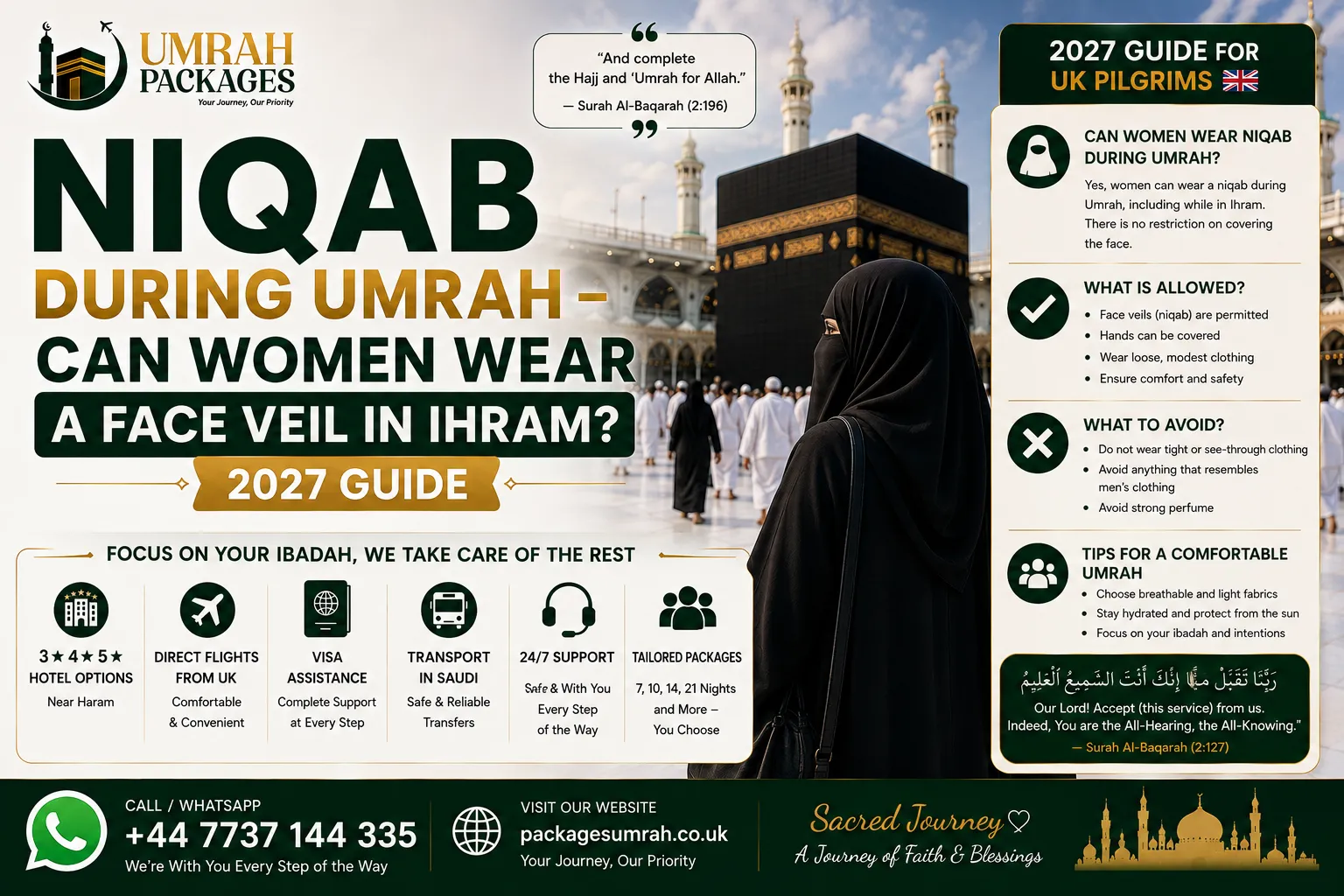
No — a woman in the state of Ihram cannot wear a niqab (fitted face veil that attaches to the head). This is based on an explicit hadith narrated in Sahih Bukhari: ‘A woman in Ihram should not wear a niqab or gloves.’ This is among the few Ihram rulings on which there is near-unanimous scholarly agreement. However — and this is critically important — the prohibition is specifically on the niqab as a fitted garment. A woman may cover her face in Ihram by draping her headscarf or garment loosely over her face, provided it does not touch the face. This distinction is the key to how niqabi UK Muslim women navigate Umrah with both scholarly compliance and modesty.
For UK Muslim women who wear the niqab as a daily practice, the Ihram ruling is one of the most practically significant questions in preparing for Umrah. It is not a question with a comfortable answer — the prohibition on the fitted niqab is clear in the hadith, agreed upon by scholars across all four madhabs, and creates a genuine practical challenge for women who have not uncovered their face in public in years. This guide addresses the ruling honestly, explains the reason behind it, and gives the complete scholarly guidance on how to maintain modesty in Ihram for women who normally wear niqab.
Packages Umrah (7 Huxley Avenue, Manchester M8 0SJ). Women’s Umrah packages from £645/pp. ATOL protected. WhatsApp +44 7737 144335 — same-day quote.
The prohibition on wearing niqab in Ihram is based on an explicit narration from the Prophet ﷺ, narrated by Abdullah ibn Umar (RA) and recorded in Sahih Bukhari:
وَلَا تَنْتَقِبِ الْمَرْأَةُ الْمُحْرِمَةُ وَلَا تَلْبَسِ الْقُفَّازَيْنِ
Wa la tantaqib al-mar’atu al-muhrimatu wa la talbas al-quffazayn
“And the woman in Ihram should not wear a niqab (face veil) nor wear gloves.” — Sahih Bukhari 1838
This narration appears in the context of the Prophet ﷺ instructing pilgrims on the garments and restrictions of Ihram. It is directed specifically at women — the niqab prohibition parallels the prohibition on men covering their heads in Ihram, and the gloves prohibition parallels the prohibition on men wearing stitched clothing. The symmetry is not coincidental: it reflects the Ihram principle that certain parts of the body are to be left uncovered as an act of consecration before Allah.
The prohibition is reinforced by a second narration:
إِحْرَامُ الْمَرْأَةِ فِي وَجْهِهَا
Ihramu al-mar’ati fi wajhiha
“The Ihram of a woman is in her face.” — narrated by al-Dar al-Qutni
This narration — though debated in terms of chain strength — captures the principle that scholars across all madhabs have applied: for a woman in Ihram, the face is uncovered just as a man’s head is uncovered. The face is the specific part of a woman’s body that enters the state of Ihram exposure, symbolically corresponding to the man’s uncovered head.
The reason the niqab is prohibited while other face coverings may be permitted (in certain conditions) lies in a specific technical distinction in Islamic jurisprudence — one that explains what appears to be a contradiction: ‘niqab is forbidden, but covering the face is permitted.’ Understanding this distinction is the key to the entire ruling.
The scholars derived from the Ihram rules a general principle: what is prohibited in Ihram is wearing garments that are specifically cut or tailored to fit specific body parts. For men: chemises (tailored for the torso), trousers (tailored for the legs), turbans (tailored for the head). For women: the niqab (tailored/fitted specifically for the face). The Permanent Committee of Senior Scholars in Saudi Arabia stated in Fatawa al-Lajnah al-Da’imah: ‘the reason why the woman in Ihram is forbidden to wear the niqab is because the niqab has been made to fit the face.’ Ibn al-Qayyim stated in Bada’i al-Fawa’id: ‘She is prohibited from wearing the burqu’ and niqab because they are specifically made for covering the face.’
The technical principle: In Ihram, wearing garments tailored to fit specific body parts is prohibited. For women, the niqab — because it is sewn and shaped to fit the contours of the face — is a ‘fitted face garment’ and therefore falls under the same prohibition as men’s tailored clothing. A loose scarf or garment draped over the face is NOT tailored to the face — it is merely cloth held in position — and therefore does not fall under the same prohibition.
The near-unanimous scholarly position across all four madhabs is that while the fitted niqab is prohibited, covering the face by draping a headscarf, khimar, or any piece of cloth loosely over the face is permitted — as long as the cloth does not touch the face. This permitted method of face covering is referenced in multiple classical and contemporary scholarly sources:
Ibn al-Qayyim states in Bada’i al-Fawa’id: ‘She is entitled to cover her face with anything other than a face veil — she can let her head cover hang down on her face.’ Ibn Uthaymeen (RA) concurred with this position. The Mathabah Learning Centre (citing classical Hanafi and Shafi’i sources) confirms: ‘The Hanafi and Shafi’i schools permit women to cover their faces during Ihram, regardless of whatever the reason, provided the veil cloth does not touch the face.’
In practice, the ‘draping method’ works as follows: The woman wears her normal headscarf or khimar. When she is in proximity to non-Mahram men, she lowers or extends the front of her headscarf so that it falls over her face, covering it. Crucially, the cloth must not touch or rest directly against the face — it should fall in front of the face with a gap between the cloth and the skin. The common practical method used by many niqabi women performing Hajj and Umrah is to hold the cloth away from the face slightly with a finger or to use a face frame (a semi-circular structure worn under the cloth to hold it away from the face).
A practical solution widely used by niqabi women performing Hajj and Umrah is a face frame — sometimes called a Sitr frame or nose piece. This is a lightweight semi-circular structure, typically made of plastic or flexible cardboard, worn on the nose bridge and upper face. The headscarf is then draped over this frame, allowing the cloth to cover the face without touching the skin. This satisfies the scholarly condition that the cloth does not directly contact the face, while achieving modesty comparable to that of a niqab. Face frames specifically designed for Ihram use are available in Islamic bookshops and online before Umrah travel.
Item | Permitted in Ihram? | Condition / Notes |
Fitted niqab (attached to head, shaped to face) | NO — prohibited | Clear hadith prohibition. Consensus of scholars. Any fitted face veil regardless of material. |
Burqu’ (another type of fitted face veil) | NO — prohibited | Specifically mentioned in classical scholarly sources as prohibited — same ruling as niqab. |
Litham (a face covering that ties at the back) | NO — prohibited | Scholars such as Imam Ahmad ibn Hanbal specifically prohibited this as it is effectively a niqab. |
Face mask (medical/surgical) | NO — prohibited during Ihram | Islamqa.info: a face mask is a niqab — tailored to fit the face — and shares the same prohibition. Exception for genuine medical necessity. |
Headscarf/khimar draped over face (not touching) | YES — permitted | Cloth must not touch the face. Used when passing non-Mahram men. Classic scholarly permission. |
Face frame under draped headscarf | YES — permitted | Holds cloth away from face. Widely used by niqabi women at Hajj/Umrah. Satisfies the ‘not touching’ condition. |
Sleeve or garment held over face | YES — permitted | As long as the fabric does not directly touch the face as a fitted covering. |
Gloves (fitted for the hand) | NO — prohibited | Explicitly mentioned in the hadith alongside niqab. Same principle: tailored for a specific body part. |
Covering hands with sleeves or scarf | YES — permitted | The prohibition is on fitted gloves specifically; covering hands with loose sleeves is not the same. |
Glasses (prescription or sunglasses) | YES — permitted | Not a garment tailored to the face; a functional item. |
Face shield (not touching skin) | Scholarly debate — caution advised | Similar to face frame principle; consult your imam for specific guidance. |
All four madhabs agree that the fitted niqab is prohibited in Ihram. Where they differ is on the question that arises immediately from this prohibition: if the face must be uncovered, what happens to the Hanafi requirement that the face be covered in front of non-Mahram men?
The Hanafi madhab holds that it is necessary (wajib) for a woman to cover her face in front of non-Mahram men — the face is considered effectively part of the awrah (that which must be covered) in the Hanafi school due to the risk of fitna (temptation/harm). This creates a specific challenge in Ihram: the niqab is prohibited, but the face must be covered when non-Mahram men are present. The Hanafi resolution: the woman covers her face using the draping method — lowering her headscarf over her face without the cloth touching the face. This satisfies the Ihram restriction (no fitted face veil) while maintaining the Hanafi requirement of face covering in the presence of non-Mahram men.
The DarulIftaa Islamqa.org note on this Hanafi position: ‘Indeed a woman must not have a cloth whilst in Ihram that touches her face. However, at the same time, she should avoid exposing her face in front of non-Mahram men, especially when she is young and when the risk of fitna is greater. As such, in the presence of non-Mahram men, she should [drape the cloth over her face].’
This creates a practical situation for Hanafi niqabi women performing Umrah: the face is uncovered when no non-Mahram men are in immediate proximity, and covered by the draped method when non-Mahram men pass near. In the Haram — which is often crowded with men — this may mean the face is frequently covered by the draping method throughout the Tawaf and Sa’i, which is entirely consistent with both the Ihram restriction and the Hanafi modesty requirement.
The Maliki school does not hold that covering the face in front of non-Mahram men is obligatory in the same way as the Hanafi school. From the Maliki perspective, the face is not awrah — and therefore, a woman performing Ihram whose face is uncovered is not in violation of any Maliki modesty requirement, even in the presence of men. The niqab is still prohibited (the hadith prohibition applies to all madhabs), but the Maliki woman does not face the additional challenge of needing to find an alternative face-covering method. Her face simply remains uncovered during Ihram.
The Shafi’i school is similar to the Maliki in that it does not hold the face as awrah requiring mandatory covering in front of non-Mahram men in the same way. A Shafi’i woman’s face during Ihram can remain uncovered. The Shafi’i school also permits the draping method for women who, due to personal piety or specific circumstances, want to cover their face — as long as the cloth does not touch the face. The Mathabah Learning Centre (citing Shafi’i sources) confirms the draping permission regardless of specific reason.
The Hanbali school holds that a woman’s face is awrah (requiring covering) in front of non-Mahram men. This creates the same practical situation as the Hanafi: the fitted niqab is prohibited in Ihram, but the face must be covered when non-Mahram men are present. The Hanbali solution is identical to the Hanafi: draping the headscarf over the face without touching it. Imam Ahmad ibn Hanbal specifically prohibited the litham (a tied face covering) as equivalent to the niqab — but permitted the draped method. The face frame approach (widely used by Hanbali women performing Hajj in Saudi Arabia) satisfies both the Ihram restriction and the Hanbali covering requirement.
Madhab | Niqab in Ihram | Face Awrah? | What to Do in Ihram |
Hanafi | PROHIBITED | Yes — must cover in front of non-Mahram men | Drape headscarf over face (not touching) when non-Mahram men are present. Face uncovered otherwise. |
Maliki | PROHIBITED | No — face not obligatory awrah | Face can remain uncovered during Ihram. No additional covering requirement. |
Shafi’i | PROHIBITED | No — but draping permitted if desired | Face can remain uncovered. Draping method permitted without specific condition. |
Hanbali | PROHIBITED | Yes — must cover in front of non-Mahram men | Drape headscarf over face (not touching) when non-Mahram men are present. Face uncovered otherwise. |
Before your Umrah departure, practice lowering your headscarf or khimar over your face so that the cloth covers your face without touching your skin. This is a technique that requires practice — doing it for the first time in the middle of Tawaf while maintaining your circuit count is not the moment to figure out the logistics. Use a mirror. Practice until you can do it smoothly.
A Sitr face frame (nose piece) holds the cloth away from the face automatically without requiring you to hold it. These are widely available at UK Islamic bookshops, Hajj/Umrah equipment suppliers, and online. They are inexpensive and solve the practical problem of cloth resting on the face during sustained Tawaf or Sa’i.
For UK niqabi women who have worn the niqab consistently for years, the prospect of their face being uncovered in a public environment — even one as spiritually significant as the Haram — can create genuine anxiety. It is worth reflecting before departure on the specific nature of the Haram environment: the crowd is almost entirely Muslim pilgrims in a state of worship, the Ihram rule applies equally to all women present (no woman is wearing a niqab in the Haram during Ihram), and the instruction comes from the Prophet ﷺ himself rather than from a cultural preference or administrative rule.
Tawaf in the Mataf (the area around the Kaaba) brings the pilgrim into proximity with other pilgrims of all genders. For Hanafi and Hanbali niqabi women who follow the face-covering requirement, the draping method is used when non-Mahram men are in close proximity. Practical notes:
The Sa’i walkway (Mas’a) is a covered, air-conditioned passage with pedestrian lanes. Men and women share the walkway, though there are often distinct lanes. The draping method applies throughout Sa’i for women following the Hanafi/Hanbali covering requirement. The Mas’a’s closed environment makes the face frame particularly practical — wind (which can dislodge draped cloth in the outdoor Mataf) is not a factor in the enclosed walkway.
The Ihram state — and its restrictions including the niqab prohibition — begins when you enter Ihram at the Miqat (on the aircraft as it crosses the Miqat boundary, or at the departure airport if you put on Ihram before boarding). The niqab prohibition applies from this point until Halq or Taqsir (cutting/shaving the hair) completes the Umrah and exits the Ihram state. After Halq/Taqsir, the niqab can be immediately resumed. The Ihram state for Umrah is typically 3–5 hours of active ritual time — though you may be in Ihram for longer due to the time between the Miqat boundary (on the flight) and completing the Umrah rituals in Makkah.
For UK niqabi women: put on the Ihram at the departure airport (the UK airport) or on the aircraft before the Miqat announcement. Once in Ihram, the niqab must be removed. Re-enter your normal niqab practice immediately after completing Halq/Taqsir — typically in the hotel room after returning from the Haram. The period without the niqab covers only the active Ihram period, not the entire Makkah stay.
Gloves are prohibited in Ihram for women alongside the niqab — both are explicitly mentioned in the same hadith (Bukhari 1838). The same principle applies: fitted gloves (sewn to fit the hand) are prohibited. Covering the hands with the sleeves of the abaya or with a loose scarf is permitted, because loose cloth covering is not the same as fitted gloves. UK niqabi women who also wear gloves as part of their normal modest dress should remove both niqab and gloves upon entering Ihram, and can cover hands with sleeves as needed.
If a woman in Ihram accidentally wears the niqab or the draped cloth touches her face (the material is in contact with the face, as a fitted niqab would be), a penalty (dam) may become due depending on the duration and circumstances. Scholars differ on the specifics:
For UK niqabi Muslim women who have committed to wearing the niqab as part of their practice, the Ihram face rule can initially feel like a contradiction — a restriction on their modesty rather than an expression of it. Understanding the spiritual reasoning behind the rule changes this perception entirely.
The Ihram state is a state of deliberate simplification — the pilgrim strips away the markers of worldly identity and status to stand before Allah in the most fundamental form. For men, this means removing tailored, stitched clothing and wearing two plain white cloths — identical to the shroud. For women, it means removing the fitted face veil that distinguishes the niqabi from the non-niqabi, the one who covers her face from the one who does not. In Ihram, those distinctions dissolve. Every woman stands before the Kaaba in the same state of face-uncovered consecration.
There is a specific and beautiful symmetry in the Ihram rules: a man’s head — normally covered by a kufi or turban as an act of modesty — is uncovered in Ihram. A woman’s face — covered in daily life by many as an act of modesty — is uncovered in Ihram. Both are acts of presenting oneself before Allah in a specific, prescribed way that is different from the everyday standard of modesty. The scholar Ibn al-Qayyim wrote in Zad al-Ma’ad: ‘The woman’s Ihram is in her face, just as the man’s Ihram is in his head.’ Both are deliberate, prescriptive acts of Ihram exposure — not concessions to worldly convenience.
The niqab prohibition in Ihram is not a relaxation of modesty requirements — it is itself an act of worship, prescribed by the Prophet ﷺ, that requires a specific form of consecrated exposure before Allah. The niqabi woman who removes her veil in Ihram and covers her face by draping rather than by fitted veil is obeying the Prophet ﷺ in a manner that her regular niqab practice — however sincere — would not achieve. This is a different kind of worship, not a lesser one.
All packages below are genuinely all-inclusive: return flights, Umrah visa, Makkah and Madinah hotels, Rawdah pre-booking, and all Saudi Arabia transport. ATOL protected. Off-peak months (November, January, October, September).
Package | Duration | Makkah Nights | Madinah Nights | Price Per Person |
3★ — 7 Nights | 7 Nights | 4 Nights | 3 Nights | From £645/pp |
3★ — 10 Nights | 10 Nights | 6 Nights | 4 Nights | From £695/pp |
3★ — 12 Nights | 12 Nights | 7 Nights | 5 Nights | From £735/pp |
3★ — 14 Nights | 14 Nights | 8 Nights | 6 Nights | From £775/pp |
Women-only group (10+): from £625/pp. Off-peak all-inclusive pricing.
Package | Duration | Makkah Nights | Madinah Nights | Price Per Person |
4★ — 7 Nights | 7 Nights | 4 Nights | 3 Nights | From £765/pp |
4★ — 10 Nights | 10 Nights | 6 Nights | 4 Nights | From £845/pp |
4★ — 12 Nights | 12 Nights | 7 Nights | 5 Nights | From £925/pp |
4★ — 14 Nights | 14 Nights | 8 Nights | 6 Nights | From £1,005/pp |
100–400m from Haram. Recommended for summer months and elderly women.
Can a woman wear a niqab in Ihram?
No. The fitted niqab is prohibited in Ihram based on an explicit hadith in Sahih Bukhari: ‘A woman in Ihram should not wear a niqab or gloves.’ This is the consensus of scholars across all four madhabs.
Which hadith prohibits niqab in Ihram?
Sahih Bukhari 1838, narrated by Abdullah ibn Umar (RA): the Prophet ﷺ listed the Ihram restrictions and stated specifically, ‘the woman in Ihram should not wear a niqab or gloves.’ This is among the most clearly established Ihram prohibitions.
Is this ruling agreed upon by all four madhabs?
Yes. All four madhabs — Hanafi, Maliki, Shafi’i, and Hanbali — agree that the fitted niqab is prohibited in Ihram. This is one of the few Ihram rulings on which near-unanimous scholarly agreement exists. The differences between the madhabs are on related questions (face-covering requirements, gloves, and the draping method) — not on the core prohibition of the fitted niqab.
Why is the niqab specifically prohibited?
Because it is a garment specifically tailored and shaped to fit the face. The Ihram principle prohibits wearing garments that are cut and fitted to specific body parts. For men, this means no stitched chemise or tailored trousers. For women, this means no fitted niqab. A loose cloth draped over the face is not fitted to the face and is therefore not prohibited.
Does the prohibition also apply to the burqa’ and litham?
Yes. Scholars explicitly include the burqa’ (another type of face veil) and the litham (a face covering tied at the back) under the same prohibition as the niqab — all are fitted or tied face coverings that share the niqab’s prohibited characteristic of being specifically designed for the face.
Can a woman cover her face in any way during Ihram?
Yes — by draping her headscarf or khimar loosely over her face so that the cloth covers the face without touching it. This is explicitly permitted by scholars including Ibn al-Qayyim, Ibn Uthaymeen, and scholars across all four madhabs. The key condition: the cloth must not touch or rest directly against the face.
What is a Sitr face frame and how does it help?
A Sitr frame (nose piece) is a lightweight semi-circular plastic or flexible frame worn on the bridge of the nose. The headscarf is then draped over this frame, which holds the cloth away from the face — satisfying the ‘cloth not touching the face’ condition while covering the face fully. Face frames are widely used by niqabi women performing Hajj and Umrah and are available from UK Islamic bookshops.
Can I hold my headscarf over my face with my hand?
Yes — holding the headscarf in front of your face with your hand so that the cloth covers your face without touching it satisfies the Ihram condition. This is less practical during Tawaf and Sa’i (which require walking for extended periods) than the face frame solution, but it is valid.
Does the headscarf have to be a specific colour or type?
No. Any modest headscarf or headcovering can be used for the draping method — colour and material are not restricted. Most niqabi women use their regular headscarf or khimar.
Can I wear my niqab between the Miqat and arriving in Makkah?
No — the Ihram state begins when you enter Ihram at the Miqat (typically on the aircraft as it crosses the boundary, or at the UK airport if you put on Ihram before boarding). From the moment of entering Ihram, the niqab must be removed. The restriction applies throughout the Ihram period — on the aircraft, in Jeddah airport, in the transport to Makkah, and during the rituals — until Halq/Taqsir completes the Umrah.
In the Hanafi madhab, must a woman cover her face during Ihram?
The Hanafi position creates a specific tension: the fitted niqab is prohibited (hadith), but covering the face in front of non-Mahram men is required (Hanafi ruling on face as awrah). The resolution: use the draping method — lower the headscarf over the face without touching it when non-Mahram men are present. Face uncovered at other times.
In the Maliki and Shafi’i madhabs, must the face be covered during Ihram?
No — both madhabs do not hold the face as obligatory awrah in the same way as Hanafi and Hanbali. A Maliki or Shafi’i woman’s face can remain uncovered during Ihram without this constituting a modesty violation. Draping is still permitted for women who wish to cover, provided the cloth does not touch the face.
What does the Hanbali school say?
The Hanbali school holds a position close to the Hanafi: the face should be covered in front of non-Mahram men (face is considered awrah in the Hanbali school), but the fitted niqab is prohibited in Ihram. The solution is the same: the draping method, held away from the face. Imam Ahmad ibn Hanbal specifically prohibited the litham (tied face covering) as equivalent to the niqab.
Can women wear gloves in Ihram?
No. Gloves are explicitly prohibited in the same hadith as the niqab: ‘the woman in Ihram should not wear a niqab or gloves.’ Fitted gloves designed for the hand fall under the same principle as the niqab — they are tailored to a specific body part. Covering the hands with the sleeves of an abaya or with a loose scarf is permitted.
Can women wear glasses in Ihram?
Yes. Glasses — prescription or sunglasses — are not garments tailored to the face in the same sense as the niqab. Scholars permit glasses in Ihram. They are functional items, not face coverings, and do not share the niqab’s prohibited characteristic.
Can women wear a face mask for medical reasons in Ihram?
The general ruling is that a face mask shares the niqab’s characteristic of being shaped/tailored to cover part of the face. For genuine medical necessity, scholars have permitted its use with a dam (penalty) due. Consult your imam before departure if you have a medical condition requiring a face mask.
When can I put my niqab back on after Umrah?
Immediately after completing Halq or Taqsir (cutting/shaving the hair) — the fourth and final step of Umrah — the Ihram state is fully exited and all Ihram restrictions are lifted. The niqab can be put on in the hotel room or anywhere else immediately after Taqsir is complete. There is no waiting period.
What if I accidentally touch the niqab to my face during Tawaf?
If the cloth accidentally and briefly touches your face (for example, the wind blows it against the face for a moment before you correct it), most scholars do not require a dam for such accidental momentary contact. If the niqab rests on the face for a sustained period intentionally, a dam may become due. Consult your imam for specific guidance on your madhab’s position.
Does removing the niqab in Ihram affect the validity of the Umrah?
No — wearing a niqab in Ihram does not invalidate the Umrah. It is a restriction within Ihram — a violation of this restriction may require a dam (penalty), but it does not nullify the Umrah. However, the correct practice is to follow the Ihram rules as the Prophet ﷺ prescribed.
What women’s Umrah packages are available from the UK?
From £645/pp for a 7-night 3-star all-inclusive package in off-peak months. 4-star from £765/pp. Women-only groups of 10+ from £625/pp. All include return flights, Umrah visa, Makkah and Madinah hotels, Rawdah slot, and all Saudi Arabia transport.
Which month is best for UK niqabi women performing Umrah?
November and October are recommended. The quieter crowd in these months means the draping method (when needed) is less pressured than in Ramadan or August when the Mataf is extremely dense. Comfortable temperatures (28–36°C) also make sustained Tawaf and Sa’i more manageable.
How much is a 10 nights women’s Umrah?
From £695/pp (3-star, off-peak, all-inclusive). Our most recommended duration — enough time for the Haram experience to settle and for additional Umrahs if desired.
How do I book a women’s Umrah package?
WhatsApp +44 7737 144335. Tell us your preferred month, departure airport, star rating, duration, and whether you are travelling solo or as a group. Same-day itemised quote.
The niqab ruling in Ihram is not a barrier to your Umrah — it is a specific form of worship in its own right. The Prophet ﷺ who commanded the niqab’s removal in Ihram is the same Prophet ﷺ who described Umrah as an expiation for sins committed between one Umrah and the next. His instructions are a complete package, not a menu to be selected from. Following both — the niqab in daily life and its removal in Ihram — is following the Sunnah in its fullness.
Our women’s Umrah packages from £645/pp include everything you need for the journey: return flights, visa in your name, a named hotel near the Haram, Rawdah slot pre-booked, all Saudi Arabia transport, and a 24/7 WhatsApp agent throughout your stay. We serve UK Muslim women of every practice, every madhab, and every format of travel.
📲 WhatsApp for your women’s Umrah quote: +44 7737 144335 — Same-Day Response
📍 7 Huxley Avenue, Manchester M8 0SJ | 🗣 English & Urdu | All UK Airports | ATOL Protected
Packages Umrah — Women’s Umrah specialists from the UK. All formats. From £645/pp. Same-day quotes.

Verified Umrah Travel Specialist
Written By: Azeem Ali
A seasoned Umrah travel specialist with more than 10 years of experience in planning and managing Umrah journeys. Every article is carefully prepared by Azeem Ali, drawing on years of expertise in assisting thousands of pilgrims from the UK. Our goal is to provide reliable, up-to-date, and practical guidance to help you confidently prepare for your sacred journey.
PACKAGES UMRAH
SERVICES FROM UK

Latest Articles