

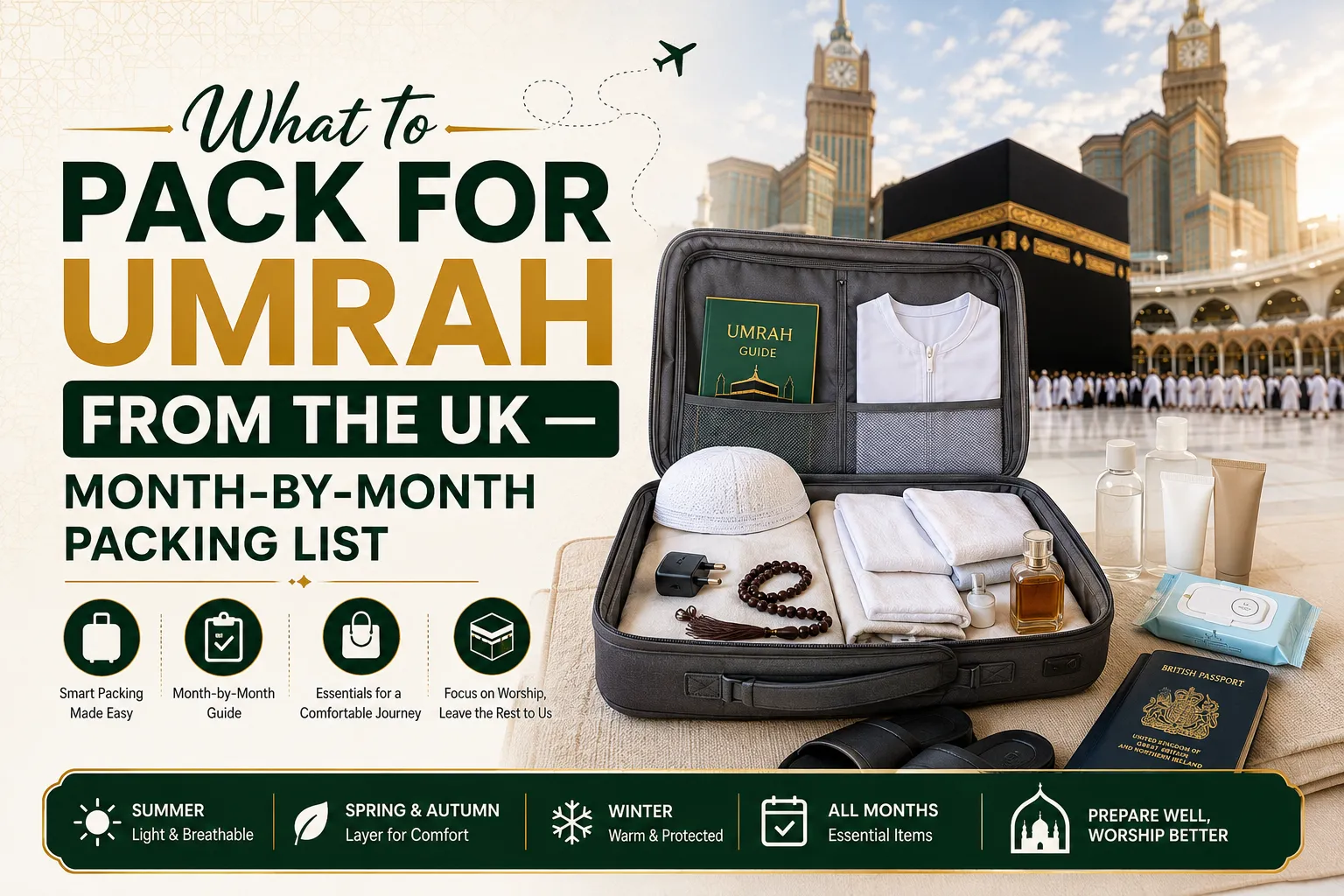
What you pack for Umrah depends far more on the month than on the length of your trip. A June departure and a January departure need genuinely different suitcases — one is built around heat management and the other around layering, because Madinah at 2am in January is cold enough to make a thin abaya a mistake.
Most packing lists online ignore this completely. They give you one generic list and leave you to work out the rest at the airport. This guide splits it properly: a core list that never changes, then month-by-month adjustments based on actual Makkah and Madinah temperature data, plus the things UK pilgrims specifically forget because British weather never prepares you for a marble courtyard at 44 degrees.
Quick answer: What should you pack for Umrah? Pack two Ihram sets or modest abayas, unscented toiletries, comfortable broken-in footwear, a shoe bag, power bank, prayer mat and a light medical kit. Everything else depends on your travel month — summer needs sun protection and rehydration, winter needs a warm layer for Madinah nights. |
Start here. These items go in the case regardless of when you travel or whether you are on a 7 nights Umrah package or fourteen.
□ Two Ihram sets for men — one worn, one spare
□ Ihram belt with a zip pocket for passport and cash
□ Safety pins or Ihram clips — pack ten, they vanish
□ Two or three loose abayas for women, in breathable fabric
□ Hijabs and underscarves that stay put through Tawaf
□ Five to seven everyday modest outfits, regardless of trip length
□ Sandals that leave the middle bones of the foot exposed (men, for Ihram)
□ Broken-in walking shoes plus slip-ons for the mosque
□ More socks than you think — this is the single most under-packed item
While in Ihram, scented products are prohibited. That rules out most of what sits in a British bathroom cabinet, including plenty of things labelled sensitive or natural.
□ Unscented soap or shower gel
□ Unscented shampoo
□ Unscented deodorant
□ Unscented wet wipes
□ Unscented lip balm
□ Toothbrush and toothpaste — buy unscented for the Ihram period
□ Nail clippers for after Halq or Taqseer, not before
□ Drawstring shoe bag — carry your shoes in rather than trusting the racks
□ Power bank, ideally 20,000mAh for a full day out
□ Charging cables and a plug adapter
□ Reusable bottle for Zamzam
□ Small prayer mat
□ Zip-lock bags for wet Ihram and used laundry
□ Notebook and pen for the duas people ask you to make
□ Small torch — useful in dim hotel corridors and for early Fajr walks
□ Blister plasters — the most-needed item on any Umrah
□ Paracetamol and ibuprofen
□ Rehydration sachets
□ Throat lozenges
□ Anti-diarrhoeal tablets and antihistamines
□ Prescription medication in original labelled packaging with a copy of the prescription
How big should your suitcase be? One 23kg checked bag and one cabin bag covers any duration from 7 to 14 nights. Hotels have laundry, and the shopping streets around both Harams sell anything you forget. Leave 5kg of headroom for Zamzam, dates and gifts on the way home — pilgrims who fill the case on the outbound leg end up paying excess baggage on the return. |
Everything in the month-by-month section below is driven by these numbers. Madinah sits 600 metres above sea level and roughly 350km north of Makkah, which is why its winter nights run considerably colder than most UK pilgrims expect.
Month | Makkah Day / Night | Madinah Day / Night | Packing Priority |
|---|---|---|---|
January | 29°C / 18°C | 24°C / 11°C | Warm layer for Madinah nights |
February | 30°C / 18°C | 26°C / 13°C | Light jacket, mild days |
March | 33°C / 21°C | 30°C / 16°C | Transitional — layers |
April | 37°C / 24°C | 34°C / 20°C | Sun protection begins |
May | 40°C / 26°C | 38°C / 24°C | Heat management |
June | 43°C / 28°C | 41°C / 26°C | Peak heat — full sun kit |
July | 41°C / 28°C | 41°C / 27°C | Peak heat — full sun kit |
August | 40°C / 28°C | 40°C / 27°C | Peak heat — full sun kit |
September | 40°C / 27°C | 38°C / 24°C | Still very hot |
October | 37°C / 24°C | 34°C / 20°C | Comfortable — easiest month |
November | 32°C / 22°C | 29°C / 16°C | Mild, slight rain chance |
December | 29°C / 19°C | 25°C / 12°C | Warm layer for Madinah |
Two things to read from that table. First, Makkah is never cold — even in January the daytime average sits at 29°C, which is a warm British August. Second, Madinah in January and December drops to 11 or 12°C at night, and pilgrims walking back from Isha in a single thin layer feel it properly.
Barely. Makkah receives around 105mm of rain across an entire year, concentrated in November through January. That is roughly a tenth of what Manchester gets. You do not need a raincoat, but a compact umbrella earns its place — for shade rather than rain.
Quick answer: What should you pack for Umrah in summer? Pack for heat management: an umbrella for shade, rehydration sachets, a cooling towel, high-factor sunscreen for after Ihram, wide-fit breathable footwear and light cotton clothing. Makkah averages 40 to 43°C from May to August, with marble surfaces hotter still. |
This is the hardest window for UK pilgrims. British summers do not prepare anyone for 43°C, and the mataf marble in direct sun becomes genuinely uncomfortable to walk on barefoot in the middle of the day. The packing list changes accordingly.
□ Compact umbrella — for shade during Tawaf and Sa’i, not rain
□ Rehydration sachets — double what you think you need
□ Cooling towel or microfibre cloth you can wet at the Zamzam taps
□ Sunglasses
□ Wide-brim hat for outside Ihram (men cannot cover the head while in Ihram)
□ Light cotton clothing only — polyester is unwearable in this heat
□ Extra socks — marble burns through thin ones at midday
□ Talcum powder or anti-chafe balm — long walks plus heat cause friction rashes
□ Electrolyte tablets as a backup to sachets
The Ihram sunscreen rule Most sunscreen is perfumed, which makes it prohibited while in Ihram. Buy an unscented, fragrance-free formula before you travel, or simply do without until after Halq or Taqseer. Do not assume you will find an unscented version in a Makkah pharmacy at short notice. |
Packing only solves half the problem. The other half is scheduling. Between roughly 11am and 4pm, the open mataf is punishing and the upper Tawaf levels are the sensible choice. Fajr and the hours after Isha are when the marble has cooled and the courtyard is bearable. Pilgrims who plan around this get far more out of a summer trip than those who fight it.
August combines peak Saudi heat with the UK school holidays, which means the highest prices of the non-Ramadan year and the toughest conditions. If your dates are movable at all, late September onwards costs less and feels considerably better.
Quick answer: Do you need warm clothes for Umrah in winter? Yes, but only for Madinah. Madinah nights drop to 11 to 13°C in December, January and February, cold enough for a fleece or light jacket walking back from Isha. Makkah stays warm year-round, averaging 29°C in January daytime. |
Winter is the most comfortable season for Umrah and the one most UK pilgrims underpack for — because the phrase “desert climate” makes people assume heat, and then Madinah at midnight surprises them.
□ Fleece or light padded jacket for Madinah evenings
□ Thermal base layer if you feel the cold, particularly for elderly pilgrims
□ Thicker socks for the cold marble at Fajr
□ Shawl or pashmina for women — doubles as a prayer covering
□ Moisturiser and heavier lip balm — dry winter air cracks skin fast
□ Compact umbrella — November to January carries the year’s small rain chance
Why Madinah feels colder than the numbers suggest Madinah sits at 600 metres elevation with very low humidity, so heat leaves quickly after sunset. A 12°C night there feels sharper than a 12°C night in Birmingham because you have spent the day in 25°C sunshine and your body has adjusted. Pack one proper warm layer even if the forecast looks mild. |
October, November and February are the sweet spot. Makkah sits in the low thirties, Madinah is pleasant, the marble is walkable at any hour, and prices sit well below the Ramadan and summer peaks. For anyone taking parents or young children on a first Umrah, these months remove an entire category of difficulty.
These are transitional months and the packing brief is simply layers. March and October both sit in the mid-thirties in Makkah with genuinely mild Madinah evenings, so you want clothing you can add to and remove rather than committing to one extreme.
□ Light layers rather than one heavy item
□ One thin fleece or cardigan for Madinah after dark
□ Sun protection — April onwards the sun is already strong
□ Umbrella, useful in both directions
Because the Islamic calendar shifts roughly eleven days earlier each year, Ramadan currently falls in February and March. That changes what you pack in one specific way: if you are fasting, you need to plan around iftar timing rather than heat, and the crowds mean you spend far longer standing than walking. Comfortable footwear matters more than usual, and a small folding stool is worth considering for elderly pilgrims who cannot stand through long queues.
Post-Ramadan April is quietly one of the best value windows in the calendar. The Ramadan crowds have gone, summer heat has not fully arrived, and prices drop noticeably. Makkah averages 37°C which is hot but manageable, and it is far easier than June.
Quick answer: What should women pack for Umrah? Women need loose modest abayas in breathable cotton, comfortable hijabs and underscarves, socks for the Haram, a small under-abaya bag, unscented toiletries and closed walking shoes. There is no specific Ihram garment for women — regular modest dress in any colour is the Ihram. |
The most common mistake we see is packing formal or heavy abayas. What works in the Haram is loose, light, cotton or a cotton blend, and dark enough not to show dust. Two or three is genuinely enough for any duration — hotel laundry handles the rest.
□ Two or three loose cotton abayas — avoid heavy or fitted styles
□ Underscarves that grip, so you are not adjusting your hijab mid-Tawaf
□ Socks — required in the Haram and constantly forgotten
□ Small crossbody bag that sits under the abaya
□ Sanitary products — bring your preferred brand, availability varies
□ Hair ties and clips
□ Unscented facial cleanser and moisturiser
□ A shawl for cooler Madinah evenings and extra covering
Menstruating women cannot perform Tawaf, which is why some pilgrims consider period-delaying medication. This is a personal medical decision and should be discussed with a GP well before departure, not decided at the last minute. If your period does arrive, you can still enter Ihram, recite the Talbiyah, make dua and perform Sa’i — you simply wait to complete Tawaf. Pack accordingly and do not let it become a source of distress.
Current Saudi rules allow women of any age to perform Umrah without a male guardian. Practically, we would still suggest a well-lit hotel within short walking distance of the Haram, which is what our 3 star Makkah properties provide at 500 to 900 metres.
□ Lightweight foldable pushchair — the Haram distances are long for small legs
□ Child-sized Ihram for boys if they are performing Umrah
□ Snacks for the flight and for long waits between prayers
□ Refillable water bottles
□ A quiet activity for hotel downtime
□ ID card or wristband with your Saudi mobile number written on it
That last item matters more than anything else on the list. The Haram holds enormous crowds and children get separated in seconds. A wristband with a working local number turns a crisis into an inconvenience.
□ Comfortable supportive footwear — not new, not slip-on for walking
□ Folding walking stick or lightweight seat-stick
□ Full medication supply plus a written list of medicines and dosages
□ Copy of any relevant medical history in English
□ Compression socks for the flight
□ Extra warm layer — older pilgrims feel Madinah nights considerably more
Sa’i alone covers around 3.5 kilometres, and a typical Umrah day involves 12 to 15 kilometres of total walking once you count hotel trips for five prayers. Wheelchair Tawaf is available on the upper levels and can be arranged in advance. We build this into every duration, including 12 nights Umrah packages and 14 nights Umrah packages, where the longer stay lets families move at a realistic pace.
Half of packing well is knowing what to leave behind.
Leave at Home | Why |
|---|---|
Alcohol and pork products | Prohibited in Saudi Arabia |
Scented toiletries for the Ihram period | Prohibited while in Ihram |
Hairdryer, iron, travel kettle | Provided by every hotel we use |
More than 7 outfits | Hotel laundry is cheap and fast |
New shoes | Blisters ruin the first three days |
Heavy formal clothing | Never worn, always carried |
Outbound gifts | Use the space for Zamzam and dates on return |
Large cash amounts | Card works nearly everywhere; declare over £10,000 |
Material promoting other religions | Not permitted at customs |
Airlines on the UK route generally permit one sealed five-litre Zamzam container per passenger, carried separately from your standard baggage allowance. It must be bought sealed at the airport — water decanted into your own bottle will not clear security. Do not plan to bring extra in your suitcase.
How long you stay changes what you pack less than you would expect, but it changes everything else. Our 3 star Umrah packages keep you within walking distance of the Haram, which is the difference between praying there five times a day and twice.
Package Duration | 3 Star Price (pp) | Nights Split | Walk to Haram |
|---|---|---|---|
7 nights Umrah package | £759 | 3 Makkah / 4 Madinah | 600–900m |
10 nights Umrah package | £959 | 5 Makkah / 5 Madinah | 600–900m |
12 nights Umrah package | £1,159 | 7 Makkah / 5 Madinah | 500–800m |
14 nights Umrah package | £1,309 | 8 Makkah / 6 Madinah | 500–800m |
Included in every package
Prices per person on quad-share basis, off-peak season rates. Ramadan, August and December departures carry a seasonal premium. |
Very little. A 14-night trip needs the same clothing volume as a 10 nights Umrah package because hotel laundry resets the equation every few days. What changes is consumables — more rehydration sachets, more blister plasters, a second unscented deodorant. Pack for seven days of clothing and however many days of medical supplies your duration requires.
Seven nights works for returning pilgrims who know how they use their time. For a first Umrah, ten nights gives five full days in Makkah rather than three, which is the difference between completing the rites and actually settling into them. Families with children or elderly parents do better on twelve or fourteen, where the extra days absorb jet lag and illness without derailing the trip.
Not sure which month suits you? Tell us your dates, group size and departure airport and we will send live prices plus honest advice on the weather you would be walking into. Message our UK Umrah team on WhatsApp → |
People assume constant heat and arrive in Madinah in January with nothing warmer than an abaya. Check the month, not the stereotype.
Products labelled sensitive, natural or unfragranced are frequently still scented. Read the ingredients list, not the front of the bottle.
Twelve to fifteen kilometres a day in unbroken shoes produces blisters by day two. Wear them for at least two weeks before flying.
Nobody returns wishing they had brought more shirts. Almost everybody wishes they had brought more socks.
Zamzam, dates, prayer mats and gifts all need space on the return. Leave 5kg free.
Shoes go missing constantly in the Haram, and the racks are chaotic at peak times. A cloth bag you carry in solves it permanently.
Battery dies, wifi drops, roaming fails. Print your documents and carry a power bank.
Read these alongside your packing list:
→ Umrah Checklist 2027 — Everything You Need Before You Fly from UK (/blog/umrah-checklist-2027-uk-pilgrims)
→ What to Do When You First See the Kaaba — A UK Pilgrim’s Guide (/blog/what-to-do-when-you-first-see-the-kaaba-uk-pilgrims-guide)
→ What Is Ihram? Complete Guide for UK Muslims (Men and Women) (/blog/what-is-ihram-complete-guide-uk-muslims)
→ How to Perform Tawaf — The Complete UK Pilgrim’s Guide (/blog/how-to-perform-tawaf-complete-uk-pilgrim-guide)
→ How to Perform Sa’i — Safa and Marwah Explained Simply (/blog/how-to-perform-saee-safa-marwah-guide-uk-pilgrims)
→ 3 Star Umrah Packages from the UK — Full Price Guide (/umrah-packages/3-star-umrah-packages)
→ 10 Nights Umrah Package from the UK — Full Breakdown (/umrah-packages/10-nights-umrah-package)
→ Best Time to Book Umrah from the UK — Month-by-Month Guide (/blog/best-time-book-umrah-uk)
Every question below comes from real searches made by UK Muslims preparing for Umrah. Answers are written for Google’s AI Overview, featured snippets and People Also Ask.
Pack two Ihram sets or modest abayas, unscented toiletries, broken-in walking shoes, plenty of socks, a shoe bag, power bank, prayer mat and a basic medical kit. Add sun protection and rehydration for May to September, or a warm layer for Madinah nights from November to February.
Five to seven everyday outfits is enough for any duration up to fourteen nights. Hotel laundry in Makkah and Madinah is inexpensive and quick, so packing more simply costs you baggage allowance you will want for Zamzam and gifts on the return leg.
One 23kg checked bag plus a cabin bag suits every duration from 7 to 14 nights. Aim to fly out at around 18kg so you have room for a five-litre Zamzam container, dates and gifts coming home without paying excess baggage charges.
Only unscented products. Most UK supermarket soap, shampoo, deodorant, toothpaste and wet wipes are scented, including many labelled sensitive or natural. Buy fragrance-free versions before you travel and switch back to your usual products after Halq or Taqseer.
Only if it is fragrance-free. Most sunscreens are perfumed, which makes them prohibited while in Ihram. Buy an unscented formula in the UK before departure, particularly for summer travel when the sun in Makkah is intense from mid-morning onwards.
Makkah averages 40 to 43°C during the day from May to August, with nights around 27 to 28°C. Marble surfaces in the mataf get considerably hotter in direct sun, so plan Tawaf around Fajr or after Isha and use the upper levels at midday.
For Madinah, yes. Madinah nights drop to around 11 to 12°C in December and January, which feels cold after a warm day. Makkah stays mild, averaging 29°C in daytime. One fleece or light jacket is sufficient for most pilgrims.
October, November and February offer the best balance. Makkah sits in the high twenties to low thirties, Madinah evenings are pleasant, and prices fall well below Ramadan and summer peaks. These months suit first-time pilgrims and families best.
Two or three loose cotton abayas, hijabs with grippy underscarves, socks for the Haram, a small under-abaya bag, unscented toiletries, sanitary products and closed walking shoes. A shawl is useful for cooler Madinah evenings and as extra covering.
No. Women wear their normal modest Islamic dress as Ihram, in any colour. The restrictions are the same as for men — no perfume, no cutting hair or nails — and the face and hands remain uncovered during Ihram according to the majority position.
Two. One to wear and one spare, since Ihram gets wet during Wudu and can be difficult to dry quickly in humid conditions. Buy in the UK so you can check the fabric is genuinely unstitched and practise tying it before you travel.
Sandals that leave the middle bones of the top of the foot exposed. Closed shoes and trainers are not permitted while in Ihram for men. Bring comfortable walking shoes separately for use before and after the Ihram period.
Leave out alcohol, pork products, scented toiletries for the Ihram period, and material promoting other religions. Skip hairdryers, irons and kettles as every hotel provides them, and avoid new shoes, heavy formal clothing and outbound gifts.
Airlines on the UK route typically allow one sealed five-litre container per passenger, carried separately from your baggage allowance. It must be purchased sealed at the airport — water decanted into your own bottle will not pass security screening.
Yes if your child is under five. Haram distances are long and Sa’i alone covers around 3.5 kilometres. A lightweight foldable pushchair is far easier than carrying. Also pack an ID wristband showing your Saudi mobile number in case of separation.
Supportive broken-in footwear, a folding walking stick or seat-stick, full medication in labelled packaging with a written dosage list, compression socks for the flight, and an extra warm layer. Arrange airport wheelchair assistance at the time of booking.
Most hotels in Makkah and Madinah use Type G sockets, the same as the UK, so British plugs usually fit. Carry a universal adapter anyway, as some older properties use Type A or C, and a multi-USB charger saves fighting over limited sockets.
Both. Contactless works in hotels, restaurants and larger shops throughout Makkah and Madinah. Smaller shops near the Haram, barbers performing Halq and trolley porters prefer cash. Carry 500 to 800 Riyals per person and use a fee-free travel card for the rest.
A 7 nights Umrah package with our 3 star option starts at £759 per person, including return flights, Saudi eVisa, Nusuk-linked hotels in both cities, all transfers and daily breakfast. A 10 nights package starts at £959, 12 nights at £1,159 and 14 nights at £1,309.
Not really. Hotel laundry means a 14-night trip needs the same clothing volume as a 7-night one. What increases is consumables — rehydration sachets, blister plasters, toiletries. Pack seven days of clothing and scale only the supplies to your duration.
Socks, followed closely by a shoe bag. The Haram requires socks, marble gets hot in summer and cold at Fajr, and shoes go missing from the racks constantly. Both items weigh almost nothing and solve daily problems.
Yes. Hotel laundry services are widely available and inexpensive, and there are laundrettes throughout the hotel districts in both cities. Turnaround is usually 24 hours, which is why packing seven outfits covers even a 14-night stay comfortably.
Packing well is straightforward once you know which month you are travelling in. Choosing that month is the harder decision, and it affects your cost, your comfort and how much walking your family can realistically manage.
Send us your rough dates and we will tell you honestly what the weather and crowds look like in that window, then price it against the alternatives.
Message our UK Umrah team on WhatsApp — live prices within the hour →
3 star packages from £759pp • 7, 10, 12 and 14 nights • Departures from London, Manchester, Birmingham, Glasgow and Bradford

Verified Umrah Travel Specialist
Written By: Azeem Ali
A seasoned Umrah travel specialist with more than 10 years of experience in planning and managing Umrah journeys. Every article is carefully prepared by Azeem Ali, drawing on years of expertise in assisting thousands of pilgrims from the UK. Our goal is to provide reliable, up-to-date, and practical guidance to help you confidently prepare for your sacred journey.
PACKAGES UMRAH
SERVICES FROM UK
Latest Articles