

Of all the rites of Umrah, Sa’i is the one that tends to catch UK pilgrims off guard — not because it is difficult, but because of what it represents. Walking seven times between the hills of Safa and Marwah, you are retracing the steps of Hajar (AS), the wife of Ibrahim (AS), as she ran in desperation through a scorching valley searching for water to save her infant son. Every step you take is a step she once took. That is not a metaphor. It is a physical re-enactment of one of the most powerful acts of tawakkul (complete reliance on Allah) in all of prophetic history.
This guide will walk you through how to perform Sa’i correctly — from the moment you leave the Tawaf area to the moment you complete your seventh lap at Marwah. The steps, the duas, the rules for women, what Wudu is required (or not), the green lights, wheelchair access, and how your choice of Umrah package affects how much time you have to do it properly. All of it, explained simply.
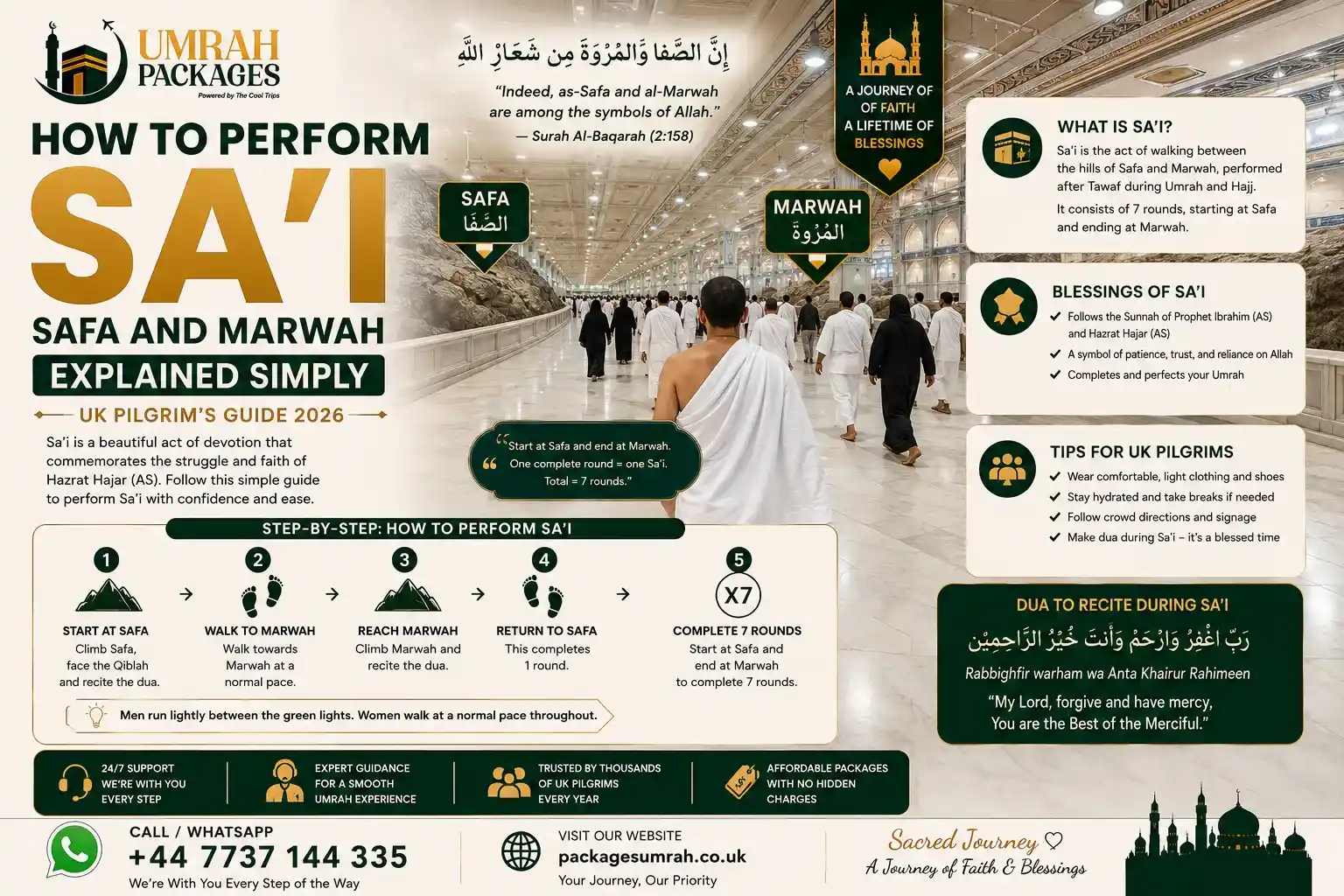
Sa’i (سعي) means “to strive” or “to walk with effort.” In the context of Umrah and Hajj, it refers to walking seven times between the two hills of As-Safa (الصفا) and Al-Marwah (المروة), which are now enclosed within the Mas’a — the large air-conditioned corridor inside Masjid al-Haram that runs parallel to the Kaaba. Sa’i is one of the essential rites of both Umrah and Hajj, and it is performed after Tawaf.
When Ibrahim (AS) left his wife Hajar (AS) and their infant son Isma’il (AS) in the barren valley of Makkah under Allah’s command, he left them with only a small amount of food and water. When the provisions ran out, Hajar — alone, in scorching heat, with a crying infant — did what any mother would do: she ran. She climbed Safa to look for any sign of water or a passing caravan. She saw nothing. She ran to Marwah. She saw nothing. She did this seven times.
On the seventh trip, as she looked across the valley, she heard a sound beneath her son’s feet. The angel Jibril (AS) struck the earth, and water began to flow. That water became the well of Zamzam — still flowing in Makkah to this day, more than four thousand years later.
When Allah commanded the rites of Hajj and Umrah to be established, this act of Hajar was enshrined as a permanent rite. The Prophet ﷺ said about it: “Perform Sa’i, for Allah has prescribed for you Sa’i.” (Ahmad). Her desperation became a pillar of worship. Her trial became our ritual.
Direct Answer: According to the majority of scholars (Maliki, Shafi’i, and Hanbali), Sa’i is a Rukn (pillar) of Umrah — meaning Umrah is completely invalid without it. The Hanafi school considers it Wajib, meaning it is obligatory but missing it incurs a dam (penalty sacrifice) rather than invalidating the entire Umrah. In practice, every UK pilgrim should perform Sa’i as a non-negotiable rite.
The distance between the hill of Safa and the hill of Marwah inside the Mas’a corridor is approximately 394.5 metres. One trip from Safa to Marwah — or from Marwah back to Safa — counts as one lap (shawt). Sa’i consists of seven laps total.
Direct Answer: Sa’i consists of 7 laps. It begins at Safa and ends at Marwah. The total walking distance is approximately 2.76 kilometres (394.5 metres × 7 laps).
The lap count goes like this:
This is an important detail many first-time pilgrims get wrong — they count a round trip (Safa to Marwah and back) as one unit. It is not. Each one-way trip is one shawt. Sa’i ends at Marwah, not at Safa.
Safa to Marwah (one-way): 394.5 metres
Total laps: 7 (odd number; starts at Safa, ends at Marwah)
Total distance walked: Approximately 2.76 kilometres
Running zone (green lights): Approx. 76 metres — men only
Sa’i corridor name: Al-Mas’a (enclosed within Masjid al-Haram)
Floors available: Ground floor, first floor, and rooftop
Direct Answer: No. Wudu is not a condition for Sa’i. Unlike Tawaf — which requires ritual purity — Sa’i is valid without Wudu according to the majority of scholars, including the four major madhabs. However, being in a state of Wudu while performing Sa’i is strongly recommended as an act of respect and worship.
Direct Answer: Yes. A woman who is menstruating or experiencing post-natal bleeding (nifas) may not perform Tawaf, but she can perform Sa’i once her Tawaf has been completed. Since Sa’i follows Tawaf during Umrah, a woman who could not perform Tawaf due to menstruation would have to wait until she is pure, complete Tawaf, and then proceed immediately to Sa’i.
During Umrah, Sa’i is performed after Tawaf al-Umrah. There is no obligatory requirement to perform it immediately — you may rest, drink Zamzam, and pray two rak’ahs at Maqam Ibrahim before beginning Sa’i. However, Sa’i should not be delayed to a completely separate day without a valid reason. For UK pilgrims on shorter 7 nights Umrah packages, most perform Sa’i on the same day as Tawaf.
Sa’i performed before its associated Tawaf is not valid. The sequence is Tawaf first, then Sa’i. During Umrah, Sa’i follows Tawaf al-Umrah. During Hajj Tamattu’, most scholars permit performing Sa’i after the Umrah Tawaf (before the Hajj days begin) or after Tawaf al-Ifadah.
Sa’i with fewer than 7 laps is incomplete. There is some scholarly difference on whether an incomplete Sa’i requires a dam or starting over, but the safe position — and the agreed position of all four schools — is to complete all 7 laps without counting shortcuts.
Sa’i must begin at Safa and end at Marwah. Starting at Marwah means that first trip to Safa does not count, and you must restart from Safa. This is based on the Prophet ﷺ beginning at Safa and stating: “We begin with what Allah began with.” (Muslim)
Each lap must fully reach from one hill to the other. Stopping short of Safa or Marwah — even by a few metres — means that lap is incomplete. Inside the Mas’a, the hills are clearly marked at each end.
Follow these steps in the exact order given. Each step is grounded in the Sunnah of the Prophet ﷺ as established in authentic ahadith.
Sa’i is only valid after a completed Tawaf. Once you finish 7 circuits of Tawaf, perform your two rak’ahs at Maqam Ibrahim, then drink from the Zamzam water stations and make your dua. You are now ready to begin Sa’i.
From the Tawaf area, proceed toward the Mas’a corridor. Follow the signs to Safa — they are clearly marked in Arabic and English throughout Masjid al-Haram. The entrance to the Mas’a is on the side of the mosque closest to the Safa hill.
💡 Tip: If you are at the mataf (Tawaf area) after Tawaf, head toward the exit in the direction of Safa. It takes roughly 3–5 minutes on foot to reach the start of the Sa’i corridor.
Climb the incline of Safa. The hill itself is now enclosed within the Mas’a building, but a raised platform marks its location. Once you are at Safa, turn to face the Kaaba — it may not be directly visible, but face in the direction of the Qiblah.
Recite:
“Inna as-Safa wal-Marwata min sha’a’ir-illah.”
(Indeed, Safa and Marwah are among the symbols of Allah.) — Quran 2:158
Then raise your hands, make takbeer (Allahu Akbar three times), and make dua. The Prophet ﷺ made extensive dua at Safa before beginning his walk to Marwah. This is a powerful dua spot — use it.
“La ilaha illallahu wahdahu la sharika lah, lahul-mulku wa lahul-hamd, wa huwa ‘ala kulli shay’in qadeer. La ilaha illallahu wahdah, anjaza wa’dah, wa nasara ‘abdah, wa hazamal-ahzaba wahdah.”
(None has the right to be worshipped except Allah alone, with no partner. To Him belongs all sovereignty and all praise, and He is capable of all things. None has the right to be worshipped except Allah alone; He fulfilled His promise, granted victory to His servant, and defeated the confederates alone.) — Reported in Muslim
The Prophet ﷺ repeated this dua three times at Safa, making personal supplications between each repetition. You may recite it in full each time, or recite it once and follow with your own personal duas.
Step down from Safa and begin walking toward Marwah. Keep the Kaaba direction broadly to your left as you walk through the Mas’a corridor. Walk at a calm, steady pace — there is no rush. You may recite dua, dhikr, or Quran as you walk. There is no prescribed route or lane — simply walk in the direction of Marwah.
As you walk from Safa toward Marwah, you will see two sets of green lights — one on each wall of the Mas’a corridor — marking a stretch of approximately 76 metres.
Men: pick up your pace to a jog or brisk run between these green markers. This act is called Harwala and it is Sunnah — it commemorates the valley where Hajar (AS) ran frantically, losing sight of her infant. Women walk through this stretch at a normal pace. There is no Harwala for women.
After passing the second green light, men slow back down to a normal walk for the remainder of the trip to Marwah.
Once you reach the Marwah platform, climb the incline, face the Qiblah, and repeat the dua performed at Safa — raising your hands, making takbeer three times, and supplicating. Lap 1 is now complete.
💡 Tip: Keep a counter in your hand throughout Sa’i. Green lights = halfway marker per lap. Marwah or Safa at the end of each leg = completed shawt. This helps prevent losing your count across 7 laps.
From Marwah, you walk back toward Safa. This is Lap 2. Again, men run between the green lights. Reach Safa, make dua, and continue. Laps 3, 4, 5, and 6 follow the same pattern — alternating between Safa and Marwah, with men running between the green lights each time.
Your 7th and final lap goes from Safa to Marwah. Once you reach Marwah on this last lap, make your closing dua — this is your final act of Sa’i. You do not return to Safa. Sa’i is complete.
Important: Ending at Marwah is not optional — Sa’i must begin at Safa and end at Marwah. This is the Sunnah of the Prophet ﷺ and the position of all four schools of Islamic law.
Once Sa’i is complete for Umrah, the next rite is Halq (shaving the head — Sunnah for men) or Taqseer (cutting a small amount of hair — permissible for men, required for women). After this, you exit the state of Ihram and your Umrah is complete.
This is the sequence: Ihram → Tawaf → Sa’i → Halq/Taqseer → Exit Ihram. Sa’i is the penultimate rite before your Umrah becomes complete.
There are no fixed, compulsory duas prescribed for individual laps of Sa’i. The Prophet ﷺ did not assign specific recitations to specific laps. However, certain duas and dhikr are strongly recommended at specific points.
Recite: “Allahu Akbar, Allahu Akbar, Allahu Akbar, La ilaha illallahu wahdahu la sharika lah…” (the full dua mentioned in Step 3 above)
This dua is confirmed from the Prophet ﷺ at both Safa and Marwah. Repeat it three times with personal duas in between.
Between Safa and Marwah (and between Marwah and Safa), recite freely:
Direct Answer: Yes. Using your phone, a dua book, or a printed card during Sa’i is completely permissible. There is no ruling that prohibits reading from a text while performing Sa’i. Many first-time UK pilgrims find this helpful — just be mindful of other pilgrims walking around you.
As Hajar (AS) ran between Safa and Marwah, there was a section of the valley that was low-lying and deep — scholars call it the ‘batha’ (a low depression). In this section, she could no longer see her infant son Isma’il from either hill, and her running became more frantic and desperate as a result.
This specific stretch is now marked by green fluorescent lights on both walls of the Mas’a corridor. When men reach these lights, they pick up their pace to a jog or brisk walk in commemoration of that frantic search. It is not a sprint — it is a meaningful, purposeful change of pace.
The green lights are located approximately in the middle stretch of the Mas’a corridor, between Safa and Marwah. They are on both the left and right walls at eye level, making them easy to spot even in a crowd. The section they mark is roughly 76 metres long.
💡 Tip: On the upper floors of the Mas’a, the green light zone is marked differently — look for the floor markings and wall signs rather than the lights themselves, as the lighting may vary on upper levels.
Direct Answer: If you are unable to run or walk briskly between the green lights due to age, physical condition, or disability, you are completely excused. Walk at whatever pace is comfortable for you. The obligation of Harwala is waived for anyone with a valid physical reason.
Direct Answer: Yes. Sa’i performed on the upper floors or rooftop of the Mas’a building is completely valid. The Mas’a has been expanded and now includes multiple floors to accommodate the millions of pilgrims who perform Sa’i each year. Scholars across all four major madhabs have confirmed that Sa’i on any floor of the designated Mas’a building is acceptable.
For UK pilgrims with mobility issues, elderly pilgrims, families with young children in prams, or anyone who finds the ground floor too crowded, the upper floors are a genuine and entirely valid option. Escalators and lifts are available inside the Mas’a building.
Pilgrims who cannot walk can perform Sa’i in a wheelchair. The Mas’a corridor accommodates wheelchairs on the ground floor and, to a varying degree, on the upper floors. Wheelchair hire services are available inside Masjid al-Haram.
If a helper is pushing the wheelchair and making the intention of Sa’i themselves, both people receive the reward. The person in the wheelchair makes their own intention for their own Sa’i.
In some periods, battery-powered vehicles are available inside the Mas’a for pilgrims with severe mobility difficulties. These are typically available near the ground-floor entrance and can be arranged through the mosque’s accessibility services.
If you have a mobility condition, we strongly recommend choosing a longer Umrah package — 10 nights or 14 nights — over a 7 nights option. The extra time means you can plan Sa’i for an early morning slot when the Mas’a is significantly less crowded, reducing the physical and navigational difficulty.
The single most common Sa’i mistake: going from Safa to Marwah and back, then saying ‘that’s one round.’ It is not. Each one-way trip is one shawt. Safa to Marwah = Lap 1. Marwah to Safa = Lap 2. Sa’i ends on the 7th lap at Marwah — not back at Safa.
Sa’i must begin at Safa. If you begin at Marwah, that first lap does not count. The Prophet ﷺ explicitly stated ‘we begin with what Allah began with,’ referring to the Quranic verse that mentions Safa first. Return to Safa and begin correctly.
Each lap must be completed all the way to the hill — right up to the green marker at Safa or the platform at Marwah. Stopping short by even a few metres means that lap is incomplete. Many pilgrims turn around a metre or two early in a crowd. Pay attention to the markers at each end.
Harwala (the brisk walk or jog between the green lights) is for men only. Women walk through the entire Sa’i at a normal pace. This is the unanimous position of all scholars. Women who run between the green lights receive no additional reward for doing so.
Sa’i must follow a valid Tawaf. Performing Sa’i before Tawaf is not valid — the sequence is non-negotiable. This rule applies to Umrah Sa’i, Hajj Sa’i (after Tawaf al-Ifadah), and Nafl Sa’i.
Many pilgrims invest enormous emotional and spiritual focus into Tawaf, then rush through Sa’i as if it were an administrative formality. Sa’i is a full act of ibadah — 7 laps, approximately 2.76 kilometres, and a spiritual re-enactment of one of the most profound acts of tawakkul in Islamic history. Give it the attention it deserves.
Direct Answer: In normal conditions, Sa’i takes approximately 45 minutes to 1.5 hours to complete. During Ramadan, Hajj season, or peak pilgrimage periods, it can take 2 to 3 hours due to heavy foot traffic in the Mas’a corridor.
The total walking distance is roughly 2.76 kilometres at a relaxed pace. Add the time for duas at Safa and Marwah at each lap, plus the running section for men, and most pilgrims complete Sa’i in just under one hour during quiet periods.
During Umrah, Sa’i is performed once after Tawaf al-Umrah. There is no other Sa’i in Umrah. Once Sa’i is complete, the pilgrim proceeds to Halq or Taqseer and exits Ihram. The entire sequence of Umrah rites is complete.
Hajj Tamattu’ involves performing Umrah in its entirety (Tawaf + Sa’i + exit Ihram) during the months of Hajj, and then re-entering Ihram on the 8th of Dhul Hijjah for Hajj. Most scholars agree that a second Sa’i is required for Hajj itself (after Tawaf al-Ifadah), making a total of two Sa’is — one for Umrah and one for Hajj.
For Ifrad and Qiran Hajj, there is only one Sa’i. It can be performed after Tawaf al-Qudum (the arrival Tawaf) or after Tawaf al-Ifadah, according to scholarly opinion. Only one Sa’i is required — not two.
Direct Answer: No. Unlike Tawaf — which can be performed as a Nafl act of worship any time — Sa’i is not performed as a standalone voluntary act. Sa’i is only performed in connection with a specific Tawaf, either as part of Umrah or as part of Hajj. You cannot perform ‘Nafl Sa’i’ without an associated Tawaf.
Performing Sa’i requires being in Makkah — and getting to Makkah from the UK starts with the right Umrah package. Our 3 star Umrah packages from UK airports include return flights, hotel accommodation in Makkah and Madinah, Umrah visa processing, transfers, and full support from our UK-based team. All packages depart from London Heathrow, Manchester, Birmingham, Glasgow, Bradford, and other major UK airports.
📦 7 Nights 3 Star Umrah Package from UK — From £779 per person
From £779 per person (inclusive of flights, hotel, visa & transfers)
Best suited for working professionals with limited leave. Typically split as 4 nights in Makkah and 3 nights in Madinah. You will have adequate time to complete Tawaf, Sa’i, Halq, and Ziyarah — but the schedule is tight. Early morning planning of Sa’i is recommended to avoid peak Mas’a crowds on this duration.
Keywords: 7 nights umrah package | 7 night umrah package UK | short umrah packages 2026
📦 10 Nights 3 Star Umrah Package from UK — From £979 per person
From £979 per person (inclusive of flights, hotel, visa & transfers)
Our most requested package by UK families. Ten nights gives you meaningful time in Makkah — enough for multiple visits to the Haram, proper pacing of Sa’i, and a comfortable stay in Madinah without feeling rushed. The right balance of time, cost, and experience.
Keywords: 10 nights umrah package | 10 night umrah package from UK | popular umrah 2026
📦 12 Nights 3 Star Umrah Package from UK — From £1,179 per person
From £1,179 per person (inclusive of flights, hotel, visa & transfers)
Twelve nights allows pilgrims who want to absorb the full spiritual environment to do so at a real pace. Extra days in Makkah mean you can choose the quietest hours for Sa’i — the post-Fajr Mas’a on a weekday morning is a completely different experience from peak afternoon crowds.
Keywords: 12 nights umrah package | 12 night umrah UK | extended umrah packages 2026
📦 14 Nights 3 Star Umrah Package from UK — From £1,329 per person
From £1,329 per person (inclusive of flights, hotel, visa & transfers)
For pilgrims who want the full journey — the ability to rest between rites, perform Sa’i at your own pace, attend as many congregational prayers as possible, and leave knowing you left nothing behind. Fourteen nights is particularly valuable for first-timers, elderly pilgrims, and families with children.
Keywords: 14 nights umrah package | 14 night umrah from UK | best value umrah packages
Not sure which package suits your group best? Message our UK Umrah team on WhatsApp — tell us your travel dates and group size and we will come back to you with the best available deals within the hour.
Continue building your Umrah knowledge with these related articles:
→ How to Perform Tawaf — The Complete UK Pilgrim’s Guide (/blog/how-to-perform-tawaf-complete-uk-pilgrim-guide)
→ What to Wear in Ihram — Rules, Restrictions & Common Mistakes for UK Pilgrims (/blog/ihram-guide-uk-pilgrims)
→ Halq and Taqseer Explained — Completing Your Umrah After Sa’i (/blog/halq-taqseer-umrah-guide)
→ 3 Star Umrah Packages from UK — Full Price Breakdown 2026 (/umrah-packages/3-star-umrah-packages)
→ Best Time to Book Umrah from the UK — Month-by-Month Guide (/blog/best-time-book-umrah-uk)
Every question below matches a real search query UK Muslims type into Google before performing Umrah. Answers are direct, concise, and structured for Google’s AI Overview and featured snippet selection.
Q1: How many times do you walk between Safa and Marwah in Sa’i?
A: Sa’i consists of 7 laps (ashwat) between Safa and Marwah. Each one-way trip counts as one lap. Sa’i begins at Safa and ends at Marwah on the 7th lap. A round trip (Safa to Marwah and back) counts as two laps, not one — this is one of the most common mistakes made by first-time pilgrims.
Q2: Does Sa’i have to be done immediately after Tawaf?
A: No. There is no ruling that Sa’i must follow Tawaf without any gap. You may rest, drink Zamzam, and pray your two rak’ahs at Maqam Ibrahim before beginning Sa’i. However, Sa’i should be performed on the same day as Tawaf without unnecessary delay, and it must always follow a valid Tawaf.
Q3: Do you need Wudu for Sa’i?
A: Wudu is not a mandatory condition for Sa’i. Unlike Tawaf, Sa’i is valid without ritual purity according to the majority of scholars. Being in a state of Wudu is strongly recommended as an act of respect and good conduct, but it does not affect the validity of your Sa’i if you are not.
Q4: Where does Sa’i end — at Safa or at Marwah?
A: Sa’i ends at Marwah. The 7th and final lap goes from Safa to Marwah. You do not return to Safa after completing the 7th lap. This is the established Sunnah of the Prophet ﷺ, who began at Safa and ended Sa’i at Marwah.
Q5: Why do men run between the green lights during Sa’i?
A: Men run or walk briskly between the green lights in the Mas’a corridor to commemorate the section of the valley where Hajar (AS) lost sight of her infant son Isma’il while running. In that low-lying section, she ran frantically. The green lights mark the same stretch. This brisk pace (Harwala) is Sunnah for men only — women walk normally throughout.
Q6: Can women perform Sa’i on their period?
A: Yes. A menstruating woman may perform Sa’i. Wudu is not required for Sa’i, and menstruation does not prevent it. However, she cannot perform the Tawaf that must precede Sa’i — so she must wait until she is pure, complete Tawaf, and then proceed to Sa’i.
Q7: Can Sa’i be performed on the upper floor of the Mas’a?
A: Yes. Sa’i on any floor of the Mas’a building — ground floor, first floor, or rooftop — is completely valid. All floors are within the designated Sa’i corridor. The upper floors are a practical option for those with mobility issues, families with prams, or pilgrims visiting during peak crowd periods.
Q8: How far is it from Safa to Marwah?
A: The distance from Safa to Marwah inside the Mas’a corridor is approximately 394.5 metres one way. Across all 7 laps of Sa’i, the total walking distance is roughly 2.76 kilometres. Men add a short running section of about 76 metres per lap at the green lights.
Q9: Is Sa’i a pillar of Umrah or just Sunnah?
A: According to the Maliki, Shafi’i, and Hanbali schools, Sa’i is a Rukn (pillar) of Umrah — Umrah is invalid without it. The Hanafi school considers it Wajib, meaning omitting it requires a dam (penalty) but does not fully invalidate the Umrah. All schools agree it must be performed.
Q10: What dua should I recite at Safa and Marwah?
A: At both Safa and Marwah, the Prophet ﷺ recited: ‘La ilaha illallahu wahdahu la sharika lah, lahul-mulku wa lahul-hamd…’ three times, making personal duas between each repetition. This dua is the confirmed Sunnah at the hilltops. Between the hills, recite freely — dhikr, personal duas, Quran.
Q11: What happens if I lose count of my Sa’i laps?
A: If you genuinely lose count, apply the principle of taking the lower number — if you are unsure whether you have completed 4 or 5 laps, count it as 4 and complete 3 more laps. Ending at Marwah is the check: on the final lap (7), you should be walking from Safa toward Marwah. If you are at Marwah on an even-numbered lap, you have completed that lap and begin the next toward Safa.
Q12: Can I eat or drink water during Sa’i?
A: There is no Islamic prohibition against drinking water or eating something light during Sa’i. Many pilgrims drink Zamzam water between laps. Sa’i does not carry the same restrictions as Salah or Tawaf in this regard. Eat and drink as needed, particularly in hot weather.
Q13: What is the difference between Sa’i and Tawaf?
A: Tawaf is the act of circling the Kaaba 7 times in an anticlockwise direction inside Masjid al-Haram. Sa’i is the act of walking 7 laps between Safa and Marwah in the Mas’a corridor. Tawaf requires Wudu; Sa’i does not. Tawaf can be performed voluntarily (Nafl); Sa’i cannot. Both are obligatory rites of Umrah, performed in sequence — Tawaf first, Sa’i second.
Q14: Can you perform Sa’i with a wheelchair?
A: Yes. Sa’i in a wheelchair is completely valid. Wheelchair-accessible paths exist on the ground floor and upper levels of the Mas’a. Wheelchair hire is available at the mosque. The person in the wheelchair makes their own niyyah for Sa’i; a helper pushing the chair also receives the reward if they make the same intention.
Q15: How many Sa’is are performed during Hajj Tamattu’?
A: During Hajj Tamattu’ — the most common Hajj type for UK pilgrims — two Sa’is are typically performed. The first is after Tawaf al-Umrah (as part of Umrah). The second is after Tawaf al-Ifadah (as part of Hajj). Some scholars permit combining them, but the cautious position is to perform both.
Q16: Which Umrah package gives the most time for Sa’i and worship?
A: A 14 nights 3 star Umrah package gives the most time for unhurried worship, including Sa’i at the quietest hours. A 10 nights package is the best balance for most UK families. A 7 nights package is workable but tight — Sa’i will likely need to be planned for early morning to avoid Mas’a congestion.
Q17: Is there a specific time when Sa’i is not allowed?
A: No. Unlike some acts of worship, Sa’i has no restricted times. It can be performed at any hour — day or night, including sunrise and sunset periods. It is one of the few Islamic rites with no time restrictions. This gives pilgrims on any package duration full flexibility in planning their schedule.
Q18: What is the first thing I say when I reach Safa to begin Sa’i?
A: When you reach Safa, recite the Quranic verse: ‘Inna as-Safa wal-Marwata min sha’a’ir-illah’ (Indeed, Safa and Marwah are among the symbols of Allah — Quran 2:158). Then face the Kaaba, raise your hands, say Allahu Akbar three times, and make dua before beginning your first lap. This opening recitation is only said the very first time at Safa — not at subsequent visits to Safa during the remaining laps.
Every lap of Sa’i is a lap Hajar (AS) ran before you. Every step in that corridor carries the weight of thousands of years of tawakkul, of surrender, of a mother’s love, and of Allah’s answer. Walk it with that in your chest — not as a task to tick off, but as an act that binds you to one of the greatest human beings to have ever lived.
Whether you are travelling on a 7 nights 3 star Umrah package from £779, a 10 nights package from £979, a 12 nights from £1,179, or a 14 nights Umrah package from £1,329 — our UK team will handle every flight, transfer, visa, and hotel so that all you have to think about when you arrive in Makkah is your ibadah.
Talk to our UK Umrah team on WhatsApp — get a free quote within the hour →

Verified Umrah Travel Specialist
Written By: Azeem Ali
A seasoned Umrah travel specialist with more than 10 years of experience in planning and managing Umrah journeys. Every article is carefully prepared by Azeem Ali, drawing on years of expertise in assisting thousands of pilgrims from the UK. Our goal is to provide reliable, up-to-date, and practical guidance to help you confidently prepare for your sacred journey.
PACKAGES UMRAH
SERVICES FROM UK

Latest Articles